
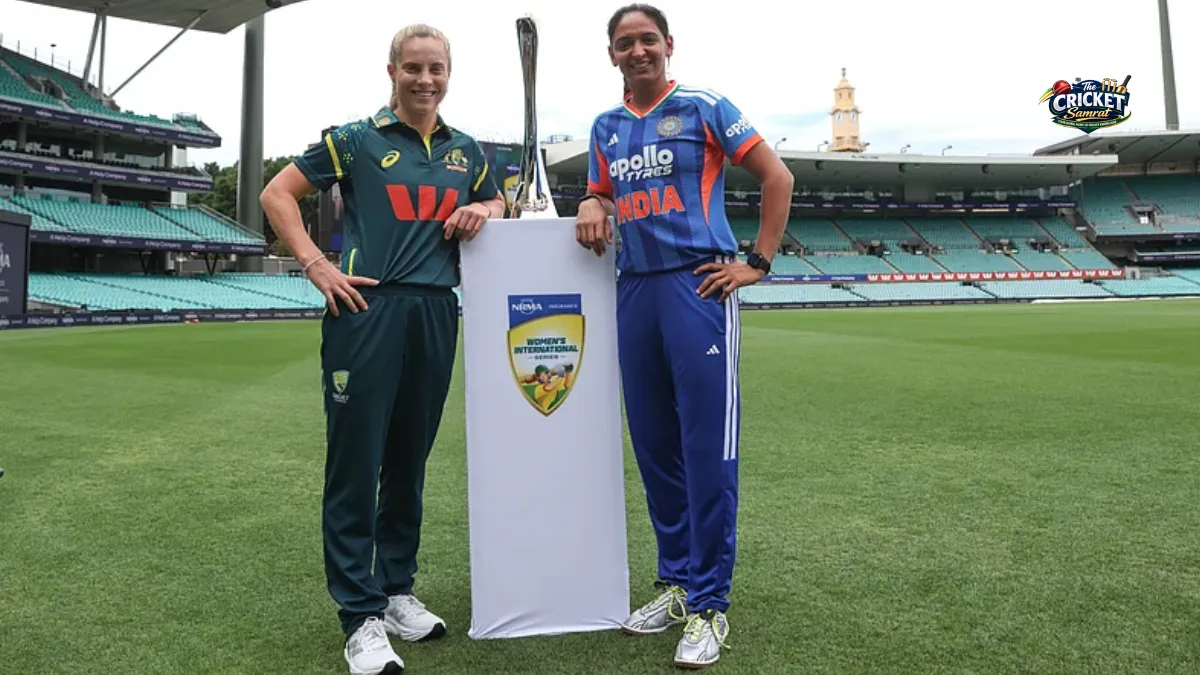
India made a powerful statement in the opening clash of the australia women vs india women T20I series, defeating the hosts by 21 runs via the DLS method in a rain-curtailed contest at the Sydney Cricket Ground.
In what marked the beginning of a new leadership chapter for Sophie Molineux, Australia were bowled out for 133 before India raced ahead in their chase. Rain halted proceedings shortly after the required five overs were completed, but by then, India were comfortably ahead of the Duckworth-Lewis-Stern target.
The result puts India just one win away from sealing only their second-ever bilateral T20I series victory on Australian soil — a landmark achievement if completed.
Match Summary: Australia Women vs India Women, 1st T20I
| Match | 1st T20I |
|---|---|
| Venue | Sydney Cricket Ground, Sydney |
| Australia Women | 133 all out (18 overs) |
| India Women | 50/1 (5 overs) |
| Result | India won by 21 runs (DLS method) |
| Player of the Match | Arundhati Reddy (4/22) |
Reddy and Renuka Lead India’s Bowling Charge
The turning point in the australia women vs india women encounter came with India’s disciplined and aggressive bowling display.
Arundhati Reddy’s Career-Best Spell
Arundhati Reddy delivered a sensational performance, claiming a career-best 4 for 22. She removed key batters including Phoebe Litchfield and Ellyse Perry, derailing Australia’s momentum at crucial moments.
Reddy’s spell proved decisive, especially during the middle overs when Australia looked set to build a competitive total.
Renuka Singh’s Powerplay Precision
Renuka Singh played an equally vital role. Bowling three consecutive overs during the powerplay — a demanding task in T20 cricket — she maintained tight control.
After conceding boundaries at the end of her first over, Renuka bounced back brilliantly. Her next two overs cost just two runs combined and included the crucial wicket of Beth Mooney, who mistimed a lofted shot into the off side.
She also delivered a maiden over to Litchfield, who required nine balls to get off the mark — a rare slowdown in Australia’s usually fluent top order.
Australia’s Batting Collapse: From Stability to Sudden Downfall
At 68 for 2 after seven overs, Australia appeared comfortably placed. However, what followed was a dramatic collapse.
Australia lost their final eight wickets for just 65 runs, eventually being bowled out for 133 in 18 overs. Notably, this was only the sixth time in T20I history that Australia have been dismissed in the first innings, underlining the rarity of such a collapse.
Australia Women Batting Scorecard
| Batter | Runs | Notes |
|---|---|---|
| Georgia Wareham | 30 | Top scorer |
| Phoebe Litchfield | — | Fell to Reddy |
| Ellyse Perry | — | Brilliant catch by Harmanpreet |
| Ashleigh Gardner | — | Caught midwicket |
| Annabel Sutherland | 3 | Stumped by Richa Ghosh |
| Others | — | Five top-seven batters reached double figures |
Georgia Wareham top-scored with 30, but lacked sustained support from the middle order.
A stunning running catch by Harmanpreet Kaur to dismiss Perry triggered Australia’s slide. Shortly after, Reddy struck again, removing Litchfield with a high catch taken by the wicketkeeper.
Ashleigh Gardner chipped a simple catch to midwicket, leaving Australia five down before the halfway stage.
Though Wareham and Nicola Carey attempted a rebuild, Reddy returned to break the partnership. Wareham was caught at cover after surviving a dropped chance, and Reddy later wrapped up the innings by bowling Darcie Brown.
Australia’s Curious Batting Order Raises Questions
The first australia women vs india women match under Molineux’s captaincy also sparked debate over Australia’s batting strategy.
Vice-captain Tahlia McGrath was left out, a bold decision that raised eyebrows. Wareham batted at No. 6, Carey at No. 7, and Annabel Sutherland was pushed down to No. 8.
Interestingly, Sutherland had earlier been named the Belinda Clark Award winner for the second consecutive year. However, her T20I batting remains an area of development. Despite having over five overs available to make an impact, she managed only three runs before being brilliantly stumped by Richa Ghosh.
The middle-order reshuffle failed to produce the desired stability, contributing to Australia’s downfall.
India’s Aggressive Start Before Rain Intervenes
Chasing 134, India wasted no time asserting dominance.
Shafali Verma set the tone immediately, launching Kim Garth over mid-off for six off just the second ball of the innings.
Although Shafali fell to Molineux’s first delivery as captain, India had already seized control. As rain began to fall, India surged to 50 for 1 in five overs.
India Women Chase Snapshot
| Batter | Runs |
|---|---|
| Shafali Verma | 21 |
| Smriti Mandhana | Quick boundaries |
| Jemimah Rodrigues | First-ball four |
Smriti Mandhana struck back-to-back boundaries, while Jemimah Rodrigues opened her account with a first-ball four.
When the match was halted due to rain, India were comfortably ahead of the DLS par score, sealing a deserved 21-run victory.
What This Means for the Series
This victory gives India a 1-0 lead in the australia women vs india women T20I series and places significant pressure on the hosts.
For India, the bowling attack looks sharp and cohesive. Renuka’s powerplay mastery and Reddy’s middle-over breakthroughs suggest a balanced unit capable of thriving in Australian conditions.
For Australia, questions remain over batting order decisions and the exclusion of McGrath. As Molineux settles into her new leadership role, adjustments may be necessary before the next match.
Also read: Most Wicket In WPL 2026: Top 5 Bowlers Who Dominated the Women’s Premier League
Conclusion:
The opening australia women vs india women T20I delivered drama, discipline, and decisive performances. India’s bowlers executed their plans flawlessly, while the batters ensured the required overs were completed before rain intervened.
If this match is any indication, the remainder of the series promises high-intensity cricket between two of the strongest teams in women’s international cricket.
India now stand on the brink of a historic series win in Australia — and after this commanding performance, they will believe that moment is well within reach.