
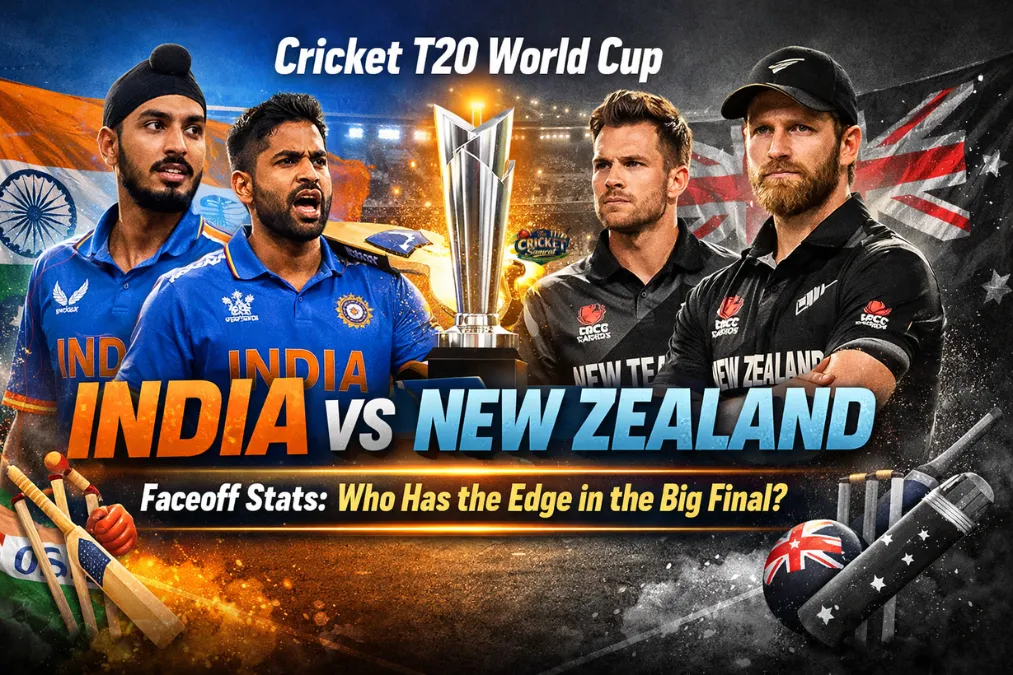
The t20 world cup final match between India and New Zealand promises to be one of the most thrilling encounters in modern cricket. As two of the most competitive teams in international cricket prepare to face each other, fans around the world are eagerly waiting to see which side will lift the coveted trophy. The final will take place on March 8 at the Narendra Modi Stadium in Ahmedabad, a venue capable of hosting more than 100,000 spectators, creating an electrifying atmosphere for cricket lovers.
For India, this moment represents a chance to defend their title and secure their third T20 World Cup championship, while New Zealand will aim to win their first-ever T20 World Cup trophy. Both teams have experienced a roller-coaster journey throughout the tournament, overcoming tough opponents and displaying remarkable skill, strategy, and resilience.
This article explores the complete faceoff statistics between Indian and New Zealand players, analyzing their performances in T20 International cricket. By comparing individual records and key matchups, we can better understand which team may hold the advantage in the t20 world cup final match.
India’s Journey to the T20 World Cup Final Match
India entered the tournament as one of the favorites and has lived up to expectations with consistent performances across all stages. The team showcased a strong combination of powerful batting, disciplined bowling, and sharp fielding.
Throughout the competition, India’s players demonstrated their ability to perform under pressure. From explosive batting at the top order to tight death bowling, the squad has shown depth in every department.
The semifinal victory over England proved to be a turning point. In that high-scoring match, Indian batters delivered a commanding performance, while the bowlers held their nerve in the final overs to secure a memorable win.
Reaching the t20 world cup final match for the second consecutive time and the fourth time overall highlights India’s dominance in the shortest format of the game.
New Zealand’s Road to the Final
New Zealand has built a reputation as one of the most consistent teams in international cricket tournaments. The team may not always start as favorites, but their ability to perform in crucial matches often makes them dangerous opponents.
During this tournament, New Zealand overcame several difficult challenges, showing exceptional teamwork and tactical awareness. Their bowlers delivered key breakthroughs at crucial moments, while the batting lineup produced match-winning contributions.
This will be New Zealand’s second appearance in a T20 World Cup final, and the team will be determined to seize the opportunity and secure their first title in this format.
Head-to-Head Player Battles in the T20 World Cup Final Match
One of the most fascinating aspects of this final will be the individual matchups between players from both teams. These battles often determine the outcome of big matches.
Below is a detailed statistical comparison of key players from India and New Zealand based on their T20 International records.
Arshdeep Singh vs Lockie Ferguson
Both teams rely heavily on their fast bowlers to control the game during the powerplay and death overs.
| Player | Matches | Wickets | Economy | Best Bowling | 5 Wickets |
|---|---|---|---|---|---|
| Arshdeep Singh | 83 | 127 | 8.53 | 5/51 | 1 |
| Lockie Ferguson | 51 | 72 | 7.31 | 5/21 | 1 |
Arshdeep Singh has been a crucial part of India’s bowling attack. Known for his ability to bowl accurate yorkers at the death, he has consistently delivered wickets in pressure situations.
Lockie Ferguson, on the other hand, brings raw pace and aggression. His ability to bowl at high speeds makes him a dangerous weapon for New Zealand, especially during the middle overs.
Jasprit Bumrah vs Matt Henry
Another key battle in the t20 world cup final match will involve two experienced fast bowlers.
| Player | Matches | Wickets | Economy | Best Bowling | 5 Wickets |
|---|---|---|---|---|---|
| Jasprit Bumrah | 94 | 117 | 6.55 | 3/7 | 0 |
| Matt Henry | 42 | 52 | 8.39 | 3/26 | 0 |
Jasprit Bumrah is widely regarded as one of the most effective T20 bowlers in the world. His ability to maintain a low economy rate while picking up key wickets makes him a game-changer.
Matt Henry has also been impressive for New Zealand. His disciplined line and length often create pressure on batters, forcing mistakes.
Varun Chakravarthy vs Kyle Mackenzie
Spin bowling can play a decisive role in the t20 world cup final match, particularly in the middle overs.
| Player | Matches | Wickets | Economy | Best Bowling | 5 Wickets |
|---|---|---|---|---|---|
| Varun Chakravarthy | 44 | 72 | 7.45 | 5/17 | 2 |
| Kyle Mackenzie | 16 | 9 | 7.87 | 3/15 | 0 |
Varun Chakravarthy’s mystery spin has troubled many international batters. His variations make him difficult to read, often leading to crucial breakthroughs.
Kyle Mackenzie is still relatively new at the international level but has shown promise with his ability to contain runs.
Axar Patel vs Mitchell Santner
Both teams feature all-rounders who contribute with both bat and ball.
| Player | Matches | Runs | Strike Rate | Best Score | 100s/50s | Wickets | Economy |
|---|---|---|---|---|---|---|---|
| Axar Patel | 93 | 702 | 133.96 | 65 | 0/1 | 94 | 7.38 |
| Mitchell Santner | 134 | 1030 | 132.05 | 77* | 0/2 | 137 | 7.21 |
New Zealand captain Mitchell Santner brings immense experience and composure. Axar Patel, however, has emerged as a reliable all-rounder who can change the game with quick runs and crucial wickets.
Hardik Pandya vs James Neesham
Two explosive all-rounders will play vital roles in the final.
| Player | Matches | Runs | Strike Rate | Best Score | 100s/50s | Wickets |
|---|---|---|---|---|---|---|
| Hardik Pandya | 137 | 2270 | 145.98 | 71* | 0/9 | 113 |
| James Neesham | 99 | 1033 | 149.71 | 48* | 0/0 | 59 |
Hardik Pandya’s ability to finish innings and provide key overs makes him one of India’s most valuable players.
James Neesham is also capable of delivering powerful cameos and breaking partnerships.
Shivam Dube vs Michael Chapman
| Player | Matches | Runs | Strike Rate | Best Score | 100s/50s |
|---|---|---|---|---|---|
| Shivam Dube | 63 | 965 | 151.96 | 66 | 0/6 |
| Michael Chapman | 112 | 2071 | 136.25 | 104* | 1/10 |
Chapman brings experience and stability to the New Zealand middle order, while Dube’s aggressive batting can accelerate the scoring rate.
Tilak Varma vs Daryl Mitchell
| Player | Matches | Runs | Strike Rate | Best Score | 100s/50s |
|---|---|---|---|---|---|
| Tilak Varma | 48 | 1382 | 145.62 | 120* | 2/6 |
| Daryl Mitchell | 103 | 1862 | 140.42 | 72* | 0/8 |
Both players are known for their ability to anchor innings and build partnerships.
Suryakumar Yadav vs Glenn Phillips
| Player | Matches | Runs | Strike Rate | Best Score | 100s/50s |
|---|---|---|---|---|---|
| Suryakumar Yadav | 112 | 3272 | 163.02 | 117 | 4/25 |
| Glenn Phillips | 96 | 2281 | 142.83 | 108 | 2/12 |
Suryakumar Yadav’s innovative batting style has revolutionized T20 cricket. Glenn Phillips is equally dangerous with his explosive hitting.
Ishan Kishan vs Rachin Ravindra
| Player | Matches | Runs | Strike Rate | Best Score | 100s/50s |
|---|---|---|---|---|---|
| Ishan Kishan | 44 | 1274 | 146.10 | 103 | 1/9 |
| Rachin Ravindra | 51 | 758 | 135.59 | 69 | 0/4 |
Both players provide aggressive starts and can change the momentum quickly.
Sanju Samson vs Tim Seifert
| Player | Matches | Runs | Strike Rate | Best Score | 100s/50s |
|---|---|---|---|---|---|
| Sanju Samson | 61 | 1310 | 154.84 | 111 | 3/5 |
| Tim Seifert | 89 | 2227 | 145.46 | 97* | 0/16 |
Samson’s explosive batting and wicketkeeping skills add balance to the Indian team.
Abhishek Sharma vs Finn Allen
| Player | Matches | Runs | Strike Rate | Best Score | 100s/50s |
|---|---|---|---|---|---|
| Abhishek Sharma | 45 | 1386 | 188.82 | 135 | 2/9 |
| Finn Allen | 61 | 1654 | 171.04 | 137 | 3/7 |
This matchup could be one of the most exciting in the t20 world cup final match. Both players are known for their fearless approach and explosive hitting during the powerplay.
Also read: India vs West Indies: India Seal Semi-Final Spot After Sanju Samson’s 97-Run Blitz at Eden Gardens
Narendra Modi Stadium: The Grand Stage for the Final
The Narendra Modi Stadium in Ahmedabad is the largest cricket stadium in the world. With a seating capacity exceeding 100,000 spectators, it provides a spectacular setting for global cricket events.
The pitch at this venue often favors batters, but spinners can also play a key role if the surface slows down during the later stages of the match.
Crowd support will heavily favor India, but New Zealand has proven time and again that they can perform under pressure in hostile environments.
Key Factors That Could Decide the T20 World Cup Final Match
Several factors could influence the outcome of the match:
1. Powerplay Performance
The team that dominates the first six overs will gain a significant advantage.
2. Middle Overs Control
Spinners and all-rounders often determine the flow of the game during the middle phase.
3. Death Overs Execution
The final overs frequently decide T20 matches. Accurate yorkers and smart variations can make the difference.
4. Fielding Standards
Sharp fielding and quick run-outs can shift momentum instantly.
Prediction: Who Has the Edge?
Predicting the winner of the t20 world cup final match is never easy. Both teams possess exceptional talent and match-winners.
India appears to have a slight advantage due to their powerful batting lineup and home support. However, New Zealand’s disciplined bowling attack and calm approach in high-pressure matches make them formidable opponents.
Ultimately, the final result will depend on which team handles the pressure better on the big day.
Conclusion
The t20 world cup final match between India and New Zealand is set to deliver an unforgettable cricket spectacle. With world-class players on both sides and millions of fans watching across the globe, the stakes could not be higher.
India will aim to defend their title and claim a third championship, while New Zealand will chase their historic first T20 World Cup victory.
As the teams walk onto the field at the Narendra Modi Stadium, one thing is certain: cricket fans are about to witness a thrilling contest that will be remembered for years to come