
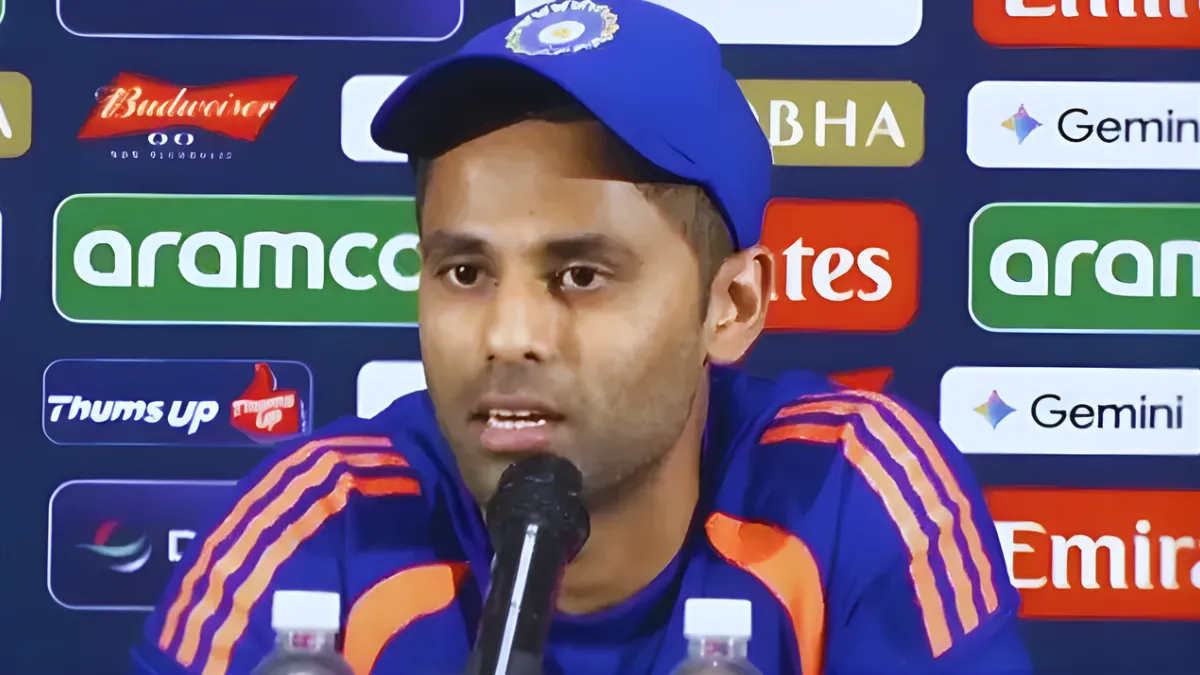
As anticipation builds for the 2026 T20 World Cup final, India captain Suryakumar Yadav has opened up about one of the tournament’s most debated selection decisions — the temporary exclusion of vice-captain Axar Patel. Speaking to the media ahead of India’s highly anticipated showdown against New Zealand national cricket team, the Indian skipper revealed that tough team decisions are taken jointly by him and head coach Gautam Gambhir.
The blockbuster 2026 T20 World Cup final will take place at the iconic Narendra Modi Stadium in Ahmedabad on Sunday, March 8, starting at 7:00 PM IST. With India aiming to lift the trophy on home soil, the pressure and excitement surrounding the match have reached fever pitch.
Suryakumar Yadav Reveals Reason Behind Axar Patel’s Exclusion
One of the biggest talking points during India’s campaign was the surprising decision to drop Axar Patel from the Super 8 match against South Africa national cricket team. Patel, who serves as India’s vice-captain in the tournament, had earlier been rested for the final group-stage match against the Netherlands national cricket team.
In that game, the team management brought in Washington Sundar as a replacement. However, the decision raised eyebrows among fans and analysts alike when Patel was also left out of the Super 8 clash against South Africa.
Speaking candidly about the move, Suryakumar explained that the call was made after careful consideration by the team leadership.
“Tough calls are taken by Gautam Gambhir and me. Axar wasn’t happy when he was dropped, but these things happen in professional sport. We felt Sanju was needed for the balance of the side, and it was a positive call,” Suryakumar said.
Despite the rationale, the decision did not yield the desired result. India suffered a heavy 76-run defeat in that match, one of their toughest setbacks during the tournament.
Washington Sundar’s Performance in the Super 8 Match
In Patel’s absence, Washington Sundar was expected to strengthen India’s bowling attack and provide depth with the bat. However, his performance against South Africa remained modest.
Washington Sundar’s Match Performance
| Category | Performance |
|---|---|
| Overs Bowled | 2 |
| Runs Conceded | Not significant impact |
| Runs Scored | 11 |
| Match Result | India lost by 76 runs |
While Sundar contributed with both bat and ball, his performance could not change the outcome of the match as South Africa dominated the contest.
Axar Patel’s Strong Comeback in the Tournament
Following the defeat, Axar Patel returned to the playing XI for India’s second Super 8 match against the Zimbabwe national cricket team. Since then, he has been a regular part of the side and has delivered key performances in crucial matches.
His contribution in the semi-final against the England national cricket team was particularly important. Patel delivered an economical spell with the ball, conceding only 35 runs in his four overs.
In addition to his bowling, Axar’s fielding efforts played a vital role in shifting the momentum in India’s favor. His agility and sharp fielding helped restrict England’s scoring opportunities, ultimately contributing to India’s victory in the knockout match.
Axar Patel’s Semi-Final Performance vs England
| Category | Performance |
|---|---|
| Overs Bowled | 4 |
| Runs Conceded | 35 |
| Key Impact | Tight bowling and excellent fielding |
| Match Outcome | India won and advanced to final |
These contributions helped India secure a place in the 2026 T20 World Cup final, setting up a high-stakes clash with New Zealand.
Suryakumar Yadav Responds to Mitchell Santner’s Comment
Ahead of the final, New Zealand captain Mitchell Santner made headlines with his remarks about wanting to silence the crowd during the final match.
Speaking to reporters, Santner stated that it would be their goal to quiet the Indian supporters in the stadium.
“Yeah, I guess that’s the goal, isn’t it? To silence the crowd. Throughout this World Cup, we’ve seen that many teams are evenly matched. Sometimes the result comes down to small moments. If we perform well, we can upset another big team. There’s obviously a lot of pressure on India to win the World Cup at home,” Santner said.
The statement quickly gained attention among cricket fans, especially with the final being played in front of a massive Indian crowd in Ahmedabad.
Suryakumar responded to the comment in a light-hearted yet confident manner.
“Koi naya line toh bolo, sab yahi line chipka rahe — say something new, everyone is repeating the same line,” he joked.
He added that the atmosphere inside the Indian camp remains upbeat and focused ahead of the big game.
“The mood in the camp is very good. We are excited to play in this stadium. It’s a special stadium for us.”
Key Details of the 2026 T20 World Cup Final
The 2026 T20 World Cup final promises to be one of the most thrilling matches of the tournament, with India looking to secure a historic victory in front of their home fans.
Match Overview
| Detail | Information |
|---|---|
| Tournament | 2026 T20 World Cup |
| Match | Final |
| Teams | India vs New Zealand |
| Venue | Narendra Modi Stadium, Ahmedabad |
| Date | March 8, 2026 |
| Time | 7:00 PM IST |
The Narendra Modi Stadium, the world’s largest cricket stadium, is expected to host a packed crowd, creating an electrifying atmosphere for the final.
India’s Tough Record Against New Zealand in T20 World Cups
One of the biggest challenges facing India in the 2026 T20 World Cup final is their historical record against New Zealand in T20 World Cup matches.
Despite being one of the strongest teams in world cricket, India have never defeated New Zealand in a T20 World Cup fixture. This statistic adds an extra layer of intrigue and pressure heading into the final.
New Zealand have often proven to be a difficult opponent in ICC tournaments, delivering disciplined performances and thriving in high-pressure games.
For India, the final represents not only an opportunity to win the title but also a chance to rewrite history by breaking their T20 World Cup jinx against the Black Caps.
A High-Stakes Finale Awaits
With the 2026 T20 World Cup final just hours away, both teams are preparing for one last battle in what has been a fiercely competitive tournament.
India will rely on the leadership of Suryakumar Yadav, the experience of players like Axar Patel, and the support of thousands of fans inside the Narendra Modi Stadium. Meanwhile, New Zealand will look to continue their reputation as giant-slayers in global tournaments.
As cricket fans around the world tune in for the final, all eyes will be on Ahmedabad to see whether India can finally overcome New Zealand and lift the coveted T20 World Cup trophy on home soil.