
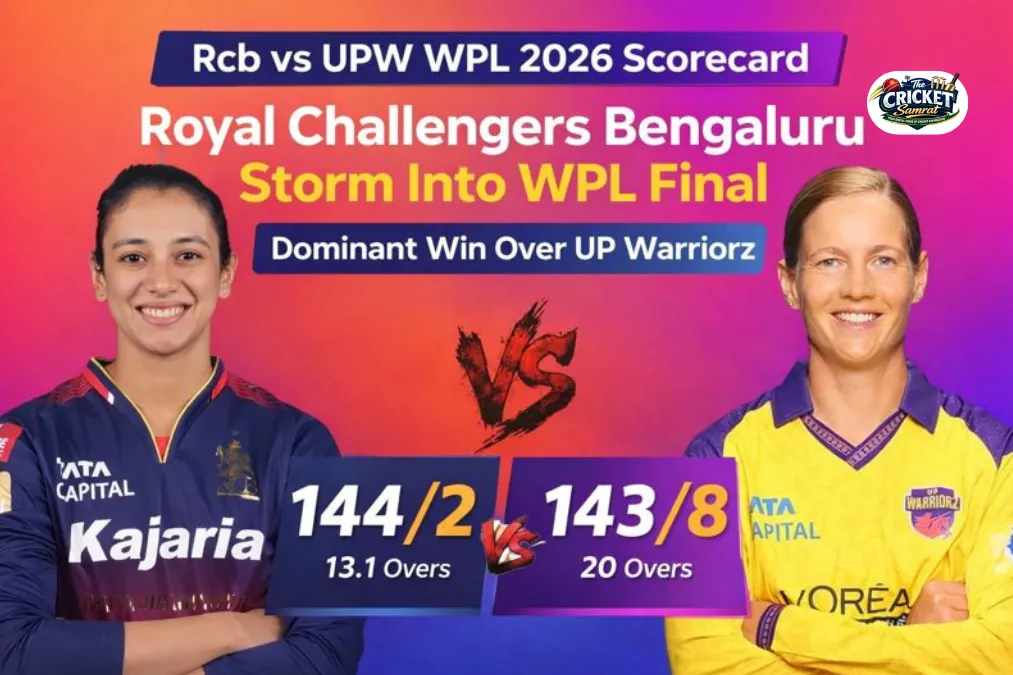
Royal Challengers Bengaluru Secure Final Spot With Commanding 8-Wicket Victory
The Rcb vs upw wpl 2026 scorecard tells the story of a one-sided contest as Royal Challengers Bengaluru (RCB) delivered a clinical all-round performance to defeat UP Warriorz (UPW) by eight wickets in Match 18 of the Women’s Premier League (WPL) 2026. The win not only underlined RCB’s dominance in the tournament but also confirmed their place in the WPL 2026 Final, while UP Warriorz saw their playoff hopes come to an abrupt end.
Played at the BCA Cricket Stadium, Vadodara, the high-stakes encounter had contrasting implications for both sides. UP Warriorz entered the match in a do-or-die situation, while RCB needed just one victory to seal a direct qualification to the final. By the end of the night, the difference between the two teams was stark.
Brilliant bowling upfront, followed by an explosive opening partnership featuring Grace Harris and Smriti Mandhana, ensured that RCB chased down the target with ease, completing the job in just 13.1 overs.
Match Overview: RCB vs UPW – WPL 2026, Match 18
| Match Details | Information |
|---|---|
| Match | RCB vs UP Warriorz |
| Tournament | Women’s Premier League 2026 |
| Match No. | 18 |
| Venue | BCA Cricket Stadium, Vadodara |
| Toss | RCB won, elected to field |
| Result | RCB won by 8 wickets |
| Player of the Match | Grace Harris |
Toss Update: RCB Opt for Fielding
Winning the toss, RCB captain Smriti Mandhana showed complete confidence in her bowling unit by choosing to field first. The decision proved spot on as RCB bowlers quickly adapted to the conditions, extracting movement and maintaining disciplined lines.
For UP Warriorz, the pressure was immense. Sitting at the bottom of the points table with 4 points from 6 matches, they needed a victory to stay alive in the playoff race. Anything less would spell elimination.
UP Warriorz Innings: 143/8 in 20 Overs
UP Warriorz began their innings with Meg Lanning and Deepti Sharma opening the batting. The duo provided a steady start but failed to capitalise fully on the powerplay.
Powerplay Summary
| Overs | Score | Wickets |
|---|---|---|
| 5 Overs | 36 | 0 |
The lack of early aggression meant UPW were always playing catch-up, especially as RCB’s bowlers tightened the screws through the middle overs.
Key Batting Performances for UP Warriorz
| Batter | Runs | Balls | Fours | Sixes |
|---|---|---|---|---|
| Deepti Sharma | 55 | 43 | 6 | 1 |
| Meg Lanning | 42 | 30 | 6 | 1 |
| Harleen Deol | 14 | 14 | 2 | 0 |
| Amy Jones | 1 | 2 | 0 | 0 |
Deepti Sharma anchored the innings beautifully, bringing up her half-century in just 40 balls. However, her dismissal at 55 runs, caught off Shreyanka Patil, proved to be the turning point.
Meg Lanning looked fluent during her stay, striking the ball cleanly and rotating the strike effectively. Her innings of 42 off 30 balls ended when she fell to Nadine de Klerk, halting UPW’s momentum.
RCB Bowling Performance
| Bowler | Overs | Runs | Wickets |
|---|---|---|---|
| Shreyanka Patil | 4 | 28 | 1 |
| Nadine de Klerk | 4 | 31 | 1 |
| Lauren Bell | 4 | 22 | 2 |
| Radha Yadav | 4 | 27 | 1 |
| Arundhati Reddy | 4 | 35 | 1 |
RCB’s bowling unit worked as a cohesive force. The pacers struck at crucial intervals, while the spinners ensured UPW never gained control in the middle overs.
UP Warriorz eventually finished on 143/8, a total that looked underwhelming given the importance of the match.
Target Set: RCB Need 144 Runs to Win
With a manageable target of 144 runs, RCB entered the chase as clear favourites. The opening pair of Grace Harris and Smriti Mandhana wasted no time in asserting dominance.
RCB Chase: 144/2 in 13.1 Overs
From the very first over, RCB’s intent was crystal clear. Grace Harris launched a brutal assault on the UP Warriorz bowling attack, while Mandhana played the perfect supporting role before shifting gears.
RCB Powerplay Blitz
| Overs | Score | Wickets |
|---|---|---|
| 4.1 Overs | 50 | 0 |
RCB raced to 50 runs in just 4.1 overs, effectively ending the contest early.
Grace Harris: A Match-Winning Knock
Grace Harris produced one of the finest innings of WPL 2026, smashing a breathtaking 75 runs off 37 balls.
| Grace Harris Batting Stats |
|---|
| Runs: 75 |
| Balls: 37 |
| Fours: 13 |
| Sixes: 2 |
| Strike Rate: 202+ |
She reached her half-century in just 28 balls, peppering the boundaries with exquisite timing and raw power. Harris eventually fell while attempting another big hit, bowled by Shikha Pandey, but by then the match was firmly in RCB’s grasp.
Smriti Mandhana’s Calm Half-Century
| Smriti Mandhana Stats |
|---|
| Runs: 54* |
| Balls: 26 |
| Fours: 7 |
| Sixes: 2 |
RCB skipper Smriti Mandhana showcased her class with an unbeaten 54, guiding the chase with elegance and authority. Her calm presence ensured there were no hiccups as RCB cruised to victory.
RCB Batting Summary
| Batter | Runs | Balls | Fours | Sixes |
|---|---|---|---|---|
| Grace Harris | 75 | 37 | 13 | 2 |
| Smriti Mandhana | 54* | 26 | 7 | 2 |
| Georgia Wareham | 9* | 8 | 1 | 0 |
RCB reached the target in 13.1 overs, losing just two wickets, sealing an emphatic 8-wicket win.
Full Rcb vs upw wpl 2026 Scorecard
UP Warriorz Innings
| Score | Overs |
|---|---|
| 143/8 | 20 |
Royal Challengers Bengaluru Innings
| Score | Overs |
|---|---|
| 144/2 | 13.1 |
Playing XIs
UP Warriorz Playing XI
| Players |
|---|
| Meg Lanning (Captain) |
| Simran Shaikh |
| Amy Jones |
| Harleen Deol |
| Chloe Tryon |
| Shweta Sehrawat |
| Deepti Sharma |
| Sophie Ecclestone |
| Asha Shobhana |
| Shikha Pandey |
| Kranti Goud |
Royal Challengers Bengaluru Playing XI
| Players |
|---|
| Grace Harris |
| Smriti Mandhana (Captain) |
| Georgia Wareham |
| Pooja Vastrakar |
| Richa Ghosh |
| Radha Yadav |
| Nadine de Klerk |
| Sayali Satghare |
| Arundhati Reddy |
| Shreyanka Patil |
| Lauren Bell |
Also read: WPL 2026: Orange Cap and Purple Cap Standings – Who’s Leading the Women’s Premier League So Far?
What This Result Means for Both Teams
RCB: Direct Entry Into the Final
This victory cements RCB’s position as one of the most dominant sides of WPL 2026. Their consistency across departments has paid rich dividends, and they now advance confidently into the final with momentum firmly on their side.
UP Warriorz: Campaign Comes to an End
For UP Warriorz, the defeat marks the end of a disappointing season. Despite individual brilliance from players like Deepti Sharma and Meg Lanning, the team struggled to put together complete performances when it mattered most.
Also read: WPL 2026 Points Table: Updated Standings, Team Rankings and Playoff Qualification Explained
Conclusion:
The Rcb vs upw wpl 2026 scorecard perfectly reflects Royal Challengers Bengaluru’s supremacy on the night. From disciplined bowling to explosive batting, RCB ticked every box in a pressure match.
With the final now in sight, RCB will look to carry this momentum forward, while UP Warriorz head back with lessons to learn ahead of the next season of the Women’s Premier League.