
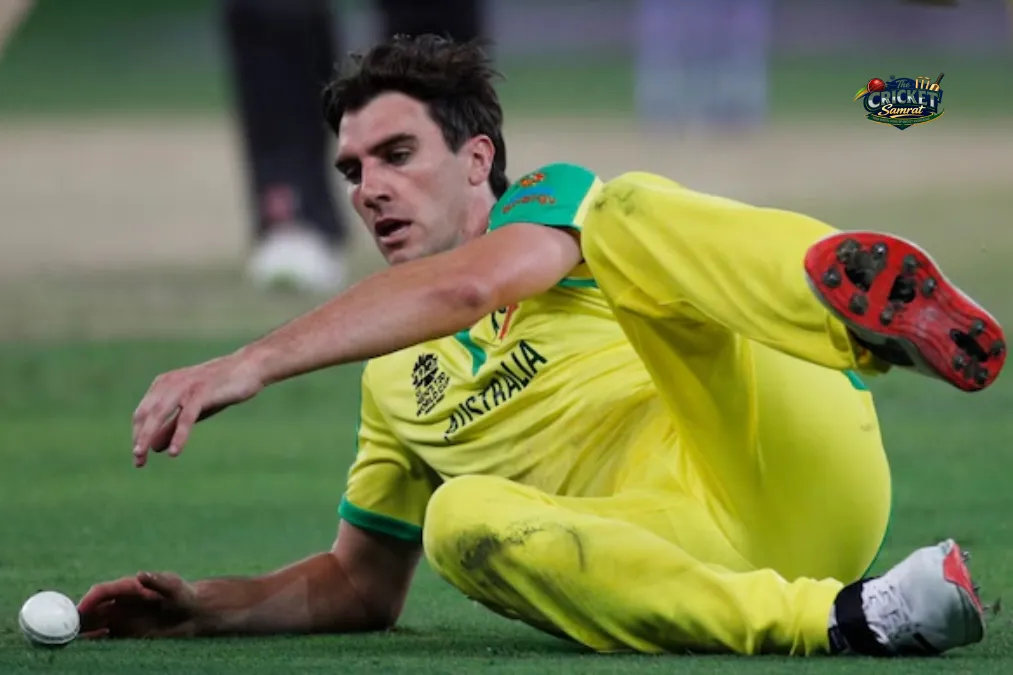
Pat Cummins Out of T20 World Cup Squad: Australia have suffered a significant setback ahead of the upcoming ICC T20 World Cup, with their regular captain Pat Cummins officially ruled out of the tournament due to injury. Cricket Australia confirmed on Saturday that Pat Cummins out of T20 World Cup squad after failing to recover fully from a persistent back issue, forcing the selectors to rethink their plans just days before the competition begins.
Cummins’ absence has resulted in a reshuffled Australian squad, with all-rounder Mitchell Marsh appointed as the new captain. Left-arm pacer Ben Dwarshuis has been named as Cummins’ replacement, while Matthew Short has also missed out, making way for Matthew Renshaw. The revised squad also features three players who are set to make their T20 World Cup debut, highlighting a blend of experience and fresh talent in Australia’s campaign.
Pat Cummins’ Injury Ends World Cup Hopes
Pat Cummins has been struggling with a back injury for several weeks and was unable to regain full fitness in time for the tournament. The Australian fast bowler did not travel with the team for the ongoing T20 series against Pakistan, raising early concerns about his availability. Although there was optimism that he might recover before the World Cup, selectors ultimately decided not to risk him.
Cricket Australia’s chairman of selectors Tony Dodemaide addressed the decision, stating that Cummins required additional recovery time and could not meet the physical demands of a high-intensity global tournament.
“Pat needs more time to fully recover from his back injury. We felt it was best not to rush him back. Ben Dwarshuis offers balance with his left-arm pace, strong fielding, and useful lower-order batting,” Dodemaide said.
The news that Pat Cummins out of T20 World Cup squad has sparked widespread discussion, given his leadership qualities and ability to perform in pressure situations.
Mitchell Marsh Handed Captaincy Responsibility
With Cummins unavailable, Cricket Australia has entrusted Mitchell Marsh with the captaincy. Marsh brings leadership experience and has been a consistent performer across formats in recent years. His appointment signals continuity rather than disruption, as he has already played a senior role within the squad.
Marsh will be supported by experienced campaigners such as Glenn Maxwell, Marcus Stoinis, Cameron Green, and Travis Head, ensuring Australia retain a strong core despite Cummins’ absence.
New Faces Included in Australia’s Squad
One of the biggest talking points following the squad announcement is the inclusion of three uncapped players for the T20 World Cup: Xavier Bartlett, Cooper Connolly, and Matthew Kuhnemann. All three have impressed at domestic level and in limited international appearances, earning them a chance on the global stage.
Cooper Connolly’s selection, in particular, surprised many observers, as he has not featured in Australia’s last 12 T20 internationals. However, selectors believe his all-round skills could prove valuable in subcontinental conditions.
Players Making Their T20 World Cup Debut
| Player Name | Role | Key Strength |
|---|---|---|
| Xavier Bartlett | Fast Bowler | New-ball pace and swing |
| Cooper Connolly | All-rounder | Left-hand batting & spin |
| Matthew Kuhnemann | Spinner | Control in middle overs |
Australia’s Current Form and Pakistan Series
Australia are currently involved in a three-match T20 series against Pakistan. The team suffered a 22-run defeat in the opening match, exposing areas that need improvement ahead of the World Cup. The second match of the series is scheduled to be played in Lahore, with Australia aiming to bounce back strongly.
Although the series serves as preparation, the absence of Pat Cummins has already been felt in the bowling department, putting extra responsibility on Josh Hazlewood, Nathan Ellis, and emerging pacers.
Bowling Attack Without Cummins
Despite Cummins being unavailable, Australia still boast a formidable bowling lineup. Josh Hazlewood leads the pace attack, supported by Ben Dwarshuis and Xavier Bartlett. Nathan Ellis provides variations at the death, while Adam Zampa and Matthew Kuhnemann offer spin options suited for slower pitches.
Australia’s Key Bowlers for the T20 World Cup
| Bowler | Style | Role |
|---|---|---|
| Josh Hazlewood | Right-arm fast | Powerplay & death overs |
| Ben Dwarshuis | Left-arm fast | Variation & fielding |
| Xavier Bartlett | Right-arm fast | Early breakthroughs |
| Nathan Ellis | Right-arm medium | Death overs |
| Adam Zampa | Leg-spinner | Middle overs control |
| Matthew Kuhnemann | Left-arm spinner | Spin support |
Group B Fixtures and Tournament Schedule
Australia have been placed in Group B, alongside Sri Lanka, Zimbabwe, Oman, and Ireland. The team will begin their campaign on 11 February against Ireland at the R. Premadasa Stadium in Colombo.
While Australia are considered the strongest team in the group on paper, matches against Sri Lanka and Ireland are expected to be competitive, especially in Asian conditions where spin often plays a crucial role.
Australia’s Group B Match Schedule
| Date | Opponent | Venue |
|---|---|---|
| 11 February | Ireland | R. Premadasa Stadium, Colombo |
| 13 February | Zimbabwe | Colombo |
| 16 February | Sri Lanka | Colombo |
| 20 February | Oman | Colombo |
Squad Stability Despite Setbacks
Even with Pat Cummins out of T20 World Cup squad, Australia have retained several match-winners. Glenn Maxwell’s explosive batting, Marcus Stoinis’ power hitting, and Tim David’s finishing ability provide depth in the middle and lower order. Josh Inglis continues as the wicketkeeper, adding flexibility to the batting lineup.
Selectors appear confident that the blend of experienced internationals and hungry newcomers will help Australia remain competitive throughout the tournament.
Read also: Cameron Green: The Rise, Resilience and Reinvention of Australia’s Modern All-Rounder
Australia’s Final T20 World Cup Squad
| Player | Role |
|---|---|
| Mitchell Marsh (Captain) | All-rounder |
| Travis Head | Batter |
| Marcus Stoinis | All-rounder |
| Glenn Maxwell | All-rounder |
| Cameron Green | All-rounder |
| Matthew Renshaw | Batter |
| Cooper Connolly | All-rounder |
| Tim David | Batter |
| Josh Inglis | Wicketkeeper |
| Josh Hazlewood | Fast bowler |
| Ben Dwarshuis | Fast bowler |
| Xavier Bartlett | Fast bowler |
| Nathan Ellis | Fast bowler |
| Matthew Kuhnemann | Spinner |
| Adam Zampa | Spinner |
Conclusion
The announcement that Pat Cummins out of T20 World Cup squad marks a crucial moment in Australia’s World Cup journey. While losing a leader of Cummins’ calibre is a blow, the appointment of Mitchell Marsh as captain and the inclusion of exciting new talent suggest Australia are ready to adapt.
With a balanced squad, strong all-round options, and a favourable group, Australia will still enter the tournament as serious contenders. How well the team copes without Cummins’ leadership and experience will ultimately determine their success on the world stage.