
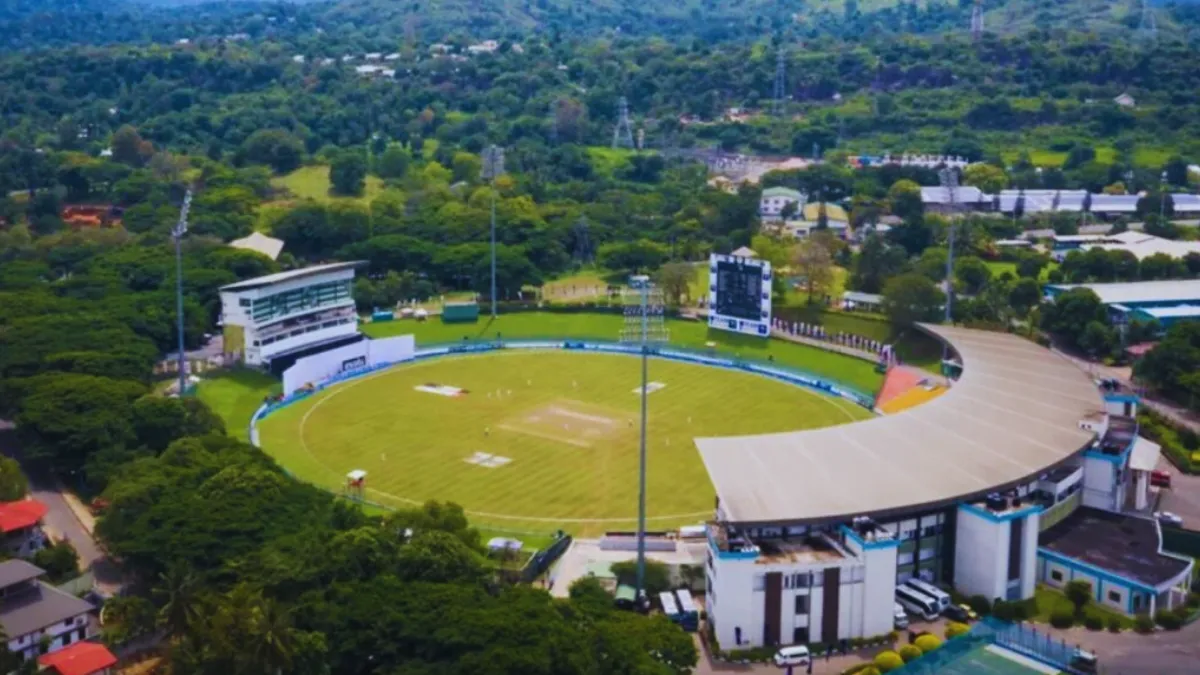
The pallekele international cricket stadium pitch report has become a major talking point ahead of every big international fixture in Sri Lanka. Located in the scenic city of Kandy, the Pallekele International Cricket Stadium is one of the country’s premier cricket venues and has played host to several high-profile international matches, including World Cup contests.
With a seating capacity of 35,000 and modern facilities, the stadium offers a vibrant cricketing atmosphere. Built in 2009 with the 2011 ODI World Cup in mind, it quickly established itself as a key venue for international cricket in Sri Lanka.
Below is a complete breakdown of the venue, including pitch behavior, T20 records, team performances, weather conditions, and a detailed statistical overview.

Stadium Overview: Key Facts and Details
Here is a quick look at the essential details of the venue:
| Category | Details |
|---|---|
| Established | 2009 |
| Location | Kandy, Sri Lanka |
| Seating Capacity | 35,000 |
| Playing Area | 80m long, 75m wide |
| Ends | Hunnasgiriya End, Rikillagaskada End |
| Floodlights | Installed in 2010 |
| Pitch Type | Grass surface |
| Curator | Asitha Wijesinghe |
| Current Local Time | 18:17, Mon Feb 16, 2026 |
The stadium features a lush green outfield and a square that has traditionally offered fair conditions for both batters and bowlers. The presence of floodlights allows for high-quality day-night encounters, particularly in the T20 format.

Pallekele International Cricket Stadium Pitch Report
The pallekele international cricket stadium pitch report suggests that this venue offers a balanced surface, especially in T20 internationals.
Batting Conditions
In the early stages of a match, the pitch generally provides:
- Good bounce
- True pace
- Consistent carry
Stroke-makers often enjoy batting during the powerplay. The ball comes nicely onto the bat, allowing aggressive stroke play. Teams frequently aim to capitalize in the first six overs, where scoring rates tend to be higher.
Middle & Death Overs Impact
As the match progresses, the surface begins to slow down slightly. The pitch can become:
- Slightly tacky
- Slower off the surface
- Helpful for spinners
Change-of-pace bowlers and spinners become increasingly effective during the middle overs. Batters often need to adjust their tempo and rely more on placement rather than pure power.
T20 Match Results at Pallekele
A total of 31 T20 International matches have been played at this venue. The results indicate a relatively even contest between teams batting first and second.
Match Results Breakdown
| Match Outcome | Number of Matches |
|---|---|
| Batting First Wins | 15 |
| Batting Second Wins | 12 |
| Tied Matches | 3 |
| No Result | 1 |
| Total Matches | 31 |
While teams batting first hold a slight advantage, the difference is marginal. Captains often base their decision at the toss on weather conditions and dew factors.
Highest and Lowest Team Totals
The stadium has witnessed both record-breaking innings and dramatic collapses.
Highest Team Totals
| Rank | Team | Score | Opponent | Year |
|---|---|---|---|---|
| 1 | Australia national cricket team | 263/3 | Sri Lanka | 2016 |
| 2 | Sri Lanka national cricket team | 225/5 | Oman | 2026 |
Australia’s 263/3 remains the highest team total recorded at this venue in T20 internationals, showcasing how destructive batting can be on a good surface.
Lowest Team Totals
| Rank | Team | Score | Opponent |
|---|---|---|---|
| 1 | New Zealand national cricket team | 88 | Sri Lanka |
| 2 | Sri Lanka | 116 | Various |
| 3 | Sri Lanka | 116 | Various |
New Zealand’s 88 stands as the lowest total at the ground, highlighting that once the pitch slows down, it can challenge even experienced batting line-ups.
Sri Lanka’s Record at Pallekele
Sri Lanka have played 25 T20Is at this venue.
Sri Lanka T20 Record
| Matches Played | Wins | Losses | Ties | No Result |
|---|---|---|---|---|
| 25 | 11 | 11 | 2 | 1 |
The record shows a perfectly balanced performance at home, with wins and losses evenly split.
Australia’s Record at Pallekele
Australia have featured in four T20 matches at this ground.
| Matches Played | Wins | Losses |
|---|---|---|
| 4 | 3 | 1 |
Australia have historically enjoyed success at this venue, winning three out of four matches played here.
Top Individual Performers at Pallekele
Several star players have left their mark at this stadium.
Most Runs at the Venue
Kusal Mendis holds the record for the most runs scored at this ground in T20Is, amassing 471 runs, including three half-centuries.
Most Wickets at the Venue
Legendary fast bowler Lasith Malinga has taken the most wickets here, claiming 18 scalps.
Among active players, Maheesh Theekshana has picked up 11 wickets at an impressive average of 18.90.
Weather Forecast: Will Rain Affect Play?
Evening conditions in Pallekele are expected to be:
- Temperature: Around 21°C
- Cloud Cover: Full cloud cover
- Rain Probability: 24%
- Humidity: Around 80%
- Wind Speed: Gusts up to 19 km/h
High humidity could make conditions heavier, particularly in the second innings. Wind gusts may assist swing bowlers early in the match, especially under lights.
Sri Lanka vs Australia: Who Holds the Advantage?
Considering home familiarity and experience in local conditions, Sri Lanka may hold a slight edge. However, Australia’s strong historical record at the venue cannot be overlooked.
If the pitch remains true early on, aggressive batters from both sides could dominate. But if it slows down as expected, spinners are likely to play a decisive role.
Also read: Sri Lanka vs Australia Prediction: Who Will Win Today’s ICC T20 World Cup 2026 Match?
Conclusion: on the Pallekele International Cricket Stadium Pitch Report
The pallekele international cricket stadium pitch report confirms that this is one of Sri Lanka’s most balanced T20 venues. Batters enjoy the early phase, while bowlers — especially spinners — come into play as the game progresses.
With competitive totals, historic high scores, and dramatic collapses, Pallekele consistently delivers entertaining cricket. Toss decisions, weather conditions, and team composition all play critical roles here.
For teams preparing to play at this venue, adaptability is key. A strong start with the bat, combined with disciplined spin bowling later in the innings, often proves to be the winning formula.
As international cricket continues to return to Kandy, the Pallekele International Cricket Stadium remains one of the most exciting and strategically intriguing grounds in the modern T20 era.