
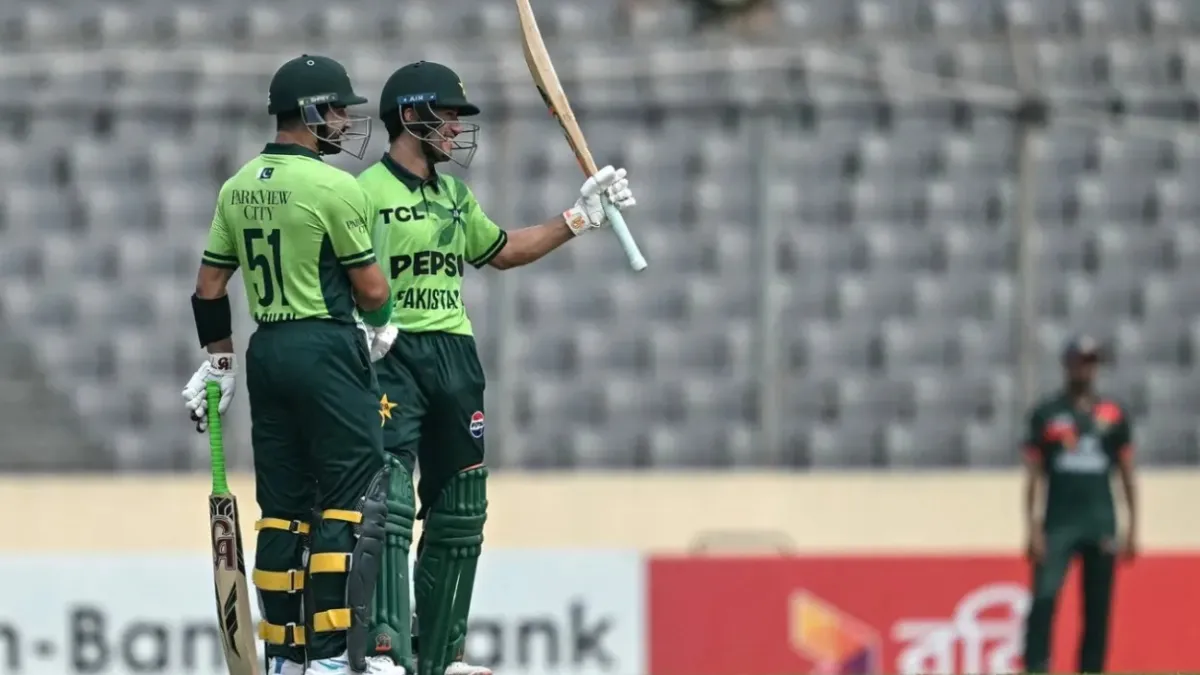
The Pakistan vs Bangladesh rivalry once again produced a dramatic contest as Pakistan delivered a commanding performance to level the ODI series. In a rain-affected second match, Pakistan defeated Bangladesh by 127 runs via the Duckworth–Lewis–Stern (DLS) method, thanks to a sensational all-round display from Maaz Sadaqat.
The young Pakistani star played a decisive role with both bat and ball, smashing a rapid 75 runs at the top of the order before returning to claim three crucial wickets during Bangladesh’s chase. Pakistan first posted 274 runs on the board before their bowlers dismantled the Bangladeshi batting lineup, eventually bowling them out for 114 runs.
The victory ensured that the Pakistan vs Bangladesh ODI series remained alive, with both teams now heading into a decisive final match. The encounter had everything—explosive batting, controversial moments, a rain delay caused by severe weather, and a ruthless bowling performance that sealed the result.
Pakistan vs Bangladesh Match Summary
| Match Details | Information |
|---|---|
| Match | Pakistan vs Bangladesh, 2nd ODI |
| Venue | Dhaka |
| Pakistan Score | 274 all out |
| Bangladesh Score | 114 all out |
| Result | Pakistan won by 127 runs (DLS method) |
| Player of the Match | Maaz Sadaqat |
| Key Performers | Sadaqat (75 & 3/23), Salman Agha (64), Haris Rauf (3/26), Litton Das (41) |
A Thrilling Pakistan vs Bangladesh Encounter in Dhaka
The Pakistan vs Bangladesh clash in Dhaka was expected to be fiercely competitive after Bangladesh’s victory in the first ODI. Pakistan came into the match under pressure to bounce back and keep the series alive.
From the very start, Pakistan looked determined to correct the mistakes that had cost them in the opening match. Their batting lineup approached the game with aggressive intent, particularly through the fearless stroke play of Maaz Sadaqat, whose early fireworks completely changed the momentum.
Bangladesh, on the other hand, struggled to maintain consistency. While their bowlers managed to slow the scoring rate during the middle overs, the damage done by Sadaqat early on gave Pakistan a platform that proved difficult to recover from.
Maaz Sadaqat’s Explosive Start Sets the Tone
One of the defining moments of the Pakistan vs Bangladesh match came right at the beginning of Pakistan’s innings. Young opener Maaz Sadaqat stepped onto the field with remarkable confidence and immediately began attacking the Bangladeshi bowling attack.
Unlike his cautious debut innings earlier in the series, Sadaqat displayed a fearless approach. He began his innings with two quick boundaries, signaling his aggressive intentions.
His most memorable shot came when he launched Bangladeshi pacer Nahid Rana over mid-off for a towering six in the very first over he faced. That shot not only electrified the crowd but also demonstrated the fearless mindset Pakistan needed after their disappointing performance in the first ODI.
By the time Sadaqat was eventually dismissed, he had scored 75 runs from just 46 balls, accounting for the majority of Pakistan’s early runs.
Pakistan’s Powerplay Dominance
Sadaqat’s blistering innings ensured Pakistan dominated the powerplay phase of the Pakistan vs Bangladesh match.
During the opening overs:
- Pakistan scored quickly despite limited support from the other end.
- The run rate remained above eight runs per over.
- Bangladesh struggled to contain Sadaqat’s attacking strokes.
While Sahibzada Farhan struggled to match the pace of scoring, Sadaqat carried the responsibility almost single-handedly. When he was finally dismissed while attempting a lap shot against Mehidy Hasan Miraz, Pakistan had already built a strong foundation.
Bangladesh Fight Back in the Middle Overs
After Sadaqat’s departure, Bangladesh found an opportunity to regain control of the Pakistan vs Bangladesh contest.
The Bangladeshi bowlers adjusted their tactics by:
- Spreading the field
- Slowing down the pace of deliveries
- Forcing Pakistani batters to take risks
This strategy worked effectively for a brief period. Sahibzada Farhan struggled to accelerate and was eventually dismissed after mistiming a shot toward third man.
Another setback came when Shamyl Hussain once again failed to make an impact. Similar to his dismissal in the previous match, he attempted an ambitious shot against Nahid Rana but only managed to produce a top edge, resulting in his departure for a modest score.
Salman Agha and Mohammad Rizwan Stabilize Pakistan
With early wickets falling, Pakistan needed stability. That responsibility fell on the experienced duo of Salman Ali Agha and Mohammad Rizwan.
The pair adopted a classic ODI approach:
- Initially absorbing pressure
- Rotating the strike
- Building a partnership through the middle overs
While Rizwan focused on anchoring the innings, Agha played the more aggressive role. His steady scoring helped Pakistan maintain momentum, eventually reaching a well-compiled 64 runs.
Their partnership lasted nearly 20 overs, giving Pakistan a solid platform to launch an attack during the final phase of the innings.
Spin Duo Slows Pakistan’s Scoring
Bangladesh’s comeback in the Pakistan vs Bangladesh match was largely led by their spin attack.
Key Bangladeshi Bowlers
| Bowler | Overs | Runs Conceded | Wickets |
|---|---|---|---|
| Rishad Hossain | 56 | 3 | |
| Mehidy Hasan Miraz | 10 | 34 | 1 |
Mehidy Hasan Miraz delivered an economical spell, keeping the Pakistani batters under control. Meanwhile, leg-spinner Rishad Hossain emerged as Bangladesh’s most successful bowler, claiming three wickets.
However, the most talked-about moment involving Miraz came during a controversial dismissal involving Salman Agha.
Controversial Run-Out Incident Sparks Drama
One of the most dramatic moments in the Pakistan vs Bangladesh match occurred during Pakistan’s late innings.
With Pakistan comfortably positioned at 231 for 3, both Agha and Rizwan appeared ready to accelerate toward a massive total.
During one delivery:
- Rizwan drove the ball back toward the bowler Miraz.
- Non-striker Salman Agha was out of his crease.
- The ball struck Agha’s foot as he tried to stop it.
- Agha attempted to pick up the ball while Miraz approached it.
Miraz quickly grabbed the ball and threw it at the stumps, catching Agha short of his crease. Bangladesh immediately appealed.
After the decision was reviewed, the umpire ruled Salman Agha run out, triggering visible frustration from the Pakistani batter.
The dismissal shifted momentum toward Bangladesh.
Pakistan’s Late Collapse
Following the controversial run-out, Pakistan’s batting lineup collapsed quickly.
Within the next few overs:
- Mohammad Rizwan attempted an ambitious shot off Miraz but was caught at deep midwicket.
- Hussain Talat fell while attempting an aggressive shot.
- Abdul Samad was involved in a terrible mix-up that led to his run-out.
Bangladesh continued taking pace off the ball, preventing Pakistan from accelerating during the death overs.
Despite these setbacks, Pakistan managed to reach 274 runs, a competitive total in the conditions.
Bangladesh’s Difficult Chase
Bangladesh faced a challenging target in the Pakistan vs Bangladesh match, but the situation became even more complicated due to severe weather.
Weather Interruption
Shortly after Bangladesh began their innings:
- A hailstorm struck the stadium.
- Lightning forced players to leave the field.
- The match was delayed for more than two hours.
When play resumed, the game was shortened.
Revised Target After Rain
Due to the weather interruption, the chase was adjusted under the Duckworth–Lewis–Stern method.
| Original Target | Revised Overs | Revised Target |
|---|---|---|
| 275 | 32 overs | 242 |
However, Bangladesh had already lost early wickets, which meant the revised target remained extremely difficult.
Pakistan’s Fast Bowlers Strike Early
Pakistan’s pace attack made an immediate impact in the Pakistan vs Bangladesh match.
Captain Shaheen Shah Afridi led from the front with two crucial early breakthroughs:
- Tanzid Hasan was trapped while attempting a flick toward midwicket.
- Najmul Hossain Shanto saw his stumps shattered by a rapid delivery.
Shortly afterward, Mohammad Wasim Jr. dismissed Saif Hasan, leaving Bangladesh struggling at 15 for 3.
Litton Das Shows Brief Resistance
Amid the collapse, Litton Das attempted to keep Bangladesh in the contest.
He launched a counterattack against Haris Rauf, scoring 20 runs from Rauf’s first two overs.
However, the required run rate remained extremely high, and he lacked support from the other end.
Sadaqat Completes His All-Round Masterclass
Maaz Sadaqat returned to the spotlight during Bangladesh’s chase.
His bowling performance included:
- Dismissing key batters
- Maintaining tight control over the run rate
- Breaking Bangladesh’s resistance
One of his biggest wickets came when Litton Das missed a sweep shot and was trapped directly in front of the stumps. The Decision Review System confirmed the decision with three red lights, ending Bangladesh’s hopes.
Haris Rauf Finishes the Job
With Bangladesh already under pressure, Haris Rauf delivered the final blow.
His aggressive pace bowling cleaned up the tail, finishing with three wickets for 26 runs.
Bangladesh’s innings collapsed quickly, with the final six wickets falling for only 19 runs.
The team was eventually bowled out for 114 runs in just 23.3 overs.
Bangladesh Batting Scorecard
| Batter | Runs |
|---|---|
| Litton Das | 41 |
| Towhid Hridoy | |
| Tanzid Hasan | |
| Najmul Hossain Shanto | |
| Saif Hasan | |
| Others | Low scores |
Total: 114 all out
Pakistan Bowling Performance
| Bowler | Wickets | Runs |
|---|---|---|
| Maaz Sadaqat | 3 | 23 |
| Haris Rauf | 3 | 26 |
| Shaheen Shah Afridi | 2 | |
| Faheem Ashraf | 1 | |
| Mohammad Wasim Jr. | 1 |
A Series Set for a Dramatic Decider
The Pakistan vs Bangladesh ODI series is now perfectly balanced, with both teams winning one match each.
Interestingly, both sides have experienced dramatic swings in form:
- Pakistan struggled badly in the first ODI.
- Bangladesh collapsed in the second match.
Such inconsistency has made the series unpredictable, adding excitement ahead of the final encounter.
What This Win Means for Pakistan
Pakistan’s victory in the Pakistan vs Bangladesh match carries significant importance.
Key positives include:
- The emergence of Maaz Sadaqat as a promising all-rounder
- Improved performance from the pace attack
- Greater stability in the middle order
The team will hope to carry this momentum into the decisive match.
Bangladesh’s Areas of Concern
For Bangladesh, the defeat highlighted several weaknesses.
Major Issues
- Top-order collapse
- Lack of partnerships
- Difficulty chasing large targets
Unless these problems are addressed quickly, Bangladesh may struggle in the final match of the Pakistan vs Bangladesh series.
Also Read: ICC Suspends Javon Searles and Two Others Over Alleged Match-Fixing in Bim10 League
Looking Ahead to the Deciding Match
With the series tied, the final game promises to be an intense battle between two competitive teams.
Fans can expect:
- High pressure
- Tactical adjustments
- Potential breakout performances
If the second ODI is any indication, the Pakistan vs Bangladesh decider could produce another thrilling contest.
Conclusion
The Pakistan vs Bangladesh second ODI delivered everything cricket fans could hope for—explosive batting, dramatic moments, a weather interruption, and a dominant bowling display.
At the heart of Pakistan’s victory was Maaz Sadaqat, whose outstanding all-round performance proved decisive. His quickfire 75 runs set the stage for Pakistan’s competitive total, while his three wickets during Bangladesh’s chase ensured the opposition never recovered.
With the series now level, anticipation is building for the final match. Both Pakistan and Bangladesh have shown flashes of brilliance and vulnerability, making the upcoming decider impossible to predict.
One thing is certain: the Pakistan vs Bangladesh rivalry continues to deliver thrilling cricket, and the series finale promises to be a fitting conclusion to an intense battle between two determined teams.