
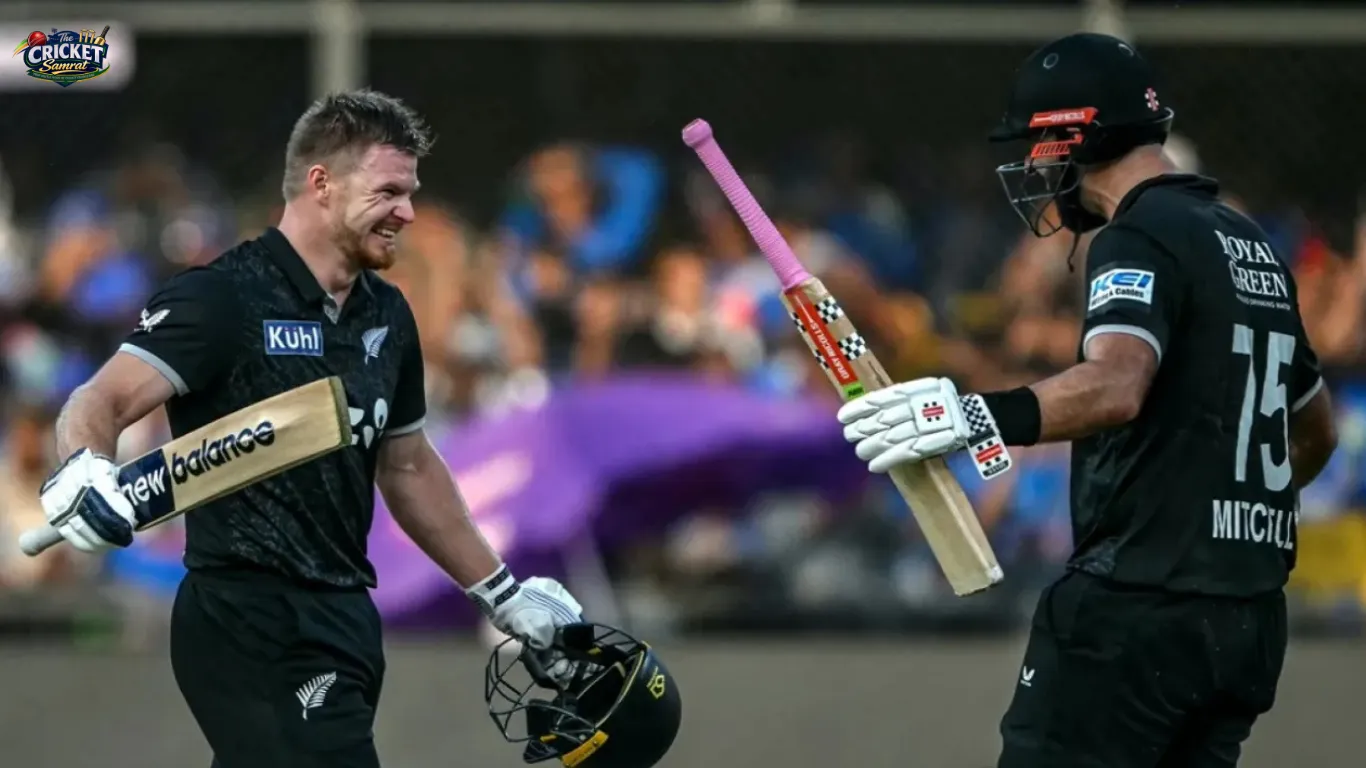
New Zealand vs India Highlights: In a night that will be remembered as one of the most significant milestones in New Zealand’s cricketing history, the Black Caps stunned India by winning their first-ever One Day International (ODI) series on Indian soil. A 41-run victory in the decisive third ODI at the Holkar Stadium sealed the series for New Zealand and ended India’s remarkable unbeaten record at the venue.
Despite a fighting century from Virat Kohli, India fell short while chasing a daunting target of 338, bowled out for 296 in 46 overs. The match, and the series as a whole, showcased New Zealand’s composure, tactical clarity, and collective strength, while also exposing areas of concern for the Indian side ahead of major international tournaments.
This comprehensive report brings you the complete New Zealand vs India Highlights, including detailed match analysis, turning points, player performances, tables, timelines, quotes, and what this historic result means for both teams.
Match Overview: Third ODI, Indore
| Match | 3rd ODI, New Zealand tour of India |
|---|---|
| Venue | Holkar Stadium, Indore |
| Date | January 18, 2026 |
| Result | New Zealand won by 41 runs |
| Series Result | New Zealand won the series 2–1 |
| Toss | India won the toss, elected to bowl |
| Player of the Match | Daryl Mitchell |
| Player of the Series | Daryl Mitchell |
A Series-Defining Night for New Zealand
New Zealand’s triumph was not just about one match. It was about rewriting history. Prior to this series, the Black Caps had never won an ODI series in India, a country where conditions often favor the hosts heavily. Yet, under the calm leadership of captain Michael Bracewell, New Zealand played fearless and intelligent cricket across all three matches.
The third ODI became the ultimate test of temperament. After losing early wickets, New Zealand rebuilt with patience, accelerated with intent, and defended their total with discipline and belief.
New Zealand’s Innings: From Early Trouble to Commanding Total
After being asked to bat first, New Zealand’s start was far from ideal. Arshdeep Singh struck in the opening over, dismissing Henry Nicholls, and Harshit Rana removed Devon Conway soon after. At 58 for 3, India sensed an opportunity to seize control.
That moment, however, marked the beginning of a partnership that would define the match.
The Game-Changing Partnership: Mitchell and Phillips
Daryl Mitchell and Glenn Phillips came together under pressure and produced a masterclass in ODI batting. Their partnership of 219 runs for the fourth wicket not only rescued New Zealand but also put India firmly on the back foot.
| Partnership | Runs | Balls |
| Mitchell–Phillips (4th wicket) | 219 | 188 |
Mitchell played the role of the anchor, rotating strike, punishing loose deliveries, and building his innings steadily. Phillips, on the other hand, brought explosive power, clearing the boundaries with ease once set.
Daryl Mitchell’s Magnificent Century
Mitchell’s innings of 137 runs was a blend of patience and precision. He reached his hundred in 106 balls, marking his second consecutive ODI century in the series.
| Daryl Mitchell Batting Stats | |
| Runs | 137 |
| Balls | 118 |
| Fours | 9 |
| Sixes | 4 |
| Strike Rate | 116.10 |
His ability to read the pitch, counter spin, and pace the innings proved crucial in pushing New Zealand beyond the 330-run mark.
Glenn Phillips’ Explosive Hundred
Phillips provided the fireworks. Returning to the team after an injury layoff, he reminded the cricketing world of his destructive potential.
| Glenn Phillips Batting Stats | |
| Runs | 106 |
| Balls | 83 |
| Fours | 7 |
| Sixes | 6 |
| Strike Rate | 127.71 |
His six-hitting spree, including a towering 75-metre hit, electrified the Indore crowd and swung momentum decisively in New Zealand’s favor.
New Zealand’s Final Score
| Team | Overs | Score |
| New Zealand | 50 | 337/8 |
Late contributions from Michael Bracewell ensured New Zealand finished strongly, setting India a challenging target of 338.
India’s Chase: Promise, Pressure, and Collapse
Chasing 338 at the Holkar Stadium is never easy, but India’s troubles began early. Rohit Sharma and Shubman Gill showed intent but failed to convert starts.
| Indian Top Order Failures | |
| Rohit Sharma | 11 |
| Shubman Gill | 23 |
| Shreyas Iyer | 3 |
| KL Rahul | 1 |
With four wickets down cheaply, the pressure mounted, and the required run rate continued to climb.
Virat Kohli Stands Tall Amid the Collapse
In the midst of chaos, Virat Kohli once again proved why he is regarded as one of the greatest batters of his generation. Holding one end together, Kohli played a courageous innings of 124 runs off 108 balls.
| Virat Kohli Batting Stats | |
| Runs | 124 |
| Balls | 108 |
| Fours | 10 |
| Sixes | 3 |
| Strike Rate | 114.81 |
This was Kohli’s 54th ODI century and the 85th international hundred of his career. It was also his first ODI hundred at the Holkar Stadium.
Despite building crucial partnerships with Nitish Kumar Reddy (53) and Harshit Rana (52), Kohli received little support from the rest of the batting lineup.
Middle-Order Resistance: Reddy and Rana
Nitish Kumar Reddy and Harshit Rana played fearless innings, showing maturity beyond their experience.
| Key Indian Partnerships | |
| Kohli–Reddy | 88 runs |
| Kohli–Rana | 62 runs |
However, once these partnerships were broken, India’s lower order could not sustain the momentum.
New Zealand’s Bowling: Calm Under Pressure
Defending a big total in India is never straightforward, but New Zealand’s bowlers executed their plans with precision.
| New Zealand Bowling Figures | |
| Christian Clarke | 3/52 |
| Jack Foulkes | 3/58 |
| Arshdeep Singh (IND) | 3 wickets |
| Kyle Jamieson | Economical spells |
Christian Clarke and Jack Foulkes shared six wickets between them, breaking key partnerships and ensuring India never fully recovered.
India Bowled Out for 296
| Team | Overs | Score |
| India | 46 | 296 all out |
Kuldeep Yadav was run out on the final ball, sealing New Zealand’s historic 41-run victory.
Captains React: What They Said After the Match
Michael Bracewell (New Zealand Captain)
“Beating India in India for the first time in an ODI series is incredibly special. We are a small country on the world map, but we always play with unity and belief.”
Daryl Mitchell
“Winning in India is something every cricketer dreams of. I try to play according to the ball and conditions. Watching Glenn Phillips score a hundred after returning from injury was very special.”
Shubman Gill (India Captain)
“This defeat is disappointing. After winning the first match, losing the series is not what we wanted. We have areas to improve, but Virat’s batting was truly exceptional.”
Full Playing XIs
India (IND)
| Player |
| Rohit Sharma |
| Shubman Gill (c) |
| Virat Kohli |
| Shreyas Iyer |
| KL Rahul (wk) |
| Ravindra Jadeja |
| Nitish Kumar Reddy |
| Kuldeep Yadav |
| Harshit Rana |
| Mohammed Siraj |
| Arshdeep Singh |
New Zealand (NZ)
| Player |
| Michael Bracewell (c) |
| Devon Conway |
| Will Young |
| Henry Nicholls |
| Daryl Mitchell |
| Glenn Phillips |
| Mitch Hay (wk) |
| Jack Foulkes |
| Kyle Jamieson |
| Christian Clarke |
| Jaden Lennox |
Pitch and Conditions
The Holkar Stadium pitch, made of black soil, was expected to favor batters. Dew played a role in the second innings, but New Zealand’s disciplined bowling neutralized any advantage India hoped to gain.
Weather conditions remained ideal, with clear skies and temperatures ranging from 13°C to 28°C.
What This Means Going Forward
For New Zealand, this series win is a massive confidence booster ahead of upcoming global tournaments. It reinforces their reputation as one of the most adaptable and mentally strong teams in world cricket.
For India, the series exposed vulnerabilities in the top order and middle-order consistency. With the World Cup on the horizon, the team management will need to address these issues quickly.
Conclusion: A Night That Changed History-New Zealand vs India Highlights
The New Zealand vs India Highlights from Indore will be remembered not just for the runs and wickets, but for the significance of the result. New Zealand broke a long-standing barrier, while India were reminded that dominance at home can never be taken for granted.
Cricket, once again, proved that belief, preparation, and execution can overcome even the toughest of challenges.
Stay tuned for more in-depth match analysis, expert opinions, and complete coverage of international cricket.