
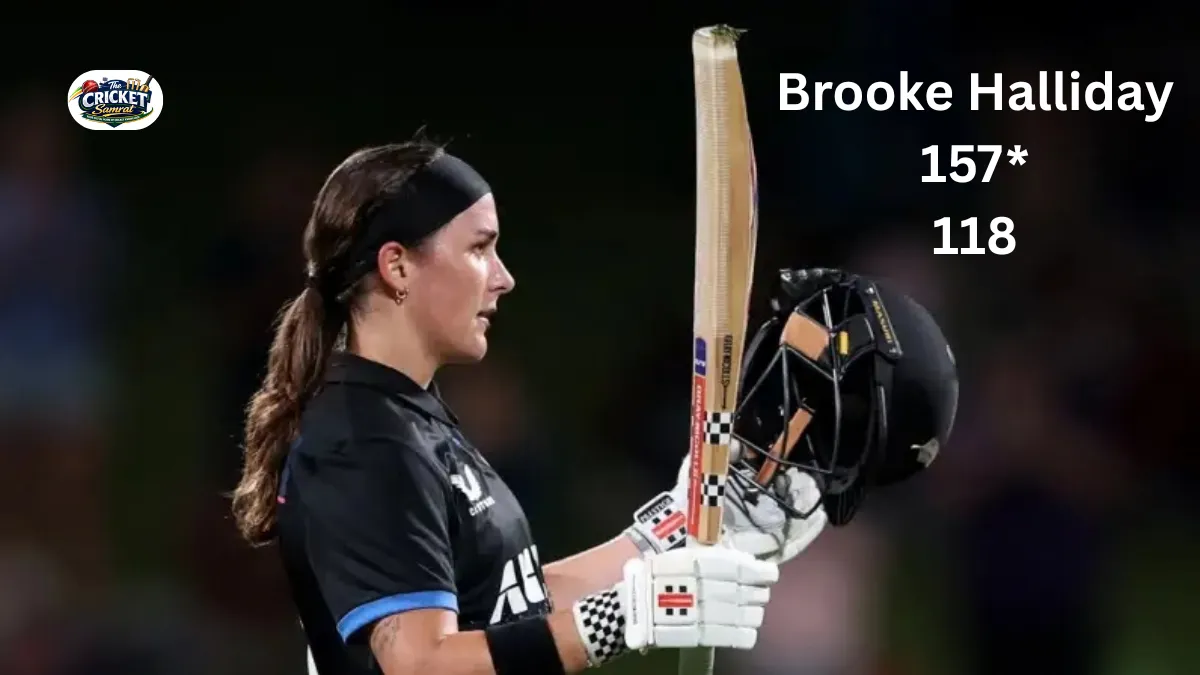
Brooke Halliday delivered the performance of her career as New Zealand began their One-Day International (ODI) series against Zimbabwe with a commanding victory in Dunedin. The New Zealand batter produced a magnificent unbeaten knock of 157 runs, guiding her side to a massive total before the bowlers wrapped up a comprehensive 180-run win.
The hosts finished their innings on 354 for 3 in 50 overs, marking the seventh time New Zealand have crossed the 350-run mark in women’s ODIs. With that total, they matched England for the most 350-plus scores in the format. Zimbabwe, in response, struggled to keep up with the required run rate and were eventually bowled out for 174 in 47.3 overs.
While Kelis Ndhlovu fought hard with a half-century for the visitors, the New Zealand bowling attack led by Amelia Kerr and Jess Kerr proved too strong.
Brooke Halliday’s Career-Best Knock Sets the Tone
The match belonged to Brooke Halliday, whose innings was not only her highest ODI score but also one of the finest individual performances by a New Zealand batter in recent times.
Coming to the crease after the fall of the opening wickets, Halliday built the innings patiently before accelerating dramatically in the later stages. She finished unbeaten on 157 from 118 balls, an innings decorated with 24 boundaries and one six.
Her ability to shift gears at the right time ensured that New Zealand’s scoring rate remained strong throughout the innings.
Brooke Halliday’s Batting Highlights
| Statistic | Performance |
|---|---|
| Runs | 157* |
| Balls Faced | 118 |
| Fours | 24 |
| Sixes | 1 |
| Strike Rate | 133.05 |
The innings showcased Halliday’s balance of composure and aggression. Early on, she rotated the strike effectively and punished loose deliveries. As the innings progressed, she unleashed a series of elegant drives and powerful strokes that kept the scoreboard ticking at a rapid pace.
Solid Start Before Halliday Takes Control
New Zealand were asked to bat first and made a stable start through openers Emma McLeod and Amelia Kerr. The pair put together 48 runs for the first wicket, laying a solid foundation.
Zimbabwe briefly found some momentum by dismissing both openers, but any hope of restricting the hosts quickly disappeared once Halliday settled at the crease.
The middle-order batter formed two crucial partnerships that shaped the innings:
- Century partnership with Maddy Green
- Another hundred-run stand with Isabella Gaze
These partnerships ensured that New Zealand maintained both stability and scoring momentum.
Key Batting Partnerships
| Partnership | Runs Added | Players |
|---|---|---|
| 1st Wicket | 48 | Emma McLeod & Amelia Kerr |
| 3rd Wicket | 100+ | Brooke Halliday & Maddy Green |
| 4th Wicket | 100+ | Brooke Halliday & Isabella Gaze |
Maddy Green played a supporting yet significant role with 67 runs from 80 balls, helping rebuild the innings after the early wickets. Later, Isabella Gaze provided the perfect finishing touch with an aggressive 59 not out off 42 deliveries.
By the end of the 40th over, New Zealand were already well placed at 237 for 3, with Halliday nearing her century on 92 runs.
Explosive Finish in the Final Overs
The final ten overs turned into a nightmare for Zimbabwe’s bowlers. Brooke Halliday and Isabella Gaze launched a brutal assault that added 117 runs in the last phase of the innings.
Gaze displayed impressive intent, smashing 10 boundaries during her quickfire knock. Meanwhile, Halliday continued to dominate with elegant stroke play, finding gaps all around the field.
By the end of the innings, New Zealand had struck 47 boundaries, underlining the aggressive nature of their batting display.
Zimbabwe’s Chase Falls Short
Facing a daunting target of 355 runs, Zimbabwe needed a strong start but lost an early wicket when Jess Kerr dismissed opener Modester Mupachikwa.
However, Kelis Ndhlovu and Chipo Mugeri-Tiripano attempted to rebuild the innings. The pair put together a partnership of 93 runs for the second wicket, which briefly steadied Zimbabwe’s chase.
Despite the solid stand, the partnership came at a slow pace. The two batters consumed 150 deliveries, leaving Zimbabwe with an increasingly difficult run chase.
Zimbabwe’s Key Batting Performances
| Player | Runs | Balls |
|---|---|---|
| Kelis Ndhlovu | 52 | – |
| Chipo Mugeri-Tiripano | – | – |
Ndhlovu eventually reached her half-century but was dismissed shortly after, while Mugeri-Tiripano fell in the 29th over to Molly Penfold.
At 142 for 3 in the 36th over, Zimbabwe still had hope of finishing strongly, but the middle and lower order collapsed under pressure.
Kerr Sisters Lead New Zealand Bowling Attack
Once the partnership was broken, the New Zealand bowlers took complete control of the match.
Amelia Kerr delivered an outstanding spell, claiming 4 wickets for 35 runs, while her sister Jess Kerr picked up 3 wickets for 28 runs.
Their combined efforts dismantled Zimbabwe’s batting line-up and ensured the visitors never got close to the required total.
New Zealand Bowling Figures
| Bowler | Wickets | Runs |
|---|---|---|
| Amelia Kerr | 4 | 35 |
| Jess Kerr | 3 | 28 |
The disciplined bowling attack wrapped up the innings in 47.3 overs, sealing a convincing victory.
Match Summary
| Team | Score |
|---|---|
| New Zealand | 354/3 (50 overs) |
| Zimbabwe | 174 (47.3 overs) |
Top Performers
| Category | Player | Performance |
|---|---|---|
| Best Batter | Brooke Halliday | 157* |
| Supporting Batters | Maddy Green | 67 |
| Isabella Gaze | 59* | |
| Best Bowler | Amelia Kerr | 4/35 |
| Second Best Bowler | Jess Kerr | 3/28 |
Result: New Zealand won by 180 runs
Also read: Halliday’s Brilliant 157* Powers New Zealand to Dominant Win Over Zimbabwe in NZ-W vs ZIM-W ODI
Halliday’s Innings Sets the Tone for the Series
The standout performance from Brooke Halliday not only secured victory for New Zealand but also sent a strong message ahead of the remaining matches in the series.
Her ability to anchor the innings while accelerating in the closing stages demonstrated her growing importance in New Zealand’s batting lineup. With support from players like Maddy Green, Isabella Gaze, and the Kerr sisters, the hosts displayed a well-balanced performance in both batting and bowling.
If Halliday continues this form, New Zealand could look forward to a successful series against Zimbabwe.
The dominant win in Dunedin has given the hosts a 1-0 lead in the ODI series, and with momentum firmly on their side, they will head into the next match full of confidence.