
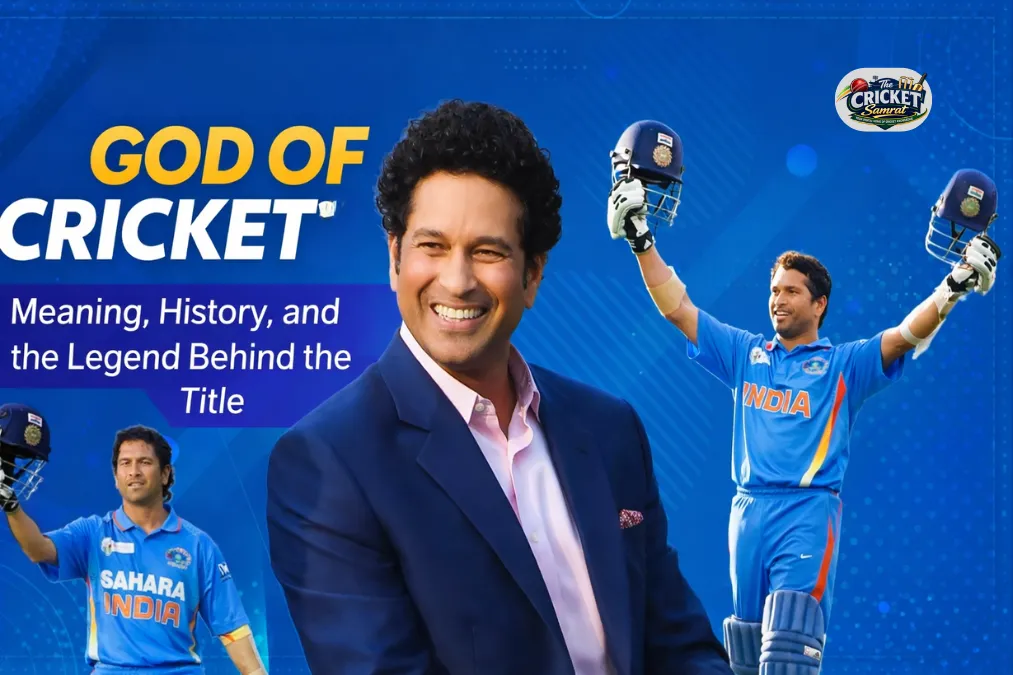
Who is the god of cricket is a question asked by millions of fans around the world. Cricket is not only a sport but a powerful emotion that connects people across nations. Over the decades, many legendary players have played the game, but only one name has earned the divine title that fans use with deep respect and admiration.
This article explains who is the god of cricket, why this title exists, and how one man’s journey turned him into the greatest icon the game has ever known.
What Does “God of Cricket” Mean?
The title “God of Cricket” is not given by the ICC or any cricket board. It is a name created by fans. This title is used for a player whose contribution goes far beyond statistics.
When people ask who is the god of cricket, they mean a cricketer who showed extraordinary skill, long-term consistency, humility, and global influence.
Who Is the God of Cricket?
Sachin Tendulkar Is the God of Cricket
When the question arises about who is the god of cricket, the most common and accepted answer is Sachin Ramesh Tendulkar.
Sachin Tendulkar, the former Indian international cricketer, is universally known as the God of Cricket. His international career lasted from 1989 to 2013, making him one of the longest-serving players in cricket history.
He did not just play cricket; he defined it for an entire generation.
Early Life of Sachin Tendulkar
Sachin Tendulkar was born on April 24, 1973, in Mumbai, India. His passion for cricket started at a very young age. Under the guidance of his coach Ramakant Achrekar, Sachin developed strong discipline and technical perfection.
As a schoolboy, he scored hundreds of runs regularly and created records in school tournaments. His talent was so exceptional that he was selected for the Indian national team at the age of just 16.
His debut against Pakistan in 1989 marked the beginning of a historic journey.
Why Is Sachin Tendulkar Called the God of Cricket?
The answer to who is the god of cricket becomes clear when we understand the reasons behind this title.
Key Reasons Behind the Title
| Reason | Explanation |
|---|---|
| Long Career | Played international cricket for 24 years |
| Consistency | Performed across different eras and formats |
| Records | Holds numerous world records |
| Fan Following | Loved by fans globally |
| Sportsmanship | Known for humility and discipline |
These qualities together made Sachin Tendulkar more than just a great player.
Sachin Tendulkar’s International Career Overview
| Format | Matches | Runs | Centuries |
|---|---|---|---|
| Test | 200 | 15,921 | 51 |
| ODI | 463 | 18,426 | 49 |
| T20I | 1 | 10 | 0 |
| Total | 664 | 34,357 | 100 |
These numbers clearly explain why fans believe who is the god of cricket has only one answer.
Major Records Held by Sachin Tendulkar
Sachin Tendulkar created records that changed cricket history.
| Record | Achievement |
|---|---|
| Most international runs | 34,357 |
| Most international centuries | 100 |
| First double century in ODIs | 200 vs South Africa |
| Most Test matches | 200 |
| First to score 10,000 ODI runs | Yes |
Many of these records still remain unmatched.
Master of All Formats
Sachin Tendulkar dominated every format of cricket. He played Test cricket with patience, ODIs with aggression, and adapted himself when T20 cricket arrived.
His ability to evolve with time is one of the strongest reasons people ask who is the god of cricket even today.
Performance Against Top Teams
Sachin consistently performed against the strongest bowling attacks in the world.
| Team | Memorable Performances |
|---|---|
| Australia | Famous desert storm innings |
| Pakistan | Fearless batting at age 16 |
| England | Multiple overseas centuries |
| South Africa | Double century in ODI |
| Sri Lanka | Numerous match-winning knocks |
Facing legends like McGrath, Akram, Warne, and Pollock, Sachin stood tall.
Emotional Connection With Fans
One major reason behind the title god of cricket is the emotional bond Sachin shared with fans.
When Sachin batted, streets became empty. People believed that as long as he was at the crease, India would not lose.
For many families, cricket viewing meant watching Sachin Tendulkar bat.
Respect From World Cricket
Great players across the world admired him.
| Cricketer | Statement Summary |
|---|---|
| Shane Warne | Called Sachin the toughest batsman |
| Brian Lara | Respected his consistency |
| Ricky Ponting | Considered him the benchmark |
| Wasim Akram | Praised his technique |
| Jacques Kallis | Called him a complete batsman |
Such respect from rivals further proves who is the god of cricket.
Awards and Honors
Sachin Tendulkar received numerous honors.
| Award | Year |
|---|---|
| Bharat Ratna | 2014 |
| Padma Vibhushan | 2008 |
| Padma Shri | 1999 |
| ICC Cricketer of the Year | 2010 |
| Wisden Cricketer of the Year | 1997 |
He became the first sportsperson to receive the Bharat Ratna.
Impact on Indian Cricket
Before Sachin Tendulkar, Indian cricket struggled overseas. During his career, India became a strong global team.
He inspired players like:
- Virat Kohli
- MS Dhoni
- Rohit Sharma
- Yuvraj Singh
- Rahul Dravid
Many of them have openly said that Sachin motivated them to become cricketers.
Comparison With Other Cricket Legends
| Player | Country | Special Achievement |
|---|---|---|
| Sachin Tendulkar | India | 100 international centuries |
| Don Bradman | Australia | Test average 99.94 |
| Brian Lara | West Indies | 400* in Tests |
| Jacques Kallis | South Africa | Greatest all-rounder |
| Virat Kohli | India | Modern-era dominance |
While many legends exist, the emotional and global impact of Sachin keeps him above all.
Is Don Bradman the God of Cricket?
Sir Don Bradman is statistically the greatest batsman in history. However, the title “God of Cricket” is mostly linked to Sachin Tendulkar because:
- Bradman played in one era only
- Cricket had limited global reach then
- Sachin played across generations
- Sachin inspired billions worldwide
That is why fans still say who is the god of cricket has only one name.
Retirement and Historic Farewell
Sachin Tendulkar retired in 2013 after his 200th Test match at Wankhede Stadium, Mumbai.
His farewell speech moved the entire nation. Even opponents applauded him. It was not just the retirement of a player but the end of a golden era.
Life After Retirement
After retirement, Sachin continued serving cricket and society.
| Area | Contribution |
|---|---|
| Mentorship | Guides young cricketers |
| Charity | Supports social causes |
| IPL | Mentor roles |
| Global Cricket | Promotes the sport worldwide |
His influence continues even without holding a bat.
Why the Title Will Never Fade
Even years after his retirement, the question who is the god of cricket remains unchanged.
New records may be broken, new stars may rise, but the emotional connection Sachin created cannot be repeated.
He carried the hopes of a nation and delivered with grace.
Also read: Cricket India vs West Indies: Complete History, Rivalry, Records, and Memorable Moments
Conclusion: Who Is the God of Cricket?
So, who is the god of cricket?
The answer is Sachin Ramesh Tendulkar.
He earned this title through unmatched records, legendary consistency, respect from the cricketing world, and the love of millions of fans.
The God of Cricket is not defined only by numbers but by legacy.
Sachin Tendulkar will forever remain the greatest symbol of cricket history, a name that generations will remember whenever the game is played.