
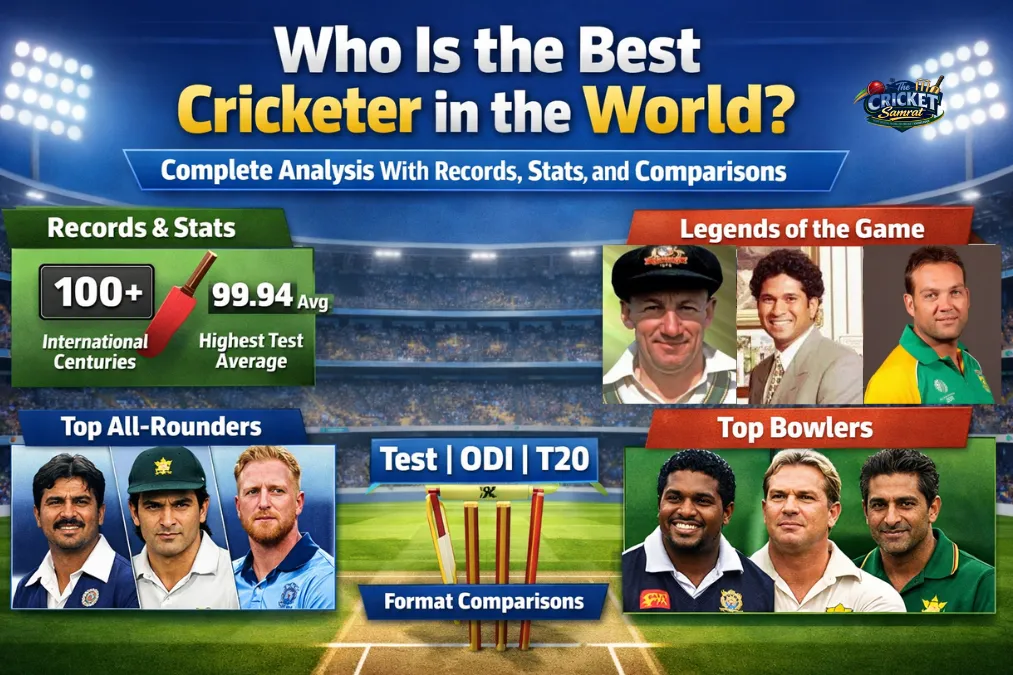
Who is the best cricketer in the world is one of the most common and emotional questions among cricket fans. From street cricket discussions to expert television panels, this topic never loses interest. Cricket has produced many legends across generations, and every era has seen players who dominated the game in their own style.
Because cricket is played in different formats, conditions, and countries, deciding the best cricketer is not simple. Some players shine in Test cricket, others dominate limited-overs formats, while a few perform exceptionally well in all three formats.
This article explains the question in a simple and clear way by comparing legends, modern stars, statistics, formats, and impact on the game.
What Does “Best Cricketer” Really Mean?
Before answering who is the best cricketer in the world, we must understand what makes a player truly great.
A best cricketer is judged on:
Consistency over many years
Performance in pressure situations
Ability to play in all conditions
Success across formats
Match-winning contributions
Records and achievements
Mental strength and leadership
Only players who excel in most of these areas earn a place among the greatest.
Evolution of Cricket Over Time
Cricket has changed significantly over the decades.
Earlier, players focused mainly on Test cricket. Today, cricketers must adapt to Tests, ODIs, and T20Is. The rise of franchise leagues, fitness standards, technology, and aggressive batting has increased competition like never before.
This evolution makes comparisons across eras difficult but also more interesting.
Greatest Cricketers of All Time
Legendary Players From the Past
Some cricketers left such a deep mark that their names are still discussed decades later.
Sir Don Bradman
Sir Don Bradman is often considered the greatest batsman in cricket history. His batting average of 99.94 in Test cricket remains unmatched.
Sachin Tendulkar
Sachin Tendulkar is one of the strongest answers to who is the best cricketer in the world. He played international cricket for 24 years and faced every great bowler of his era.
Jacques Kallis
Jacques Kallis was one of the most complete all-rounders ever. His ability to contribute with both bat and ball makes him unique.
Career Overview of Legendary Players
| Player | Country | Matches | Runs | Wickets | Special Achievement |
|---|---|---|---|---|---|
| Don Bradman | Australia | 52 Tests | 6,996 | – | Test average 99.94 |
| Sachin Tendulkar | India | 664 | 34,357 | 201 | 100 international centuries |
| Jacques Kallis | South Africa | 519 | 25,534 | 577 | Greatest modern all-rounder |
| Brian Lara | West Indies | 430 | 22,358 | – | Highest Test score 400* |
Modern Era Superstars
The modern generation has produced exceptional players who dominate world cricket.
Virat Kohli
Virat Kohli is widely regarded as the best cricketer in the world in the modern era. His consistency across formats, fitness discipline, and hunger for runs set him apart.
He has scored centuries in almost every cricket-playing nation and has dominated both fast and spin bowling.
Kane Williamson
Kane Williamson is known for his calm temperament and textbook batting technique. He has delivered outstanding performances in difficult overseas conditions.
Joe Root
Joe Root has been England’s most dependable batsman in Test cricket for many years, especially during overseas tours.
Steve Smith
Steve Smith is considered one of the greatest Test batsmen of all time due to his extraordinary average and concentration.
Comparison of Modern Greats
| Player | Country | Test Avg | ODI Avg | T20I Avg | Strength |
|---|---|---|---|---|---|
| Virat Kohli | India | 49+ | 57+ | 51+ | All-format dominance |
| Steve Smith | Australia | 58+ | 43+ | 26+ | Test mastery |
| Kane Williamson | New Zealand | 54+ | 47+ | 33+ | Technique and leadership |
| Joe Root | England | 50+ | 47+ | 35+ | Consistency |
Performance Across Formats
To decide who is the best cricketer in the world, performance in all formats is extremely important.
Test Cricket
Test cricket checks patience, technique, and temperament. Players like Bradman, Smith, Tendulkar, Root, and Williamson have excelled here.
One Day Internationals
ODI cricket requires balance between aggression and stability. Sachin Tendulkar and Virat Kohli are considered among the greatest ODI batsmen ever.
T20 Internationals
T20 cricket demands innovation and fearlessness. Modern players must adapt quickly to this fast format.
All-Format Greats
| Player | Tests | ODIs | T20Is | Successful in All Formats |
|---|---|---|---|---|
| Sachin Tendulkar | Yes | Yes | Limited | Yes |
| Virat Kohli | Yes | Yes | Yes | Yes |
| Jacques Kallis | Yes | Yes | Limited | Yes |
| Kane Williamson | Yes | Yes | Yes | Yes |
Greatest All-Rounders in Cricket History
All-rounders add balance and depth to teams.
Famous All-Rounders
| Player | Country | Runs | Wickets | Key Strength |
|---|---|---|---|---|
| Jacques Kallis | South Africa | 25,534 | 577 | Complete all-rounder |
| Imran Khan | Pakistan | 7,516 | 544 | Fast-bowling all-rounder |
| Kapil Dev | India | 9,031 | 687 | Match-winner |
| Ben Stokes | England | 10,000+ | 300+ | Big-match performer |
Among all-rounders, Jacques Kallis is often included in discussions about who is the best cricketer in the world due to his unmatched balance.
Greatest Bowlers in World Cricket
Bowlers also play a major role in shaping cricket history.
Legendary Bowlers
| Bowler | Country | Test Wickets | Specialty |
|---|---|---|---|
| Muttiah Muralitharan | Sri Lanka | 800 | Spin |
| Shane Warne | Australia | 708 | Leg-spin |
| Wasim Akram | Pakistan | 916 Intl | Swing |
| Glenn McGrath | Australia | 563 | Accuracy |
While batsmen dominate popularity, bowlers often decide matches.
Impact Beyond Statistics
Statistics alone cannot define greatness.
Some players changed the way cricket is played. Others inspired millions to pick up the sport.
Sachin Tendulkar became a symbol of hope for Indian cricket.
Virat Kohli redefined fitness standards.
MS Dhoni changed leadership thinking.
Imran Khan transformed Pakistan cricket culture.
Such influence plays a major role in determining who is the best cricketer in the world.
Also read: What Is a Diamond Duck in Cricket? Complete Meaning, Rules, Examples, and Facts
Leadership and Captaincy Factor
Great players often become great captains.
| Captain | Country | Major Achievement |
|---|---|---|
| MS Dhoni | India | All ICC trophies |
| Ricky Ponting | Australia | World Cup wins |
| Imran Khan | Pakistan | 1992 World Cup |
| Kane Williamson | New Zealand | World Test Championship |
Leadership adds another strong dimension to a cricketer’s legacy.
So, Who Is the Best Cricketer in the World?
There is no single answer that satisfies everyone.
If statistics matter most, Sir Don Bradman stands unmatched.
If longevity and consistency matter, Sachin Tendulkar remains supreme.
If modern dominance across formats is considered, Virat Kohli leads the race.
If all-round excellence is valued, Jacques Kallis stands tallest.
Each generation has its own hero.
Also read: How Many Players in Cricket: Complete Guide to Team Size, Roles, and Match Formats
Conclusion:
The debate about who is the best cricketer in the world will never truly end, and that is the beauty of cricket. The game continues to evolve, and new stars emerge with every generation.
What remains constant is the passion of fans and the legacy left by legends who shaped world cricket.
Whether it is Bradman’s average, Sachin’s centuries, Kohli’s consistency, or Kallis’s all-round brilliance, each has contributed something unforgettable to the sport.
Cricket does not belong to one player or one era. It belongs to every legend who made the game richer, stronger, and more loved across the world.