
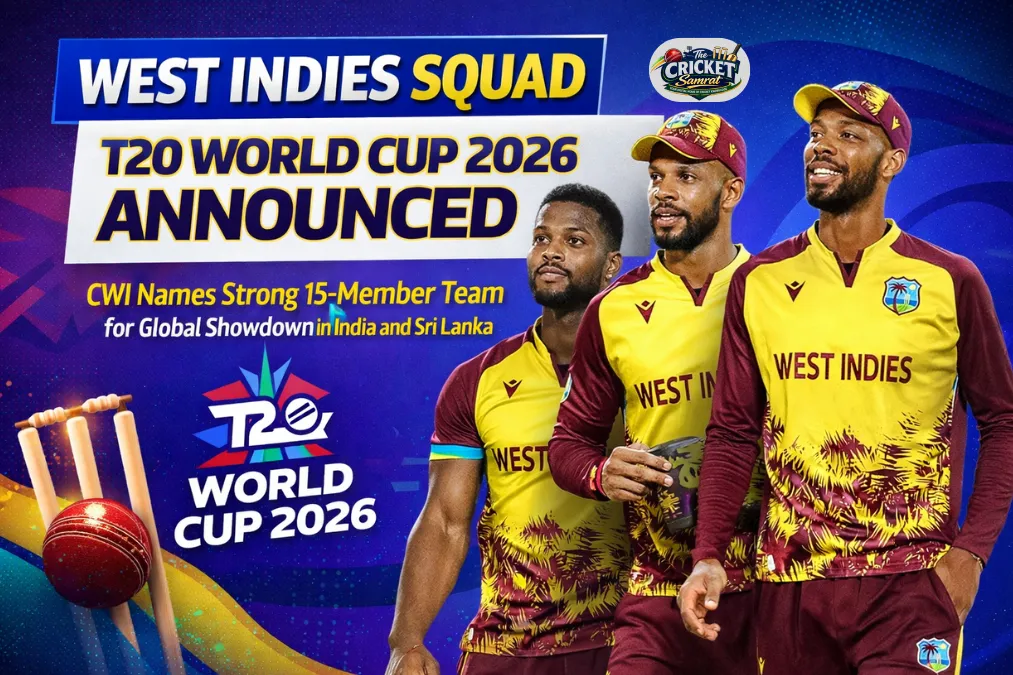
Cricket West Indies (CWI) has officially unveiled the West Indies Squad T20 World Cup 2026, naming a 15-member group set to compete in the ICC Men’s T20 World Cup scheduled to be held across India and Sri Lanka from February 6 to March 9, 2026. The announcement marks a crucial milestone in the Caribbean side’s preparations for one of the most competitive global tournaments in modern cricket.
Following months of evaluations, performance reviews, and strategic planning, selectors have assembled a squad designed to balance experience with adaptability—two qualities considered essential for success in the demanding conditions of the subcontinent. With spin-friendly surfaces, high-pressure environments, and intense competition expected, the selected group reflects a clear tactical vision from the West Indies think tank.
Strategic Selection After Extended Assessment Period
According to Cricket West Indies, the selection process involved an extended assessment phase that looked beyond raw statistics. Player fitness, versatility, recent form, and suitability for Asian conditions were all carefully weighed before final decisions were made. The goal was not merely to field a competitive team, but to build a squad capable of maintaining consistency throughout the tournament.
Head coach Daren Sammy, a two-time T20 World Cup–winning captain with West Indies in 2012 and 2016, emphasized that the squad reflects long-term planning rather than short-term experimentation. Sammy noted that understanding conditions in India and Sri Lanka, particularly the importance of spin control, smart powerplay execution, and death-over efficiency, played a central role in shaping the final list.
Leadership Group Confident of Strong Tournament Run
Captain Shai Hope, who will lead the side at the global event, expressed pride in representing the region on cricket’s biggest T20 stage. Hope highlighted the team’s collective belief and unity, stating that the group is fully aware of the responsibility that comes with wearing West Indies colors at a World Cup.
The leadership group, supported by senior players such as Jason Holder, Roston Chase, and Rovman Powell, is expected to provide calm direction during high-pressure moments. Their experience in franchise leagues around the world is seen as a valuable asset, particularly in adapting to different match situations.
Key Inclusions and Player Updates
Several selections in the West Indies Squad T20 World Cup 2026 have drawn attention for their strategic significance.
Left-arm spinner Gudakesh Motie makes a return to the squad with renewed confidence after completing a valuable development stint in South Africa, including involvement around the SA20 competition. His improved control and ability to extract turn on slower surfaces make him a vital option in subcontinental conditions.
Veteran batter Johnson Charles has been named as the backup wicketkeeper. Selectors highlighted his international experience and proven powerplay hitting as key reasons for inclusion, noting that he also provides cover as an opening batter if required.
Middle-order depth has been strengthened with the inclusion of Quentin Sampson, who offers flexibility and stability during the crucial middle overs.
Fast bowler Alzarri Joseph continues his return-to-play journey following injury. While he has made encouraging progress, he has not yet received full clearance for high-intensity competition. CWI confirmed that Joseph will remain under close supervision of the medical and performance teams, with decisions guided strictly by player welfare.
Final Preparations Before the World Cup
As part of their final build-up, the West Indies squad assembled in South Africa for a three-match T20 International series against the Proteas, scheduled from January 27 to January 31. The series is being treated as a key rehearsal, allowing the coaching staff to finalize combinations and test strategies ahead of the World Cup opener.
The matches will also provide valuable exposure to high-quality opposition, helping players fine-tune their roles under match conditions.
West Indies Squad T20 World Cup 2026 – Full Player List
Below is the complete West Indies Squad for the ICC Men’s T20 World Cup 2026, presented in a clear table format for easy reference:
| Player Name | Role |
|---|---|
| Shai Hope | Captain / Top-order Batter |
| Johnson Charles | Wicketkeeper-Batter |
| Roston Chase | All-rounder |
| Matthew Forde | Fast Bowling All-rounder |
| Shimron Hetmyer | Middle-order Batter |
| Jason Holder | All-rounder |
| Akeal Hosein | Left-arm Spinner |
| Shamar Joseph | Fast Bowler |
| Brandon King | Top-order Batter |
| Gudakesh Motie | Left-arm Spinner |
| Rovman Powell | Middle-order Batter |
| Sherfane Rutherford | Batting All-rounder |
| Quentin Sampson | Middle-order Batter |
| Jayden Seales | Fast Bowler |
| Romario Shepherd | Bowling All-rounder |
This squad offers a balanced mix of pace, spin, power-hitting, and all-round depth—elements that have traditionally defined West Indies’ success in the shortest format.
Team Management and Support Staff
Strong off-field support remains a cornerstone of West Indies’ campaign. Cricket West Indies has confirmed a comprehensive management and support unit to back the players throughout the tournament.
West Indies Team Management Unit
| Staff Member | Role |
|---|---|
| Rawl Lewis | Team Manager |
| Daren Sammy | Head Coach |
| Floyd Reifer | Assistant Coach (Batting) |
| Ravi Rampaul | Assistant Coach (Bowling) |
| Rayon Griffith | Assistant Coach (Fielding) |
| Dr Denis Byam | Physiotherapist |
| Darc Browne | Strength & Conditioning Coach |
| Fitzbert Alleyne | Massage Therapist |
| Dr Akshai Mansingh | Team Doctor |
| Avenesh Seetaram | Performance Analyst |
| Jerome Foster | Content & Media Officer |
The presence of experienced former internationals within the coaching setup is expected to play a crucial role in guiding players through the pressures of a global tournament.
Also read: Scotland Squad T20 World Cup 2026 Announced Amid Visa Uncertainty Over Safyaan Sharif
Conditions in India and Sri Lanka: A Tactical Challenge
Playing the T20 World Cup across India and Sri Lanka presents unique challenges. Slow pitches, variable bounce, and the importance of spin bowling are expected to influence match outcomes significantly. West Indies’ selection of multiple spin options, combined with seamers capable of using cutters and variations, reflects an awareness of these demands.
Batters, meanwhile, will need to balance aggression with smart shot selection—an area the coaching staff has reportedly emphasized during preparation camps.
Also read: ICC Men’s T20 World Cup 2026 Schedule: Full Details, Venues, and Key Fixtures
Expectations and Legacy
West Indies remains the only team to have won the ICC Men’s T20 World Cup twice, and expectations are naturally high whenever the Caribbean side enters the tournament. While recent years have seen mixed results, the West Indies Squad T20 World Cup 2026 represents a renewed attempt to restore the team’s reputation as a formidable force in global T20 cricket.
With experienced leadership, emerging talent, and a carefully planned support system, West Indies will aim not just to compete, but to make a deep and meaningful run in the tournament.
As the countdown to February begins, fans across the Caribbean and beyond will be watching closely, hopeful that the men in maroon can once again light up the world stage with their trademark flair and resilience.