
Vijay hazare trophy vaibhav suryavanshi: The Vijay Hazare Trophy once again delivered a gripping day of domestic cricket, packed with big names, record-equalling performances, dramatic moments, and emerging talent making headlines. From Virat Kohli’s blistering half-century for Delhi against Gujarat to Rohit Sharma’s shocking first-ball dismissal, from Rinku Singh’s commanding century for Uttar Pradesh to Dhruv Shorey’s historic consistency, the tournament underlined why India’s premier List-A competition remains a critical platform for both established stars and future icons.
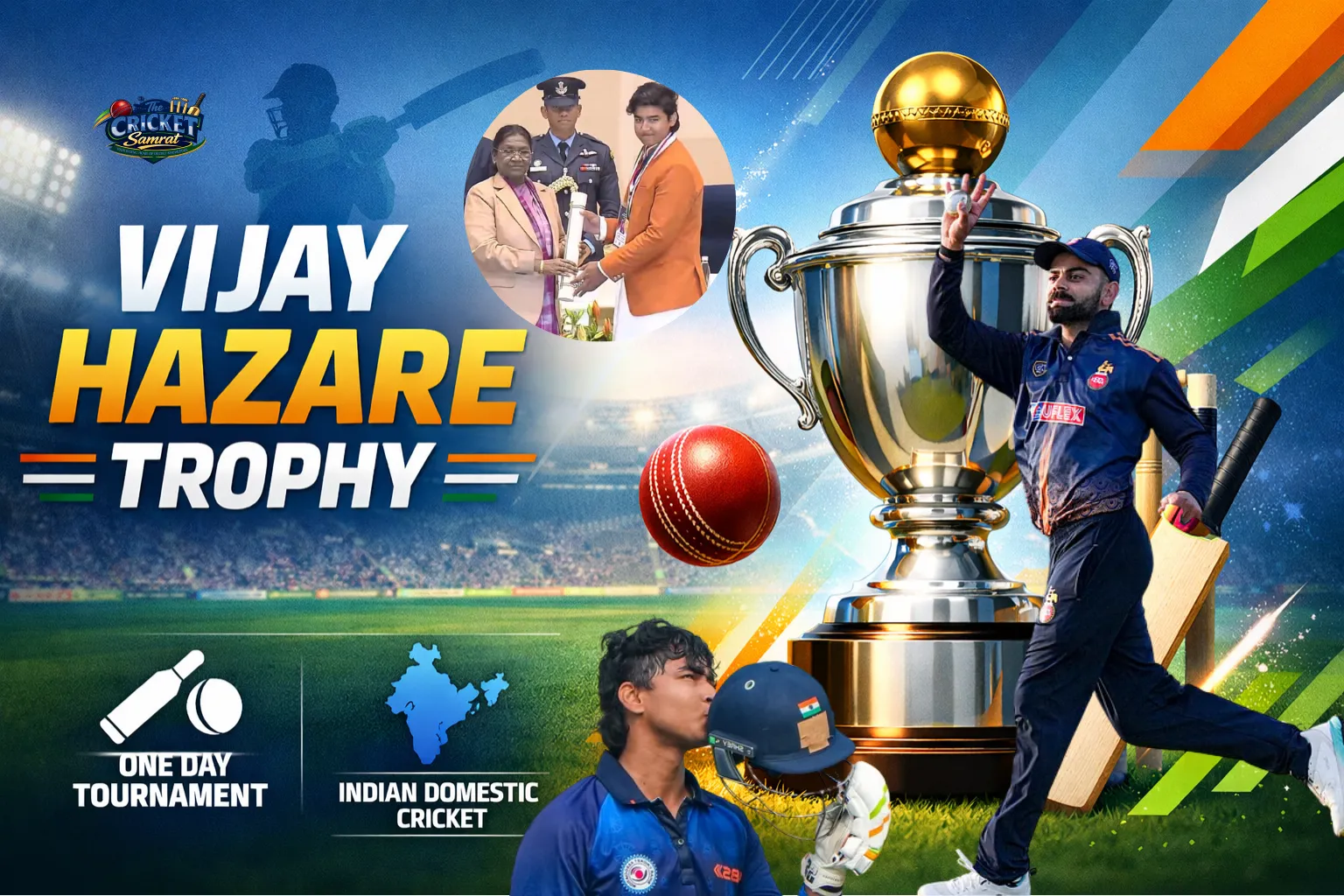
Amid these performances, young prodigy Vaibhav Suryavanshi drew national attention despite not taking the field, as the 14-year-old travelled to Delhi to receive the prestigious Prime Minister’s National Child Award-an achievement that added a proud chapter to his rapidly growing cricketing journey. The story of Vijay hazare trophy vaibhav suryavanshi became one of inspiration beyond runs and wickets.
Virat Kohli’s Explosive Knock Powers Delhi Past Gujarat
Playing for Delhi in a Group D fixture at the Centre of Excellence in Bengaluru, Virat Kohli delivered a reminder of his enduring class with an aggressive and assured innings against Gujarat. After Gujarat won the toss and chose to bowl, Delhi found themselves under early pressure when opener Priyansh Arya was dismissed for just two runs.
Kohli walked in with intent and immediately seized control of the innings. Mixing classical strokeplay with modern aggression, the former India captain smashed 77 runs off 61 balls, including 11 boundaries and one towering six. More striking was the pace of his scoring-Kohli raced to his half-century in just 29 deliveries, electrifying the crowd and putting Gujarat’s bowling attack under sustained pressure.
His partnership-building ability once again came to the fore as he stabilized the innings and ensured Delhi recovered from their shaky start. Kohli’s dismissal eventually slowed momentum slightly, but the platform he created proved decisive.
Captain Rishabh Pant played a crucial supporting role, scoring 70 runs from 79 balls, while Harsh Tyagi added valuable lower-order runs with a 40-run contribution off 47 deliveries. Delhi closed their innings at 254 for 9 in the allotted 50 overs-a competitive total given the early setbacks.
In response, Gujarat mounted a spirited chase but fell agonizingly short. Despite resistance from the middle order, the team was bowled out for 247 runs in 47.4 overs, handing Delhi a hard-fought seven-run victory. The match reaffirmed Kohli’s importance in domestic cricket and highlighted the depth of India’s List-A talent pool.
Rohit Sharma Shocked by First-Ball Dismissal in Jaipur
While Kohli flourished in Bengaluru, a contrasting moment unfolded in Jaipur during the Group C encounter between Mumbai and Uttarakhand. Uttarakhand won the toss and elected to field, and the decision paid off immediately in dramatic fashion.
Mumbai skipper Rohit Sharma was dismissed on the very first ball of the innings, registering a rare golden duck. The unexpected dismissal sent a ripple of surprise through the stadium, as fans watched one of India’s most prolific limited-overs batters return to the pavilion without scoring.
Despite the early blow, Mumbai’s batting lineup showcased remarkable resilience. Musheer Khan and Sarfaraz Khan steadied the innings with identical scores of 55, absorbing pressure and rebuilding after Rohit’s exit. The standout performance, however, came from Hardik Tomar, who played a sensational unbeaten knock of 93 runs from 82 balls. His innings was a blend of composure and controlled aggression, ensuring Mumbai maintained a strong run rate throughout.
Mumbai finished their innings at an imposing 331 for 7 in 50 overs, setting Uttarakhand a daunting target.
Uttarakhand responded with determination, led by Yuvraj Chaudhary’s impressive 96 and J Suchith’s solid half-century. However, disciplined bowling from Mumbai restricted their progress. Shardul Thakur, Omkar Tarmale, and Musheer Khan each picked up two wickets, applying pressure at key moments. Uttarakhand ultimately fell short, managing 280 for 9 at the end of 50 overs, handing Mumbai a comfortable victory.
Injury Scare for Angkrish Raghuvanshi During Fielding
The Jaipur match also witnessed a concerning moment when Mumbai fielder Angkrish Raghuvanshi suffered an injury while attempting a catch near the deep midwicket boundary. Diving forward in an effort to complete the catch, Raghuvanshi landed awkwardly, injuring his shoulder and head.
Medical staff rushed to his aid, and he was taken off the field on a stretcher before being shifted to a hospital in Jaipur for further evaluation. While official details regarding the extent of his injuries were not immediately released, the incident cast a shadow over an otherwise positive day for Mumbai.
Rinku Singh and Aryan Juyal Dominate as Uttar Pradesh Crush Chandigarh
In Rajkot, Group B action delivered a one-sided contest as Uttar Pradesh registered a commanding 227-run victory over Chandigarh. After winning the toss, Chandigarh opted to bowl, a decision that quickly backfired as UP’s batters unleashed a relentless assault.
Captain Rinku Singh led from the front with a breathtaking unbeaten century. Batting with authority and clarity, Rinku smashed 106 runs off just 60 balls, peppering the boundary and dismantling the bowling attack with ease. At the other end, Aryan Juyal played an equally vital role, compiling a composed yet commanding 134 runs from 118 balls.
The duo’s partnership laid the foundation for an imposing total, with Uttar Pradesh finishing at 367 for 4 in 50 overs. Tarunpreet Singh was the lone bright spot for Chandigarh’s bowlers, picking up two wickets.
Chandigarh’s chase never gained momentum. The batting lineup crumbled under sustained pressure, and the team was bowled out for just 140 runs well before the 30-over mark. Captain Manan Vohra top-scored with 32, but lacked support from the rest of the lineup. For Uttar Pradesh, Zeeshan Ansari starred with the ball, claiming four wickets to seal a dominant victory.
Rinku Singh’s performance further strengthened his reputation as one of the most destructive middle-order batters in Indian domestic cricket.
Dhruv Shorey Equals Historic Record with Fifth Consecutive Century
Another standout performance in Rajkot came from Vidarbha’s Dhruv Shorey, who etched his name into the record books during a Group match against Hyderabad. Shorey produced a sublime unbeaten 109 off 77 balls, showcasing exceptional consistency and shot selection.
With this knock, Shorey became only the second player in List-A cricket history to score centuries in five consecutive matches, equalling a record previously set by Tamil Nadu’s Narayan Jagadeesan. His innings featured nine fours and six sixes, propelling Vidarbha to a formidable total of 365 for 5 in 50 overs.
This century was Shorey’s eighth in List-A cricket and his fifth in succession, underlining a golden run of form that began toward the end of the previous season. Vidarbha went on to win the match by 89 runs, further cementing their position in the group standings.
Jagadeesan had achieved his record during the 2022–23 Vijay Hazare Trophy, a season in which he also recorded the highest individual score in List-A cricket-277 runs against Arunachal Pradesh. Shorey’s achievement places him in elite company and signals his readiness for higher honours.
Vijay Hazare Trophy Vaibhav Suryavanshi: A Young Star Honoured by the Nation
One of the most inspiring stories of the day did not involve runs or wickets. Fourteen-year-old cricket sensation Vaibhav Suryavanshi was absent from his team’s match against Manipur in Ranchi, but for a reason that filled fans with pride.
Vaibhav travelled to New Delhi to attend a ceremony at Rashtrapati Bhavan, where he was honoured with the Prime Minister’s National Child Award. This prestigious recognition is the country’s highest civilian honour for children, awarded to young individuals who demonstrate exceptional talent, bravery, or service to society.
For Vaibhav Suryavanshi, receiving this award marked a milestone moment in his young career. Widely regarded as one of the most promising teenage cricketers in the country, Vaibhav has already made headlines with his performances at the junior and domestic levels. His journey, now intertwined with national recognition, has made the phrase Vijay hazare trophy vaibhav suryavanshi resonate far beyond the cricketing world.
While he missed the match due to the ceremony, his absence was felt only briefly; his presence in Indian cricket’s future appears inevitable.
Read also: Australia v England: Bowling Dominates as 20 Wickets Fall on Dramatic Day One of Melbourne Test
Gill and Abhishek Sharma Miss Punjab Clash
In another notable development, Punjab took the field without two of their prominent players, Shubman Gill and Abhishek Sharma, for their match against Chhattisgarh in Jaipur. In their absence, Prabhsimran Singh assumed the captaincy role.
Punjab’s lineup featured Salil Arora, Naman Dhir, and Ramandeep Singh, as the team looked to adjust its strategy without two key batters. The decision sparked discussions among fans and analysts, highlighting the depth and rotation strategies often employed in the Vijay Hazare Trophy.
A Tournament That Reflects India’s Cricketing Depth
The latest round of matches in the Vijay Hazare Trophy showcased everything that makes the tournament special-international superstars delivering match-winning performances, emerging players grabbing their opportunities, records being equalled, and young talents being celebrated at the national level.
Virat Kohli’s aggressive return to domestic cricket, Rohit Sharma’s rare failure, Rinku Singh’s dominance, Dhruv Shorey’s historic consistency, and the inspiring journey of Vaibhav Suryavanshi collectively highlighted the depth and diversity of Indian cricket.
As the tournament progresses, fans can expect more compelling narratives, fierce competition, and moments that shape the future of the sport. For now, the spotlight remains firmly on performances and personalities that continue to make the Vijay Hazare Trophy one of the most watched and respected domestic tournaments in the cricketing world.