
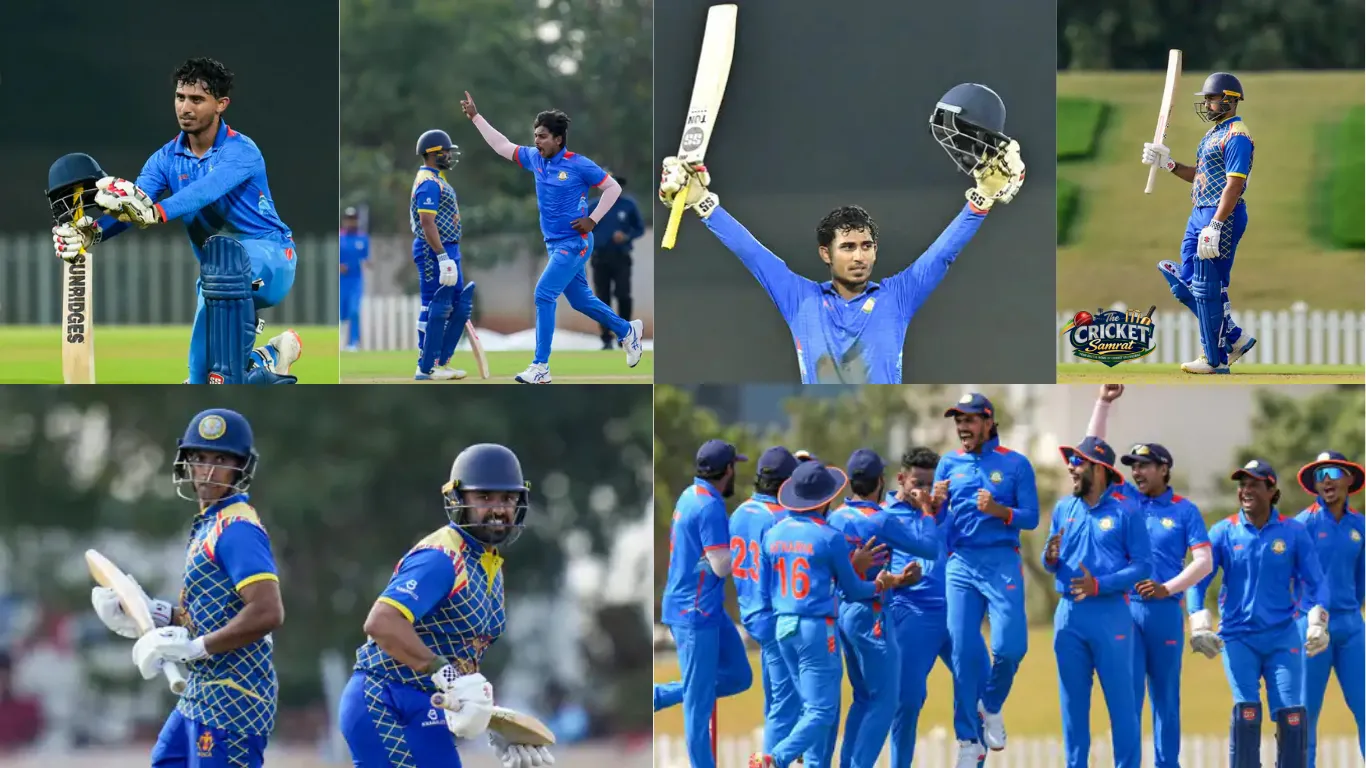
Vijay hazare trophy match: Vidarbha produced a commanding all-round performance to book their place in the Vijay Hazare Trophy final for only the second time in history, defeating five-time champions Karnataka by six wickets in a high-intensity semi-final encounter on Thursday. The Vijay hazare trophy match, played at the BCCI Centre of Excellence Ground in Bengaluru, showcased Vidarbha’s growing dominance in India’s premier domestic one-day tournament.
The highlight of the contest was a magnificent century by Aman Mokhade, whose match-winning knock guided Vidarbha to a comfortable chase of a competitive total. Earlier, a brilliant five-wicket haul by Darshan Nalkande dismantled Karnataka’s batting order and laid the foundation for Vidarbha’s memorable victory.
With this win, Vidarbha repeated their achievement from the 2024–25 season, once again reaching the final and reinforcing their reputation as one of the most consistent teams in the tournament.
Karnataka’s Batting Effort Ends at 280 After Promising Start
Karnataka captain Mayank Agarwal won the toss and opted to bat first, hoping to put scoreboard pressure on Vidarbha in this crucial Vijay hazare trophy match. However, despite moments of resilience, Karnataka were bowled out for 280 runs in 49.4 overs, falling just short of a total that could have truly tested the Vidarbha batting lineup.
Early Setbacks for Karnataka
The five-time champions suffered an early collapse that immediately shifted momentum in Vidarbha’s favor. Skipper Mayank Agarwal departed cheaply after scoring just 9 runs, while in-form opener Devdutt Padikkal was dismissed for a disappointing 4 runs.
With two early wickets lost, Karnataka found themselves under pressure, and it was then that Karun Nair stepped up to anchor the innings.
Karun Nair’s Composed 76 Rescues Karnataka
Karun Nair once again proved why he is regarded as one of Karnataka’s most dependable batters in pressure situations. Playing with maturity and composure, Nair crafted a vital 76-run innings off 90 balls, striking 8 boundaries and one six.
He first stitched together a steady partnership with Dhruv Prabhakar, who contributed 28 runs, helping Karnataka stabilize after the early collapse.
Key Partnerships That Lifted Karnataka
After three wickets fell for just 74 runs, Karnataka desperately needed a solid partnership—and they found one in the form of Karun Nair and Krishnan Sreejith.
The duo added 113 runs for the fourth wicket, shifting the momentum back towards Karnataka.
Sreejith’s Impactful Half-Century
Krishnan Sreejith played an aggressive yet controlled knock, scoring 54 runs from 53 balls, including 7 fours. His ability to rotate the strike and find boundaries at crucial moments allowed Karnataka to rebuild and aim for a competitive total.
Lower-Order Contributions Push Karnataka to 280
Following the dismissal of Karun Nair, Karnataka’s middle and lower order ensured the team crossed the 275-run mark.
- Shreyas Gopal played a useful cameo, scoring 36 runs off 39 balls
- Abhinav Manohar added a valuable 26 runs off 33 balls
These contributions helped Karnataka reach 280, a total that looked defendable on a good batting surface.
Karnataka Batting Score Summary
| Batter | Runs | Balls | Fours | Sixes |
|---|---|---|---|---|
| Karun Nair | 76 | 90 | 8 | 1 |
| Krishnan Sreejith | 54 | 53 | 7 | 0 |
| Shreyas Gopal | 36 | 39 | 2 | 1 |
| Abhinav Manohar | 26 | 33 | 2 | 0 |
| Dhruv Prabhakar | 28 | 41 | 3 | 0 |
| Mayank Agarwal | 9 | 14 | 1 | 0 |
| Devdutt Padikkal | 4 | 7 | 1 | 0 |
Darshan Nalkande’s Five-Wicket Haul Turns the Match
Vidarbha’s bowling attack was led brilliantly by Darshan Nalkande, who delivered one of the finest spells of the tournament. His disciplined line and length troubled Karnataka’s batters throughout the innings.
Darshan Nalkande’s Victims
Nalkande picked up five crucial wickets, dismissing:
- Karun Nair
- Dhruv Prabhakar
- Shreyas Gopal
- Abhinav Manohar
- Vidyadhar Patil
His spell ensured Karnataka never gained full control of the innings.
Support from the Rest of the Bowling Unit
- Yash Thakur chipped in with 2 wickets
- Yash Kadam and Nachiket Bhute claimed one wicket each
Vidarbha Bowling Performance Table
| Bowler | Overs | Runs | Wickets |
|---|---|---|---|
| Darshan Nalkande | 9.4 | — | 5 |
| Yash Thakur | 10 | — | 2 |
| Yash Kadam | 10 | — | 1 |
| Nachiket Bhute | 10 | — | 1 |
Vidarbha’s Chase Begins with Early Blow
Chasing 281 runs in this crucial Vijay hazare trophy match, Vidarbha did not have the perfect start. Opener Atharva Tayde was dismissed early, managing just 6 runs, giving Karnataka a brief opening.
However, what followed was a masterclass in controlled chasing.
Aman Mokhade and Dhruv Shorey Steady the Ship
After the early setback, Aman Mokhade joined hands with Dhruv Shorey, and the duo put together a vital 98-run partnership for the second wicket in 119 balls.
Shorey played the role of the stabilizer, scoring 47 runs, while Mokhade gradually took control of the innings, rotating the strike and punishing loose deliveries.
Century Stand with Ravikumar Samarth Seals the Match
Once Shorey was dismissed, Aman Mokhade shifted gears. He first completed his well-deserved half-century and then formed a match-defining 147-run partnership with Ravikumar Samarth.
This partnership completely tilted the game in Vidarbha’s favor and drained the confidence of Karnataka’s bowlers.
Aman Mokhade’s Match-Winning Century
Aman Mokhade delivered a sensational knock, playing one of the finest innings of the tournament.
- Runs: 138
- Balls: 122
- Fours: 12
- Sixes: 2
His innings was a perfect blend of patience, timing, and aggression, ensuring Vidarbha chased down the target with ease.
Ravikumar Samarth’s Calm Half-Century
Ravikumar Samarth complemented Mokhade brilliantly, remaining unbeaten on 76 runs. His knock included 7 fours, and he stayed till the end to guide Vidarbha across the finish line.
Vidarbha reached 284/4 in 46.2 overs, winning the semi-final by six wickets.
Vidarbha Batting Score Summary
| Batter | Runs | Balls | Fours | Sixes |
|---|---|---|---|---|
| Aman Mokhade | 138 | 122 | 12 | 2 |
| Ravikumar Samarth* | 76 | 89 | 7 | 0 |
| Dhruv Shorey | 47 | 61 | 4 | 0 |
| Atharva Tayde | 6 | 9 | 1 | 0 |
| Rohit Binker | 11 | 14 | 1 | 0 |
Karnataka’s Bowling Struggles
Karnataka’s bowlers found it difficult to contain Vidarbha’s batters during the chase.
- Abhilash Shetty was the most successful bowler, picking up 3 wickets
- Vidyadhar Patil managed 1 wicket
Despite their efforts, Karnataka could not defend the total.
Road to the Semi-Finals
Karnataka’s Quarter-Final Journey
Karnataka reached the semi-finals after defeating Mumbai by 55 runs in the quarter-final. That win showcased their strong batting lineup and disciplined bowling.
Vidarbha’s Dominant Quarter-Final Win
Vidarbha, on the other hand, booked their semi-final spot by beating Delhi by 76 runs, displaying dominance in all departments.
Playing XI of Both Teams
Vidarbha Playing XI
| Player |
|---|
| Atharva Tayde |
| Aman Mokhade |
| Dhruv Shorey |
| Ravikumar Samarth |
| Yash Rathod |
| Yash Kadam |
| Rohit Binker (WK) |
| Nachiket Bhute |
| Harsh Dubey (C) |
| Darshan Nalkande |
| Yash Thakur |
Karnataka Playing XI
| Player |
|---|
| Mayank Agarwal (C) |
| Devdutt Padikkal |
| Karun Nair |
| Krishnan Sreejith (WK) |
| Abhinav Manohar |
| Dhruv Prabhakar |
| Shreyas Gopal |
| Abhilash Shetty |
| Vijaykumar Vishak |
| Vidyadhar Patil |
| Vidhat Kaverappa |
What This Victory Means for Vidarbha
This emphatic win in the Vijay hazare trophy match highlights Vidarbha’s evolution into a formidable force in Indian domestic cricket. With a balanced squad, in-form batters, and a potent bowling attack, Vidarbha will enter the final brimming with confidence.
Aman Mokhade’s century and Darshan Nalkande’s five-wicket haul will be remembered as defining moments of this semi-final, and fans will now eagerly await Vidarbha’s performance in the grand finale.