
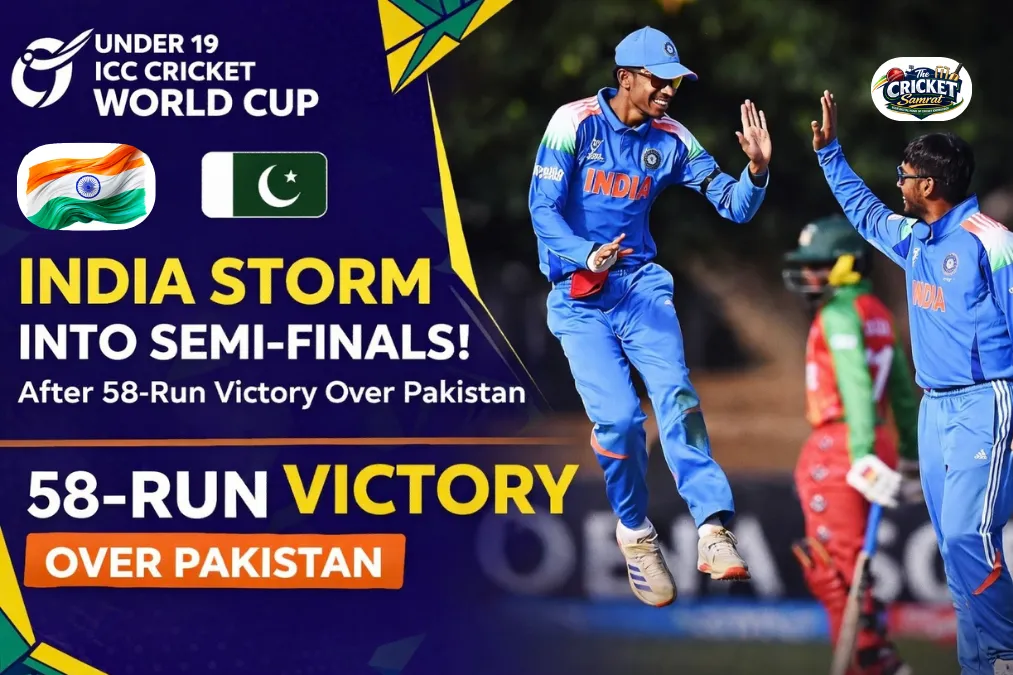
The Under 19 india pakistan world cup match once again lived up to its reputation as the most intense rivalry in world cricket. In a high-pressure Super Six encounter of the ICC Under-19 Cricket World Cup, India produced a dominant all-round performance to defeat Pakistan by 58 runs, sealing their place in the tournament semi-finals.
Played at Bulawayo, Zimbabwe, the contest carried massive significance for both teams. While India needed only a win to confirm qualification, Pakistan faced a do-or-die situation that required not just victory, but a win by a huge margin. In the end, India’s discipline with both bat and ball proved too strong, knocking Pakistan out of the semi-final race.
This clash delivered drama, momentum swings, individual brilliance, and tactical battles — everything fans expect from an India–Pakistan showdown on the world stage.
Match Overview: Under 19 India Pakistan World Cup Match
| Match | Under-19 Cricket World Cup – Super Six |
|---|---|
| Venue | Bulawayo, Zimbabwe |
| Date | 29 May |
| Toss | Pakistan won, chose to bowl |
| India Score | 252 all out (49.5 overs) |
| Pakistan Score | 194 all out (46.2 overs) |
| Result | India won by 58 runs |
| Player of the Match | Kanishk Chauhan |
High Stakes Before the Match
Before the start of the Under 19 india pakistan world cup match, the points table placed both teams under contrasting pressure.
Group 2 Points Table Before Match
| Team | Matches | Points | Net Run Rate |
|---|---|---|---|
| England | 4 | 8 | +2.118 |
| India | 4 | 6 | +3.337 |
| Pakistan | 4 | 4 | +1.484 |
- India: A simple win would guarantee semi-final qualification.
- Pakistan: Needed a massive victory to overcome India’s superior net run rate.
The equation meant Pakistan had to chase 253 runs within 33.3 overs, or win by an enormous margin if batting first — a nearly impossible task against India’s balanced bowling attack.
Toss and Team Strategy
Pakistan captain Farhan Yousuf won the toss and elected to bowl first, hoping early wickets would expose India’s middle order and allow a rapid chase.
India, meanwhile, remained confident in their batting depth and placed faith in their spin-heavy bowling unit to defend any competitive total.
Playing XI
India Under-19
| No | Player |
|---|---|
| 1 | Ayush Mhatre (Captain) |
| 2 | Aaron George |
| 3 | Vaibhav Suryavanshi |
| 4 | Vedant Trivedi |
| 5 | Vihaan Malhotra |
| 6 | Abhigyan Kundu (WK) |
| 7 | Kanishk Chauhan |
| 8 | R.S. Ambrish |
| 9 | Khilan Patel |
| 10 | Henil Patel |
| 11 | Deepesh Devendran |
Pakistan Under-19
| No | Player |
|---|---|
| 1 | Farhan Yousuf (Captain) |
| 2 | Hamza Zahoor (WK) |
| 3 | Sameer Minhas |
| 4 | Usman Khan |
| 5 | Ahmed Hussain |
| 6 | Huzaifa Ahsan |
| 7 | Ali Hasan |
| 8 | Abdul Subhan |
| 9 | Momin Qamar |
| 10 | Mohammad Shayan |
| 11 | Ali Raza |
India’s Innings: From Flying Start to Mid-Innings Crisis
India’s openers Aaron George and teenage sensation Vaibhav Suryavanshi began confidently. The first over yielded seven runs, and Suryavanshi immediately showed intent by striking two elegant boundaries in the third over.
At just 14 years of age, Suryavanshi continued to impress, playing fearless cricket against Pakistan’s pace attack.
Early Momentum
- India raced to 46 without loss in 7 overs
- Boundaries flowed freely
- Pakistan struggled for early breakthroughs
However, the match changed dramatically in the eighth over.
Turning Point: Pakistan’s Double Strike
Fast bowler Mohammad Shayan delivered a match-turning over:
- Vaibhav Suryavanshi dismissed for 30 off 22 balls
- Ayush Mhatre, India’s captain, out for a duck
Suddenly, India slipped from 46/0 to 47/2.
The very next over, Abdul Subhan bowled Aaron George, reducing India to 47/3.
Score at Powerplay (10 Overs)
| Overs | Score | Wickets |
|---|---|---|
| 10 | 49 | 3 |
Pakistan had stormed back into the contest, silencing the Indian dugout.
Vedant Trivedi Holds the Innings Together
With three quick wickets down, responsibility fell on Vedant Trivedi and vice-captain Vihaan Malhotra.
The pair stitched together a calm and composed partnership, rotating strike and punishing loose deliveries.
Key Partnership
- Fourth-wicket stand: 50+ runs
- Stabilised India after early collapse
- Forced Pakistan bowlers to reset fields
Wickets Fall Again
Vihaan Malhotra departed for 21 runs, caught and bowled by Ahmed Hussain. Soon after, wicketkeeper Abhigyan Kundu fell for 16, attempting a big shot.
India were 132/5, once again under pressure.
Vedant Trivedi’s Crucial Fifty
Batting at No. 4, Vedant Trivedi delivered one of the finest innings of the tournament.
- Runs: 68
- Balls: 90+
- Fours: 6
- Strike Rate: Controlled and mature
He reached his maiden World Cup half-century in 74 balls, showing remarkable temperament for a knockout-style match.
Late Surge by Kanishk Chauhan and Khilan Patel
The lower middle order then provided the momentum India desperately needed.
- Kanishk Chauhan: 35 off 29 balls
- Khilan Patel: Powerful late hitting
The duo added a rapid 50-run partnership, pushing India beyond the 250-run mark.
49th Over Highlights
- Two massive sixes
- 16 runs scored
- Momentum firmly with India
India were eventually bowled out for 252 in 49.5 overs.
India Batting Scorecard
| Batsman | Runs | Balls | 4s | 6s |
|---|---|---|---|---|
| Vaibhav Suryavanshi | 30 | 22 | 4 | 0 |
| Aaron George | 16 | 25 | 1 | 0 |
| Ayush Mhatre | 0 | 2 | 0 | 0 |
| Vedant Trivedi | 68 | 90 | 6 | 0 |
| Vihaan Malhotra | 21 | 43 | 2 | 0 |
| Abhigyan Kundu | 16 | 28 | 1 | 0 |
| Kanishk Chauhan | 35 | 29 | 2 | 1 |
| Khilan Patel | 22 | 18 | 1 | 1 |
| Others | — | — | — | — |
| Total | 252 | 49.5 overs |
Pakistan’s Chase: Pressure from the First Over
Pakistan began knowing the impossible equation:
- 253 runs in 33.3 overs to qualify
- Even victory might not be enough
Despite this, openers started confidently.
Early Overs Summary
| Overs | Score | Wickets |
|---|---|---|
| 3 | 19 | 0 |
| 7 | 42 | 1 |
| 10 | 56 | 1 |
The first breakthrough came when Henil Patel trapped Sameer Minhas LBW for 9 runs — the same batter who had smashed 172 against India in the Asia Cup final.
Usman Khan and Hamza Zahoor Build Resistance
Pakistan’s hopes rested on:
- Usman Khan
- Hamza Zahoor
The pair stitched together a half-century stand, taking Pakistan to 87/1 after 16 overs.
Hamza was later bowled by Kanishk Chauhan for 42, attempting a sweep shot.
Usman Khan’s Lone Battle
Usman Khan continued fighting:
- Reached his fifty in 76 balls
- Played with composure and authority
- Hit seven boundaries
However, the required run rate kept climbing beyond control.
He was eventually trapped LBW by captain Ayush Mhatre for 66 runs off 92 balls.
Collapse Under Pressure
Once Usman fell, Pakistan’s innings unraveled rapidly.
Key moments included:
- Brilliant sliding catch by Kanishk Chauhan to dismiss Abdul Subhan
- Sharp wicketkeeping by Abhigyan Kundu
- Tight spin bowling choking run flow
Pakistan Bowling Collapse Timeline
| Over | Event |
|---|---|
| 30 | Farhan Yousuf caught (38) |
| 36 | Usman Khan LBW (66) |
| 40 | Abdul Subhan caught |
| 44 | Ninth wicket falls |
| 46.2 | All out |
Pakistan were bowled out for 194 runs in 46.2 overs.
Pakistan Batting Scorecard
| Batsman | Runs | Balls |
|---|---|---|
| Sameer Minhas | 9 | 14 |
| Hamza Zahoor | 42 | 51 |
| Usman Khan | 66 | 92 |
| Farhan Yousuf | 38 | 39 |
| Huzaifa Ahsan | 14 | 30 |
| Others | — | — |
| Total | 194 | 46.2 overs |
India Bowling Performance
| Bowler | Overs | Runs | Wickets |
|---|---|---|---|
| Khilan Patel | 9.2 | 41 | 3 |
| Kanishk Chauhan | 10 | 30 | 1 |
| Ayush Mhatre | 6 | 28 | 1 |
| Henil Patel | 7 | 33 | 1 |
| R.S. Ambrish | 6 | 29 | 1 |
Player of the Match: Kanishk Chauhan
Kanishk Chauhan delivered a complete all-round performance:
- Batting: 35 off 29 balls
- Bowling: 10 overs, 30 runs, 1 wicket
- Fielding: Stunning sliding catch
His calm under pressure defined India’s dominance.
Why India Won the Match
- Strong middle-order recovery after early collapse
- Vedant Trivedi’s anchor innings
- Late acceleration from lower order
- Disciplined spin bowling
- Exceptional fielding standards
Under-19 World Cup Head-to-Head: India vs Pakistan
| Category | Record |
|---|---|
| Total Matches | 29 |
| India Wins | 16 |
| Pakistan Wins | 12 |
| Tied | 1 |
Top Performers – Tournament So Far
India
| Player | Matches | Runs/Wickets |
|---|---|---|
| Abhigyan Kundu | 4 | 183 runs |
| Hardik Patel | 4 | 10 wickets |
Pakistan
| Player | Matches | Runs/Wickets |
|---|---|---|
| Sameer Minhas | 4 | 188 runs |
| Ali Raza | 4 | 12 wickets |
What This Result Means
- India qualify for the semi-finals
- Pakistan eliminated despite fighting performance
- India continue their incredible streak of reaching finals since 2016
- Two-time champions remain strong title contenders
India will now face Afghanistan or Australia depending on other Super Six results.
Conclusion
The Under 19 india pakistan world cup match once again delivered intensity, emotion, and unforgettable moments. While Pakistan fought bravely, India’s superior depth, discipline, and temperament proved decisive.
From Vedant Trivedi’s composure to Kanishk Chauhan’s all-round brilliance, the young Indian side showcased why they are considered one of the most consistent teams in Under-19 World Cup history.
As the tournament moves toward its climax, India march into the semi-finals with confidence, momentum, and belief — carrying the hopes of millions on their shoulders.