Advertisement
Advertisement
Erp Manufacturing Transforming Industry Efficiency

Insurance Industry Transforming Financial Security and Risk Management

Starting with the insurance industry, it represents one of the most critical pillars of global financial stability. Insurance services provide protection against financial losses arising from health emergencies, accidents, natural disasters, property damage, and business risks. With rising economic uncertainty and increasing awareness of financial planning, the insurance sector has become an essential component of personal and corporate financial strategies.

The modern insurance ecosystem has evolved far beyond traditional policy issuance. Today, insurance companies rely on advanced digital platforms, data analytics, and automated underwriting systems to deliver faster services, accurate risk assessment, and improved customer experience. This transformation has positioned the insurance industry as a high-value financial sector with long-term growth potential.

Introduction to the Insurance Industry

The insurance industry operates on the principle of risk transfer, where individuals or businesses pay premiums to insurance providers in exchange for financial protection against uncertain future events. These events may include medical expenses, vehicle accidents, property damage, liability claims, or loss of income.

Insurance companies not only safeguard individuals but also support economic growth by enabling businesses to operate with reduced financial risk. From life insurance and health insurance to motor, home, travel, and commercial insurance, the industry covers a wide spectrum of financial protection needs.

Evolution of the Insurance Sector

The insurance industry has undergone significant transformation over the decades, shaped by regulatory changes, technological innovation, and evolving consumer expectations.

1. Traditional Insurance Models

Earlier insurance systems relied on manual documentation, agent-driven sales, and lengthy claim settlement processes. Policy issuance and customer communication were largely paper-based.

2. Digitization of Insurance Operations

The introduction of digital record-keeping and management software improved efficiency, reduced errors, and enabled better customer data management.

3. Online and Direct-to-Consumer Insurance

With the growth of the internet, insurance companies introduced online policy purchases, premium calculators, and digital claim submissions, significantly enhancing accessibility.

4. InsurTech Innovation

The emergence of InsurTech startups introduced AI-driven underwriting, automated claims processing, fraud detection, and personalized insurance products.

5. Data-Driven and Predictive Insurance

Modern insurance companies leverage big data, machine learning, and predictive analytics to assess risk accurately and offer customized premium pricing.

Key Features of Modern Insurance Systems

Insurance management systems today are designed to handle complex operations efficiently while ensuring regulatory compliance and customer satisfaction. These systems integrate multiple business functions into a unified platform, improving transparency and operational control.

Advanced insurance platforms enable real-time data access, automated workflows, and secure customer interactions, making them essential for competitive insurance providers.

Core Modules in Insurance Management Systems

Leading Insurance Software Platforms

Benefits of Digital Transformation in Insurance

Digital transformation has significantly improved efficiency and profitability in the insurance industry. Automation reduces operational costs while improving service speed and accuracy.

By integrating data analytics and AI, insurers can design personalized insurance products, improve underwriting accuracy, and enhance fraud prevention mechanisms.

Improved Decision-Making Through Insurance Analytics

📥 Download Now

Insurance Industry Performance Improvements

A global health insurance provider implemented automated claims processing and reduced settlement time by over 35%. Similarly, a motor insurance company adopted telematics-based pricing models, improving customer retention and underwriting profitability.

"Data-driven insurance models are redefining risk management and financial protection worldwide."

Challenges in Insurance Industry Modernization

Despite technological advancements, insurance companies face multiple challenges during digital adoption and system modernization.

Key Challenges

Future Trends in the Insurance Industry

The insurance sector is expected to experience rapid innovation driven by AI, IoT, and cloud computing.

AI and IoT in Insurance

AI enables automated underwriting and personalized pricing, while IoT devices support usage-based insurance models for health, motor, and property coverage.

Cloud-Based Insurance Platforms

Cloud infrastructure allows insurers to scale operations, reduce IT costs, and launch products faster while ensuring high availability and security.

Upcoming Innovations

Successful Insurance Implementation Strategies

Strategic planning and execution are essential for successful insurance system implementation.

Implementation Roadmap

Business assessment, objective definition, platform selection, data migration, testing, deployment, and continuous optimization.

Insurance Vendor Evaluation Checklist

Case Studies of Insurance Industry Success

Allianz leveraged predictive analytics to improve underwriting accuracy and profitability.

AXA adopted cloud-based platforms to enhance customer engagement and operational efficiency.

Last Word

In conclusion, the insurance industry continues to evolve as a high-value financial sector driven by technology, data analytics, and customer-centric innovation. Digital insurance platforms not only improve operational efficiency but also strengthen financial protection and trust. For insurers, embracing modernization is no longer optional—it is essential for long-term growth and competitiveness.

Advertisement
Advertisement
T20 World Cup 2026 Super 8 Schedule Announced: Full Fixtures, Groups, Venues and India Match Dates Revealed

T20 World Cup 2026 Super 8 Schedule Announced: Full Fixtures, Groups, Venues and India Match Dates Revealed

T20 World Cup 2026 Super 8 Schedule: The excitement surrounding the ICC T20 World Cup 2026 has reached a new peak as the Super 8 stage officially approaches. After an intense and closely fought group stage, the tournament now moves into its most competitive phase. The T20 World Cup 2026 Super 8 Schedule has been confirmed, and cricket fans across India, the UK, the US and around the world are preparing for high-stakes clashes beginning on February 21.

With eight top-performing teams securing their places, the battle for a semi-final spot promises thrilling encounters, packed stadiums and global viewership.

Super 8 Qualified Teams Confirmed

Following the conclusion of the group stage on February 20, the eight teams advancing to the Super 8 round have been finalised. The teams that qualified are:

  • India national cricket team
  • South Africa national cricket team
  • West Indies cricket team
  • New Zealand national cricket team
  • Sri Lanka national cricket team
  • England cricket team
  • Pakistan national cricket team
  • Zimbabwe national cricket team

Each of these sides displayed strong performances during the initial phase and will now compete in the Super 8 round for a place in the semi-finals.

Super 8 Format Explained

The Super 8 stage will feature two groups of four teams each. Every team will play three matches, facing each of the other teams in their respective group once.

At the end of this round:

  • The top two teams from each group will qualify for the semi-finals.
  • Points, net run rate and head-to-head results will play a crucial role in determining standings.
  • The competition is expected to be intense, with minimal margin for error.

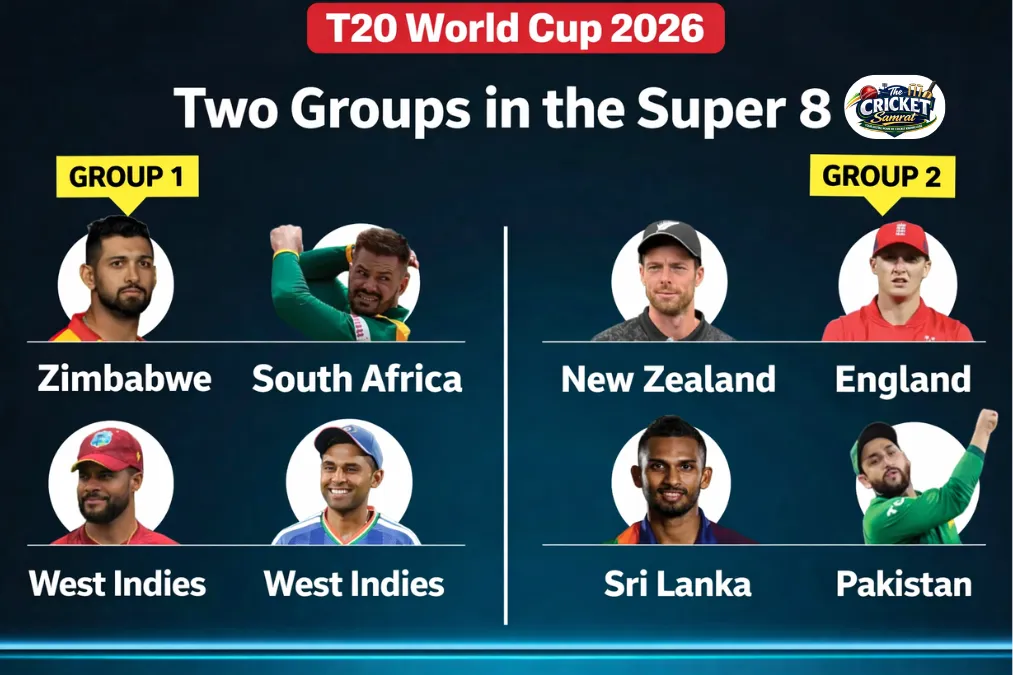
Super 8 Groups

Group 1

  • India
  • South Africa
  • West Indies
  • Zimbabwe

Group 2

  • New Zealand
  • England
  • Sri Lanka
  • Pakistan

This group division sets up some mouth-watering contests, especially with traditional rivalries and evenly matched teams in both pools.

T20 World Cup 2026 Super 8 Schedule – Full Match List

The Super 8 round begins on February 21 and continues until March 1. Below is the complete fixture list including venues and match timings (IST).

DateMatchVenueTime (IST)
21 FebruaryNew Zealand vs PakistanColombo7:00 PM
21 FebruaryEngland vs Sri LankaPallekele3:00 PM
22 FebruaryIndia vs South AfricaAhmedabad7:00 PM
23 FebruaryZimbabwe vs West IndiesMumbai7:00 PM
24 FebruaryEngland vs PakistanPallekele7:00 PM
25 FebruaryNew Zealand vs Sri LankaColombo7:00 PM
26 FebruaryWest Indies vs South AfricaAhmedabad3:00 PM
26 FebruaryIndia vs ZimbabweChennai7:00 PM
27 FebruaryEngland vs New ZealandColombo7:00 PM
28 FebruarySri Lanka vs PakistanPallekele7:00 PM
1 MarchZimbabwe vs South AfricaDelhi3:00 PM
1 MarchIndia vs West IndiesKolkata7:00 PM

This carefully structured T20 World Cup 2026 Super 8 Schedule ensures high-profile matches are evenly distributed across major cricket venues.

India’s Super 8 Matches – Key Dates to Watch

Indian fans will be particularly focused on three crucial fixtures in Group 1. The India national cricket team will play:

DateMatchVenueTime (IST)
22 FebruaryIndia vs South AfricaAhmedabad7:00 PM
26 FebruaryIndia vs ZimbabweChennai7:00 PM
1 MarchIndia vs West IndiesKolkata7:00 PM

The opening clash against South Africa in Ahmedabad is expected to be a high-intensity encounter. The match against West Indies in Kolkata could prove decisive in determining semi-final qualification.

With home conditions and strong crowd support, India will aim to dominate the Super 8 stage and secure a comfortable place in the knockouts.

Knockout Stage and Final Date

The Super 8 stage concludes on March 1. Following this:

  • First Semi-Final: March 4
  • Second Semi-Final: March 5
  • Final: March 8

The grand final on March 8 will crown the T20 World Cup 2026 champion, bringing an end to what is shaping up to be one of the most competitive editions in tournament history.

What Makes the Super 8 Stage So Crucial?

Unlike the group stage, where teams have slightly more room to recover from early setbacks, the Super 8 phase offers very limited opportunities. With only three matches per team, consistency becomes essential.

Key factors that will influence results include:

  • Middle-order stability
  • Death-over bowling efficiency
  • Spin effectiveness on subcontinental pitches
  • Net run rate management

Teams like England and Pakistan will look to use their aggressive batting depth, while New Zealand’s tactical discipline could make them dangerous opponents. South Africa’s pace attack and West Indies’ power-hitting also add further unpredictability.

Also read: Ravi Shastri Urges Patience from Abhishek Sharma After Early Dismissal in India’s Win Over Pakistan

Global Interest in the T20 World Cup 2026 Super 8 Schedule

The T20 format continues to attract massive audiences worldwide, especially in cricket-loving nations such as India, England, Australia and Pakistan. At the same time, interest in the United States has grown rapidly following recent ICC tournaments.

The T20 World Cup 2026 Super 8 Schedule is already trending across search platforms, as fans plan viewing schedules and analyse potential semi-final scenarios.

Also read: Super 8 T20 World Cup 2026: India Braces for High-Stakes Battles Against South Africa, West Indies and Zimbabwe

Conclusion:

The stage is set for a dramatic and action-packed Super 8 round in the T20 World Cup 2026. With powerhouse teams grouped together and knockout spots on the line, every match will carry enormous significance.

As February 21 approaches, cricket enthusiasts worldwide are bracing for thrilling encounters, unforgettable performances and the start of the decisive chapter in this global tournament.

Stay tuned as the race to the semi-finals begins.