
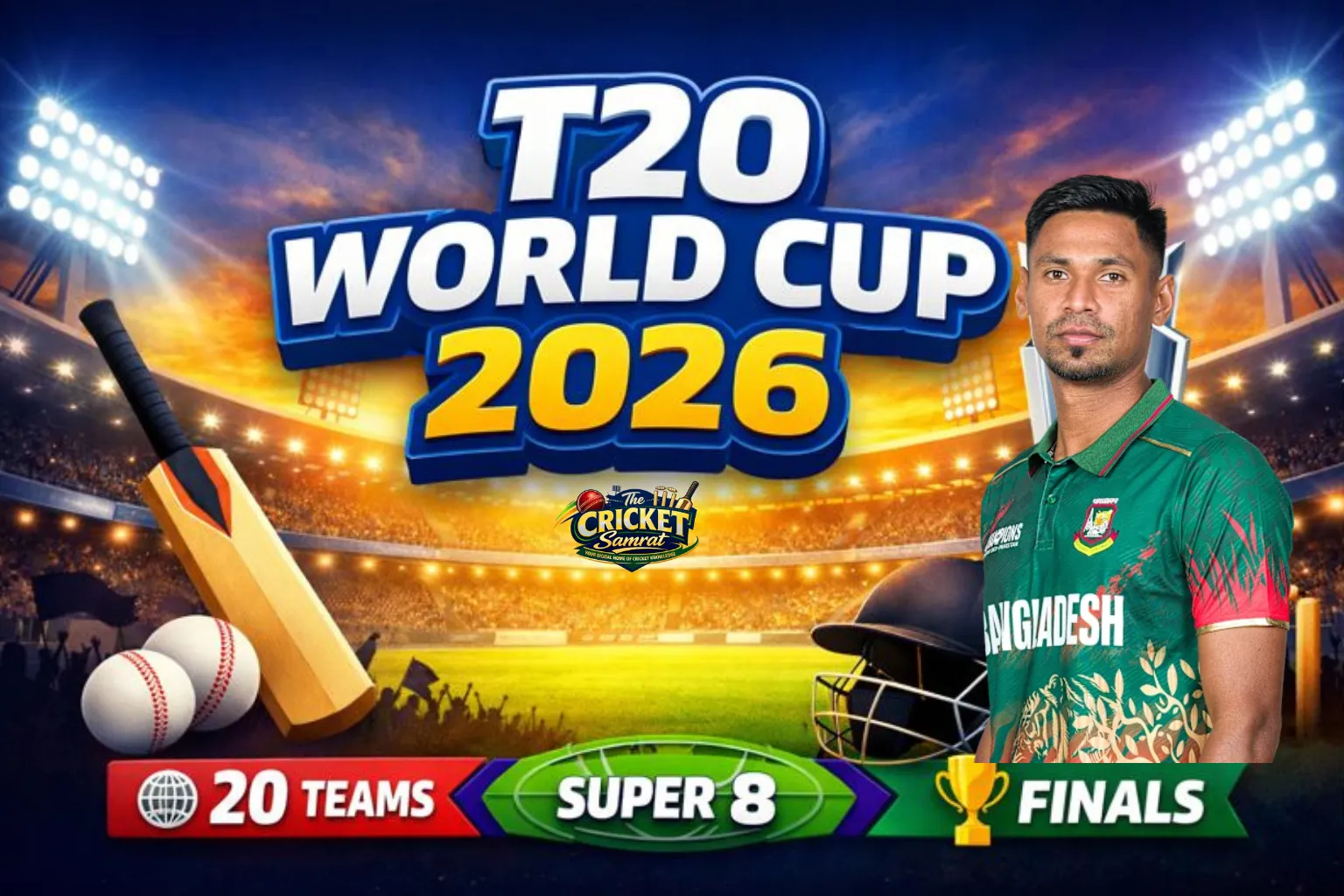
The Bangladesh Cricket Board (BCB) is considering a major move ahead of the T20 World Cup 2026, with plans to formally request the International Cricket Council (ICC) to shift Bangladesh’s scheduled matches in India to Sri Lanka. The development follows growing tensions after Bangladeshi fast bowler Mustafizur Rahman was removed from his Indian Premier League (IPL) 2026 franchise, a decision that has sparked political and security concerns within Bangladesh’s cricket establishment.
According to sources close to the board, the BCB is preparing to write an official letter to the ICC, citing player safety and broader security issues as the primary reasons behind the request. The move, if approved, could significantly impact the logistics and planning of the upcoming T20 World Cup, which is jointly hosted by India and Sri Lanka.
T20 World Cup 2026 Schedule and Bangladesh’s Fixtures
The T20 World Cup is set to begin on 7 February 2026 and will be played across venues in India and Sri Lanka. Bangladesh, under the current schedule, is slated to play all four of its group-stage matches in India.
Bangladesh’s Scheduled Group Matches (As Per Original Plan)
| Match No. | Opponent | Venue | City |
|---|---|---|---|
| 1 | TBD | Eden Gardens | Kolkata |
| 2 | TBD | Eden Gardens | Kolkata |
| 3 | TBD | Eden Gardens | Kolkata |
| 4 | TBD | Wankhede Stadium | Mumbai |
Three of Bangladesh’s matches are scheduled at Eden Gardens in Kolkata, with the remaining fixture set to take place at Wankhede Stadium in Mumbai. It is this heavy concentration of matches in India—particularly Kolkata—that has raised concerns within the Bangladesh Cricket Board.
BCB Raises Security Issues With ICC
During an emergency meeting held recently, the BCB decided that the matter must be formally raised with the ICC. Amjad Hossain, chairman of the BCB’s media committee, confirmed that the board would communicate its concerns to cricket’s global governing body.
He stated that with three matches scheduled in Kolkata, it was essential to assess whether Bangladesh’s players would feel safe and secure throughout the tournament. The board believes that the issue goes beyond cricket and has broader implications for player welfare.
Bangladesh’s Sports Advisor, Asif Nazrul, further escalated the matter by publicly stating on social media that the board would urge the ICC to relocate Bangladesh’s matches to Sri Lanka. He argued that if a Bangladeshi player cannot safely participate in a domestic league in India, questions naturally arise about the safety of the national team during a global event like the T20 World Cup.
Mustafizur Rahman’s IPL Exit Sparks Controversy
The situation intensified on 3 January, when IPL franchise Kolkata Knight Riders (KKR) announced the release of Mustafizur Rahman from their squad for IPL 2026. The decision came amid rising political pressure and controversy linked to reports of violence against minority Hindus in Bangladesh.
Following these developments, the Board of Control for Cricket in India (BCCI) reportedly directed KKR to remove the Bangladeshi pacer from their roster. BCCI Secretary Devajit Saikia later confirmed that, considering the recent developments and sensitivities, the board felt it was appropriate to ask the franchise to release the player. KKR has been allowed to seek a replacement, pending approval.
The move has been viewed in Bangladesh as politically charged, prompting concerns that national players could face similar issues during international tournaments hosted in India.
Calls to Halt IPL Broadcasts in Bangladesh
Adding another layer to the controversy, Sports Advisor Asif Nazrul revealed that he had requested Bangladesh’s Ministry of Information and Broadcasting to consider halting the broadcast of IPL matches in the country. While no official decision has been announced, the request reflects the growing strain between cricketing bodies following Mustafizur’s removal.
Group Stage Format and Tournament Structure
The T20 World Cup 2026 will feature 20 teams, divided into four groups. Each team will play four matches in the group stage, with the top two teams from each group advancing to the Super 8 round.
T20 World Cup 2026 – Tournament Format
| Stage | Details |
|---|---|
| Group Stage | 20 teams, 4 groups, 40 matches |
| Qualification | Top 2 teams from each group |
| Super 8 | 8 teams, 12 matches |
| Knockouts | Semi-finals and Final |
Bangladesh has been placed in what many experts are calling one of the toughest sections of the tournament.
“Group of Death” Concerns for Bangladesh
Bangladesh’s group has drawn particular attention due to the strength of the opposition. The group includes cricketing heavyweights such as England, West Indies, South Africa, and New Zealand—all of whom have previously reached the final of a World Cup.
In contrast, Bangladesh and Afghanistan, also part of challenging groups, have never played in a World Cup final. This makes qualification to the Super 8 stage a significant challenge for Bangladesh, even without off-field distractions.
Read also: Pakistan Submits Preliminary Squad to ICC for T20 World Cup 2026-pakistan t20 world cup squad 2026
Match Dates and Timings Announced
The group stage of the T20 World Cup will run from 7 February to 19 February, with three matches played daily. A single match is scheduled for 20 February, featuring Australia against Oman.
Key Tournament Dates
| Phase | Dates |
|---|---|
| Group Stage | 7–19 February |
| Special Fixture | 20 February |
| Super 8 Stage | From 21 February |
| Semi-Finals | Late February |
| Final | Early March |
Matches will begin at 11:00 AM, 3:00 PM, and 7:00 PM local time, allowing for global broadcast coverage across Asia, Europe, and the Americas.
Read also: Top 10 Batsmen With the Most Centuries in T20I Cricket: Four Indians Feature in Elite List
What Happens Next?
The ICC is yet to receive or respond officially to the BCB’s proposed request. Any decision to relocate matches would require approval from multiple stakeholders, including host boards, broadcasters, and security agencies.
However, the situation highlights how political and security issues can spill into international sport, even at the highest level. As the T20 World Cup 2026 approaches, all eyes will be on the ICC’s response and whether Bangladesh’s matches remain in India or are moved to Sri Lanka.
For now, the controversy has added an unexpected layer of tension to what was expected to be one of the most celebrated global cricketing events of the decade.