
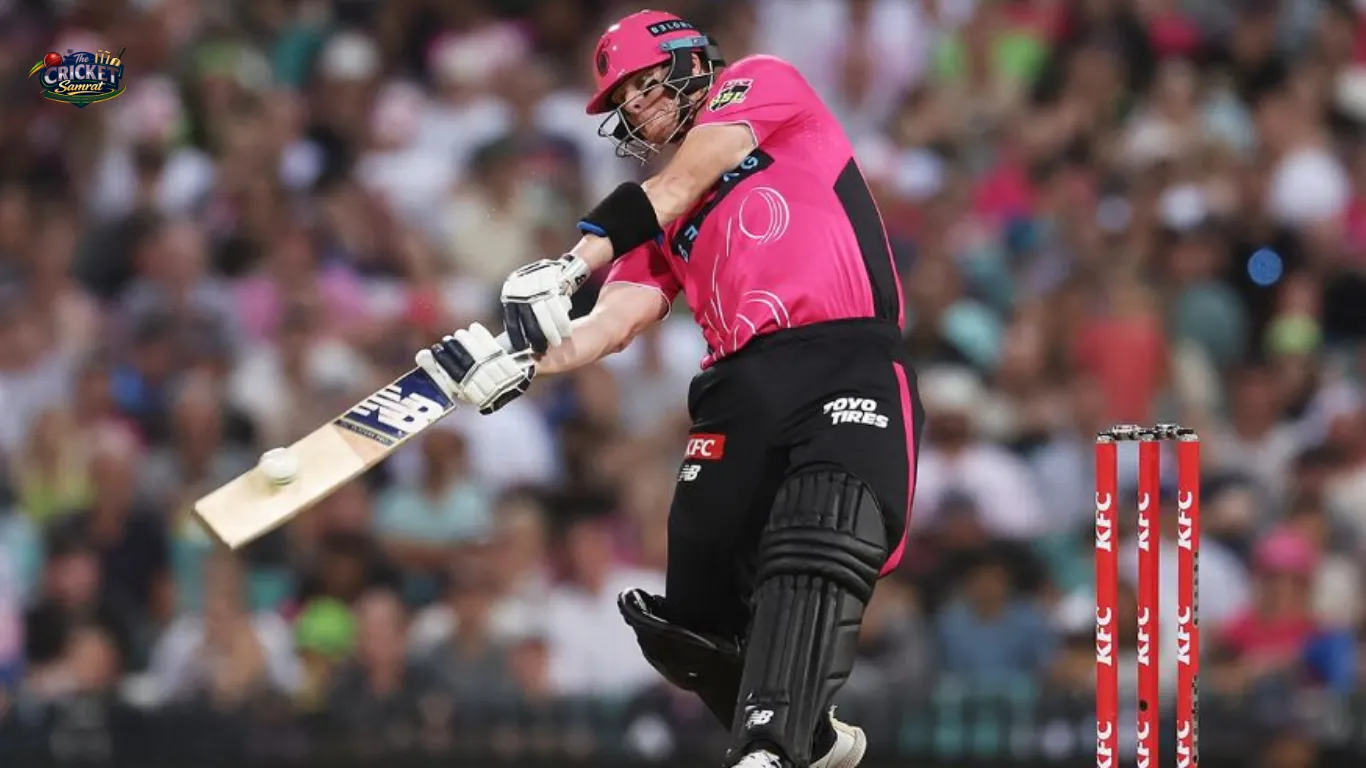
The Sydney cricket rivalry produced another unforgettable chapter as Sydney Sixers edged past Sydney Thunder by five wickets in a high-scoring Big Bash League encounter at the Sydney Cricket Ground. In a match packed with star power, momentum swings, and record-breaking moments, it was Steven Smith’s astonishing 41-ball century that ultimately stole the spotlight, eclipsing David Warner’s unbeaten 110 and keeping the Sixers’ finals hopes alive.
This Sydney Thunder vs Sydney Sixers clash was more than just a derby. It was a contest of leadership, experience, and sheer batting brilliance, with two former Australian teammates producing centuries for opposing sides. Yet, when the final runs were scored, it was Smith’s fearless aggression and tactical clarity that proved decisive.
Match Summary: Sydney Thunder vs Sydney Sixers
| Match | Sydney Thunder vs Sydney Sixers |
|---|---|
| Venue | Sydney Cricket Ground (SCG) |
| Result | Sydney Sixers won by 5 wickets |
| Thunder Score | 189/6 (20 overs) |
| Sixers Score | 191/5 (17.2 overs) |
| Player of the Match | Steven Smith |
Thunder Post a Commanding Total on Warner’s Back
Batting first, Sydney Thunder posted a formidable 189 for 6, largely thanks to a commanding knock from captain David Warner, who carried his bat through the innings. Warner finished unbeaten on 110 off 64 balls, registering his second century of the season and once again reminding everyone of his dominance in domestic T20 cricket.
Warner’s innings was a blend of control and calculated aggression. He found the gaps early, punished loose deliveries, and gradually accelerated as the innings progressed. Boundaries flowed regularly, and his ability to manipulate the field ensured Thunder maintained momentum even when wickets fell at the other end.
However, much like Thunder’s earlier defeat against Hobart Hurricanes this season, Warner’s century once again came in a losing cause, highlighting the fine margins of T20 cricket.
Key Contributions for Sydney Thunder
| Batsman | Runs | Balls | Fours | Sixes |
| David Warner | 110* | 64 | 9 | 5 |
| Nic Maddinson | 26 | 18 | 3 | 1 |
| Others | 53 | — | — | — |
The Sixers’ bowling effort was led by Sam Curran, who delivered crucial breakthroughs and finished with 3 for 28, keeping Thunder from crossing the 200-run mark. Nathan McAndrew also chipped in with 2 for 34, despite enduring a tough night against Smith later in the game.
Early Setback for Thunder as Sams Exits
An unfortunate moment occurred early in the match when Daniel Sams was forced off the field after being struck on the neck by a bouncer from Sam Curran. Sams later showed delayed concussion symptoms, prompting Thunder to bring in Nathan McAndrew as a concussion substitute. While McAndrew contributed with the ball, the incident disrupted Thunder’s balance slightly and became a talking point in the contest.
Sixers Begin the Chase with Intent
Chasing 190 on a good SCG surface was never going to be easy, but the Sydney Sixers began with clear intent. Babar Azam, one of the most technically sound batters in world cricket, opened the innings alongside Steven Smith and immediately signaled attacking plans by striking the first ball of the chase for four.
Babar played the anchor role initially, rotating the strike and punishing anything loose, while Smith started to settle into his rhythm. The pair’s chemistry was evident, though there was a brief moment of disagreement early in the innings.
During the power surge, Smith famously refused a single offered by Babar, determined to take strike himself at the start of the surge. That decision turned out to be match-defining.
Steven Smith’s Over That Changed the Game
Facing Ryan Hadley, Smith unleashed one of the most destructive overs in Big Bash League history. He plundered 32 runs in a single over, setting a new BBL record for most runs scored off one over.
The shots were breathtaking. Clean strikes down the ground, ferocious pulls, and inventive placements left the Thunder bowlers stunned and the SCG crowd on its feet. The over completely shifted momentum in the Sydney Thunder vs Sydney Sixers contest and sent a clear message that the chase was well within reach.
Smith at His Devastating Best
Smith’s innings was a masterclass in controlled aggression. Known traditionally for his accumulation rather than brute force, Smith showcased a different gear altogether.
- His first boundary came via a powerful pull shot over square leg off Wes Agar.
- He then took Nathan McAndrew for 14 runs off his first three deliveries.
- One monstrous six off McAndrew struck the roof of the Brewongle Stand, and would have cleared the stadium entirely had it not made contact.
Adding to the spectacle, Smith batted with anti-glare strips under his eyes, a familiar sight from Australia’s recent day-night Test against England at the Gabba.
Fifty in 23 Balls and Counting
Smith reached his half-century in just 23 deliveries, slicing Wes Agar for a flat six over point. The timing, balance, and power were exceptional, drawing comparisons to the very best T20 innings played at the SCG.
At the other end, Babar Azam continued to play fluently. He found boundaries off Tanveer Sangha, and by the halfway stage of the innings, the Sixers were cruising at 107 without loss, firmly in control of the chase.
Smith and Babar Partnership
| Partnership | Runs | Overs |
| Smith & Babar | 141 | 12 |
This opening stand effectively broke Thunder’s resistance and laid the foundation for victory.
Smith Brings Up a Stunning Century
Steven Smith brought up his century in just 41 balls, one of the fastest hundreds in Big Bash League history. His innings featured fearless stroke play, intelligent shot selection, and ruthless execution.
| Steven Smith Innings | |
| Runs | 100 |
| Balls | 41 |
| Strike Rate | 243.90 |
| Fours | 7 |
| Sixes | 7 |
The SCG crowd erupted as Smith acknowledged the applause, having outdone David Warner’s earlier effort with an innings that was arguably more impactful given the match situation.
Late Wobble but Sixers Hold Their Nerve
Despite the dominant position, the Sixers experienced a brief collapse, losing five wickets for 28 runs, including the prized wicket of Smith. Thunder briefly sensed an opening, but the damage had already been done.
Lachlan Shaw and Jack Edwards showed composure under pressure, rotating the strike and picking the right deliveries to attack. Their calm approach ensured there was no dramatic twist at the end.
The winning runs were scored with 16 balls to spare, underlining the authority of the Sixers’ chase.
Final Scorecard: Sydney Thunder vs Sydney Sixers
Sydney Thunder – 189/6 (20 overs)
| Player | Runs | Balls |
| David Warner | 110* | 64 |
| Nic Maddinson | 26 | 18 |
| Others | 53 | — |
Best Bowlers (Sixers)
- Sam Curran: 3/28
- Nathan McAndrew: 2/34
Sydney Sixers – 191/5 (17.2 overs)
| Player | Runs | Balls |
| Steven Smith | 100 | 41 |
| Babar Azam | 47 | 32 |
| Others | 44 | — |
What This Result Means for the Finals Race
This victory keeps the Sydney Sixers’ hopes of finishing second alive. A win against Brisbane Heat at the Gabba in their final league match will secure them second place and a spot in the Qualifier final.
However, the equation remains tight. A loss in that match could see the Sixers eliminated from the tournament, allowing the Heat to progress instead.
For Sydney Thunder, the defeat is another reminder that individual brilliance alone is not always enough. Despite Warner’s heroics, the team will rue missed opportunities with the ball and in the field.
A Derby to Remember
The Sydney Thunder vs Sydney Sixers derby once again lived up to its reputation. Two international superstars delivered centuries, records were broken, and the SCG witnessed a chase that will be remembered for years.
Steven Smith’s innings will go down as one of the finest in Big Bash League history, not just for its speed or power, but for its match-winning significance. While David Warner’s unbeaten 110 was a captain’s knock of the highest quality, it was Smith who ensured the Sixers walked away victorious.
As the Big Bash League heads toward its decisive phase, performances like this underline why the Sydney derby remains one of the most compelling rivalries in Australian cricket.