Advertisement
Advertisement
Erp Manufacturing Transforming Industry Efficiency

Insurance Industry Transforming Financial Security and Risk Management

Starting with the insurance industry, it represents one of the most critical pillars of global financial stability. Insurance services provide protection against financial losses arising from health emergencies, accidents, natural disasters, property damage, and business risks. With rising economic uncertainty and increasing awareness of financial planning, the insurance sector has become an essential component of personal and corporate financial strategies.

The modern insurance ecosystem has evolved far beyond traditional policy issuance. Today, insurance companies rely on advanced digital platforms, data analytics, and automated underwriting systems to deliver faster services, accurate risk assessment, and improved customer experience. This transformation has positioned the insurance industry as a high-value financial sector with long-term growth potential.

Introduction to the Insurance Industry

The insurance industry operates on the principle of risk transfer, where individuals or businesses pay premiums to insurance providers in exchange for financial protection against uncertain future events. These events may include medical expenses, vehicle accidents, property damage, liability claims, or loss of income.

Insurance companies not only safeguard individuals but also support economic growth by enabling businesses to operate with reduced financial risk. From life insurance and health insurance to motor, home, travel, and commercial insurance, the industry covers a wide spectrum of financial protection needs.

Evolution of the Insurance Sector

The insurance industry has undergone significant transformation over the decades, shaped by regulatory changes, technological innovation, and evolving consumer expectations.

1. Traditional Insurance Models

Earlier insurance systems relied on manual documentation, agent-driven sales, and lengthy claim settlement processes. Policy issuance and customer communication were largely paper-based.

2. Digitization of Insurance Operations

The introduction of digital record-keeping and management software improved efficiency, reduced errors, and enabled better customer data management.

3. Online and Direct-to-Consumer Insurance

With the growth of the internet, insurance companies introduced online policy purchases, premium calculators, and digital claim submissions, significantly enhancing accessibility.

4. InsurTech Innovation

The emergence of InsurTech startups introduced AI-driven underwriting, automated claims processing, fraud detection, and personalized insurance products.

5. Data-Driven and Predictive Insurance

Modern insurance companies leverage big data, machine learning, and predictive analytics to assess risk accurately and offer customized premium pricing.

Key Features of Modern Insurance Systems

Insurance management systems today are designed to handle complex operations efficiently while ensuring regulatory compliance and customer satisfaction. These systems integrate multiple business functions into a unified platform, improving transparency and operational control.

Advanced insurance platforms enable real-time data access, automated workflows, and secure customer interactions, making them essential for competitive insurance providers.

Core Modules in Insurance Management Systems

Leading Insurance Software Platforms

Benefits of Digital Transformation in Insurance

Digital transformation has significantly improved efficiency and profitability in the insurance industry. Automation reduces operational costs while improving service speed and accuracy.

By integrating data analytics and AI, insurers can design personalized insurance products, improve underwriting accuracy, and enhance fraud prevention mechanisms.

Improved Decision-Making Through Insurance Analytics

📥 Download Now

Insurance Industry Performance Improvements

A global health insurance provider implemented automated claims processing and reduced settlement time by over 35%. Similarly, a motor insurance company adopted telematics-based pricing models, improving customer retention and underwriting profitability.

"Data-driven insurance models are redefining risk management and financial protection worldwide."

Challenges in Insurance Industry Modernization

Despite technological advancements, insurance companies face multiple challenges during digital adoption and system modernization.

Key Challenges

Future Trends in the Insurance Industry

The insurance sector is expected to experience rapid innovation driven by AI, IoT, and cloud computing.

AI and IoT in Insurance

AI enables automated underwriting and personalized pricing, while IoT devices support usage-based insurance models for health, motor, and property coverage.

Cloud-Based Insurance Platforms

Cloud infrastructure allows insurers to scale operations, reduce IT costs, and launch products faster while ensuring high availability and security.

Upcoming Innovations

Successful Insurance Implementation Strategies

Strategic planning and execution are essential for successful insurance system implementation.

Implementation Roadmap

Business assessment, objective definition, platform selection, data migration, testing, deployment, and continuous optimization.

Insurance Vendor Evaluation Checklist

Case Studies of Insurance Industry Success

Allianz leveraged predictive analytics to improve underwriting accuracy and profitability.

AXA adopted cloud-based platforms to enhance customer engagement and operational efficiency.

Last Word

In conclusion, the insurance industry continues to evolve as a high-value financial sector driven by technology, data analytics, and customer-centric innovation. Digital insurance platforms not only improve operational efficiency but also strengthen financial protection and trust. For insurers, embracing modernization is no longer optional—it is essential for long-term growth and competitiveness.

Advertisement
Advertisement
Google CEO Sundar Pichai Enjoyed the Match in Ahmedabad as India Faced South Africa in T20 World Cup 2026 Super 8 Clash

Google CEO Sundar Pichai Enjoyed the Match in Ahmedabad as India Faced South Africa in T20 World Cup 2026 Super 8 Clash

Sundar Pichai Enjoyed the Match in Ahmedabad : Ahmedabad witnessed a high-profile presence during the ICC Men’s T20 World Cup 2026 Super 8 encounter between India and South Africa, as Google CEO Sundar Pichai enjoyed the match in Ahmedabad at the iconic Narendra Modi Stadium. The global tech leader was among the distinguished guests attending the crucial fixture, drawing significant attention from fans and cricket enthusiasts alike.

The much-anticipated clash formed part of the Super 8 stage of the ICC Men’s T20 World Cup, and the electric atmosphere at the world’s largest cricket stadium provided the perfect setting for a thrilling evening of cricket. While the result did not favour Team India, the occasion itself turned memorable with Pichai’s enthusiastic participation in the pre-match ceremonies.

Pichai Brings World Cup Trophy with Sunil Gavaskar

One of the standout moments before the game began was when Sundar Pichai walked onto the field alongside former Indian captain Sunil Gavaskar to present the prestigious World Cup trophy. The gesture symbolised a bridge between technology and sport, as well as a tribute to cricket’s rich heritage.

The crowd erupted in applause as the duo carried the trophy onto the field. Gavaskar, widely regarded as one of India’s greatest opening batters, shared the spotlight with Pichai in a ceremony that added grandeur to the marquee contest.

Sundar Pichai Calls Gavaskar His Childhood Hero

During the mid-innings break, Google CEO Sundar Pichai enjoyed the match in Ahmedabad and also took time to reflect on his deep-rooted love for cricket. Speaking on air, he described Sunil Gavaskar as his childhood idol.

Pichai revealed that he grew up admiring Gavaskar’s batting and followed his performances passionately. He recalled having a poster of Gavaskar on his wall as a young boy and listening to radio commentary of matches, especially those played in the West Indies, with his grandfather and family members. His nostalgic remarks resonated with many Indian fans who share similar memories of following cricket on the radio during earlier decades.

The Google chief also joined former India all-rounder Ravi Shastri in the commentary box during the match. The light-hearted interaction between Pichai and Shastri offered viewers a unique blend of cricketing insights and personal anecdotes, adding an extra dimension to the broadcast.

Meeting with ICC Chairman Jay Shah

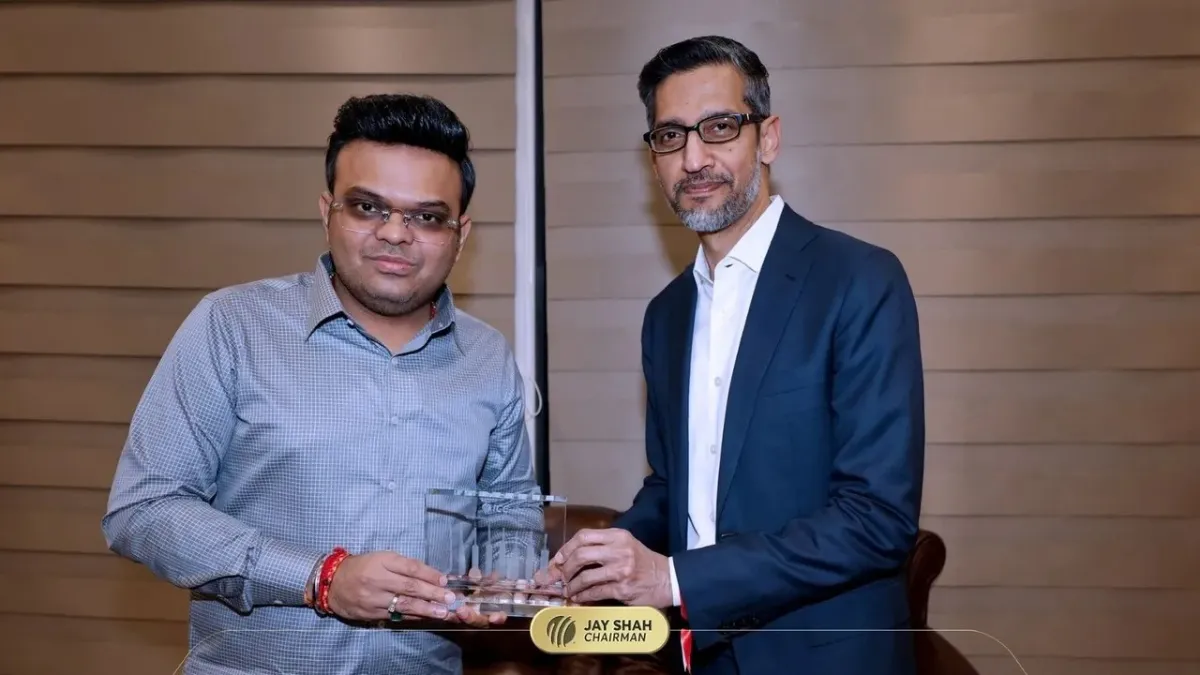
In addition to participating in pre-match ceremonies and commentary discussions, Pichai met with ICC Chairman Jay Shah during the event. Jay Shah was also present at the Narendra Modi Stadium for the high-stakes Super 8 clash.

The meeting between the two prominent figures attracted considerable attention, symbolising the growing intersection of global business leadership and international sport. While no formal announcements were made, their interaction underscored cricket’s expanding global footprint and its appeal beyond traditional sporting circles.

Pichai remained present on the field during the pre-match proceedings, interacting with officials and soaking in the vibrant stadium atmosphere. His visit highlighted how cricket continues to connect influential personalities from diverse industries.

Also read: T20 World Cup Winners List (2007–2024): Complete Champions History, Records and Year-Wise Results

India Suffers Heavy Defeat Against South Africa

Despite the celebratory mood and high-profile attendance, the match result proved disappointing for Indian fans. In the Super 8 encounter held in Ahmedabad, India suffered a comprehensive 76-run defeat to South Africa.

Batting first, South Africa posted a formidable total of 187 for 7 in their allotted 20 overs. Their disciplined batting performance and calculated acceleration in the final overs set a challenging target for the hosts.

In response, Team India struggled to build momentum. The batting line-up faltered under pressure, and wickets fell at regular intervals. India were eventually bowled out for just 111 runs in 18.5 overs, handing South Africa a dominant victory and strengthening their position in the Super 8 stage.

The defeat marked a significant setback for India’s campaign in the tournament, raising questions about their strategy and execution in high-pressure matches.

Also read: Shikhar Dhawan Wedding: Former India Opener Marries Sophie Shine in Private Ceremony

A Memorable Evening Beyond the Result

While the scoreboard told a tough story for Indian supporters, the evening will also be remembered for the presence of one of the world’s most influential technology leaders. Google CEO Sundar Pichai enjoyed the match in Ahmedabad not merely as a corporate executive, but as a lifelong cricket fan reconnecting with his childhood passion.

From sharing the field with Sunil Gavaskar to engaging with Ravi Shastri in the commentary box and meeting ICC Chairman Jay Shah, Pichai’s visit added a unique dimension to the T20 World Cup 2026 spectacle.

The event once again demonstrated cricket’s unmatched ability to unite people across professions, generations and borders — whether they are legends of the game, administrators shaping its future, or global CEOs who once grew up listening to crackling radio commentary of their heroes.