
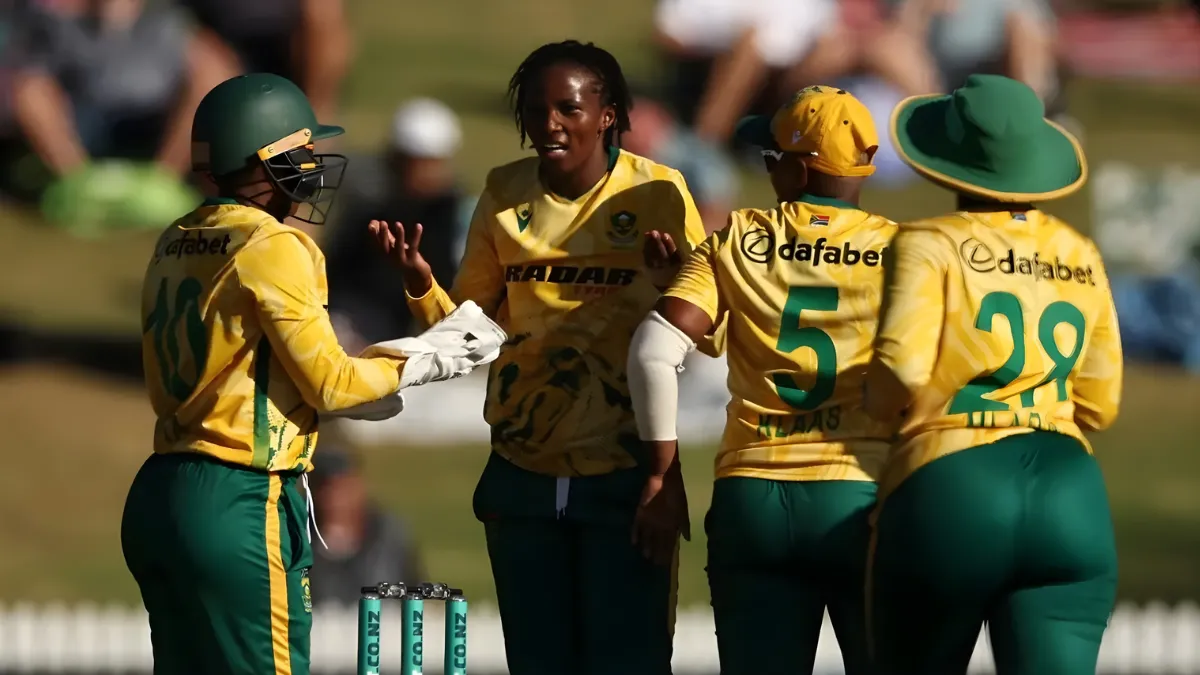
Hamilton, New Zealand — In a thrilling encounter of the south africa women vs new zealand women T20I series, South Africa Women delivered a commanding all-round performance to defeat New Zealand Women by 18 runs. The victory helped the visitors level the five-match series at 1-1, setting up an exciting contest ahead.
Despite a spirited all-round effort from Amelia Kerr, South Africa proved superior with contributions across all departments — batting, bowling, and fielding — to secure a well-deserved win.
Match Summary: South Africa Women vs New Zealand Women
| Team | Score |
|---|---|
| South Africa Women | 177/5 (20 overs) |
| New Zealand Women | 159 all out (19.5 overs) |
| Result | South Africa Women won by 18 runs |
Top Performers
| Category | Player | Performance |
|---|---|---|
| Top Scorer (SA) | Tazmin Brits | 53 (35 balls) |
| Top Scorer (NZ) | Amelia Kerr | 32 (18 balls) |
| Best Bowler (SA) | Ayabonga Khaka | 4/27 |
| Best Bowler (SA) | Nonkululeko Mlaba | 3/27 |
| Player of the Match | Kayla Reyneke | 28* (9 balls) |
Brits and Luus Set the Tone with Aggressive Start
Choosing to bat first in Hamilton — a venue known for assisting swing bowlers early on — South Africa Women showed confidence in their batting lineup. Openers Tazmin Brits and Sune Luus adopted an aggressive approach right from the beginning.
Although timing the ball proved tricky in the initial overs, the duo capitalized on loose deliveries and a bit of luck to score 14 runs in the first two overs. Brits soon shifted gears, launching a powerful six over deep midwicket against Suzie Bates and following it up with three boundaries in the same over.
As the swing faded, South Africa Women gained control, finishing the powerplay strongly at 49/0. Luus contributed a brisk 31 off 21 balls, playing a key role in building early momentum.
Amelia Kerr Reaches Milestone but South Africa Stay Dominant
New Zealand’s star all-rounder Amelia Kerr had a mixed outing with the ball. While she conceded runs early, she bounced back to claim a crucial wicket, dismissing Luus LBW.
This wicket marked a significant personal milestone for Kerr, as she reached 100 wickets in T20 Internationals. She achieved this feat in just 93 matches, becoming one of the fastest players in women’s cricket to combine 1000+ runs with 100+ wickets in the format.
However, South Africa continued to dominate despite her efforts.
Wolvaardt Anchors, Reyneke Explodes at the Death
Following Luus’ dismissal, captain Laura Wolvaardt steadied the innings with a composed knock. She rotated strike effectively and ensured South Africa maintained a solid scoring rate.
Tazmin Brits reached her half-century in just 35 balls before being dismissed, giving New Zealand a brief opening to fight back. The hosts picked up a few quick wickets, including Annerie Dercksen, Chloe Tryon, and Nadine de Klerk, to slow down the innings.
However, the momentum swung dramatically in the final overs.
A costly 18th over from Jess Kerr, which included five no-balls and a boundary off a free hit, allowed young batter Kayla Reyneke to settle quickly. The 20-year-old then produced a stunning late assault, smashing three consecutive sixes off Sophie Devine in the final over.
Reyneke’s explosive unbeaten 28 off just 9 balls propelled South Africa Women to a formidable total of 177/5.
South Africa Women Batting Scorecard
| Batter | Runs | Balls | Strike Rate |
|---|---|---|---|
| Tazmin Brits | 53 | 35 | 151.43 |
| Laura Wolvaardt | 41* | 33 | 124.24 |
| Sune Luus | 31 | 21 | 147.62 |
| Kayla Reyneke | 28* | 9 | 311.11 |
New Zealand’s Chase Falters Despite Strong Start
Chasing 178 — a target never successfully achieved in a women’s T20I in New Zealand — the hosts needed a solid start. However, early wickets put them under immediate pressure.
Georgia Plimmer fell in the very first over, and Isabella Gaze followed soon after, leaving New Zealand struggling at the top.
Amelia Kerr once again stepped up, playing an aggressive knock to keep her team in the hunt. Her quick 32 off 18 balls helped New Zealand reach 63 runs in the powerplay, briefly raising hopes of a successful chase.
Mlaba and Khaka Turn the Game Around
South Africa’s bowlers responded brilliantly to halt New Zealand’s momentum. Nonkululeko Mlaba struck a crucial blow by dismissing Amelia Kerr, effectively slowing down the chase.
Soon after, Sophie Devine was bowled by Nadine de Klerk, triggering a collapse in the middle order.
Ayabonga Khaka then took control, delivering a match-winning spell. She picked up four key wickets, including Brooke Halliday and Maddy Green, dismantling New Zealand’s batting lineup.
Mlaba also impressed, finishing with three wickets and ensuring the hosts never recovered.
New Zealand Women Batting Scorecard
| Batter | Runs | Balls |
|---|---|---|
| Amelia Kerr | 32 | 18 |
| Izzy Sharp | — | — |
| Others | Failed to build partnerships |
(Note: Multiple batters failed to convert starts into big scores, which hurt New Zealand’s chase.)
Late Fightback Falls Short
Just when the match seemed over, Izzy Sharp provided a late spark for New Zealand. She smashed three consecutive boundaries in the 17th over, bringing the equation down to 29 runs needed off the final two overs.
However, South Africa held their nerve under pressure.
Sharp was caught while attempting another big shot, and Rosemary Mair was run out shortly after. New Zealand eventually fell short, getting bowled out for 159 in 19.5 overs.
Fielding Makes the Difference
One of the defining aspects of the south africa women vs new zealand women clash was South Africa’s exceptional fielding.
Sharp catches, quick ground fielding, and disciplined bowling ensured that New Zealand never built long partnerships. Every time the hosts looked to recover, South Africa struck back with a wicket.
Player of the Match: Kayla Reyneke
Young all-rounder Kayla Reyneke was named Player of the Match for her explosive finishing.
Speaking after the match, she expressed her excitement:
“It was an incredible feeling. Batting alongside Wolvaardt was a dream come true. Facing Sophie Devine was a big moment for me — I just focused on watching the ball and clearing the boundary.”
Her fearless approach in the final overs proved to be the difference between the two sides.
Key Takeaways from South Africa Women vs New Zealand Women
- South Africa showcased a complete team performance.
- Tazmin Brits’ aggressive fifty laid the foundation.
- Kayla Reyneke’s late fireworks boosted the total significantly.
- Ayabonga Khaka’s four-wicket haul sealed the win.
- Amelia Kerr was the standout performer for New Zealand despite the loss.
- Fielding played a crucial role in determining the outcome.
What’s Next in the Series?
With the series now level at 1-1, the remaining matches promise high-intensity cricket between two competitive sides. South Africa Women will look to carry forward their momentum, while New Zealand Women will aim to bounce back strongly.
The south africa women vs new zealand women series is shaping up to be a thrilling contest, with both teams showcasing depth, talent, and fighting spirit.
Conclusion
The second T20I between South Africa Women and New Zealand Women delivered everything fans could ask for — explosive batting, disciplined bowling, and dramatic moments.
South Africa’s ability to perform collectively across departments proved decisive, while New Zealand’s reliance on individual brilliance fell short in the end.
As the series progresses, both teams will look to refine their strategies and push for dominance. If this match is any indication, cricket fans can expect more exciting battles in the upcoming fixtures of the south africa women vs new zealand women series.