
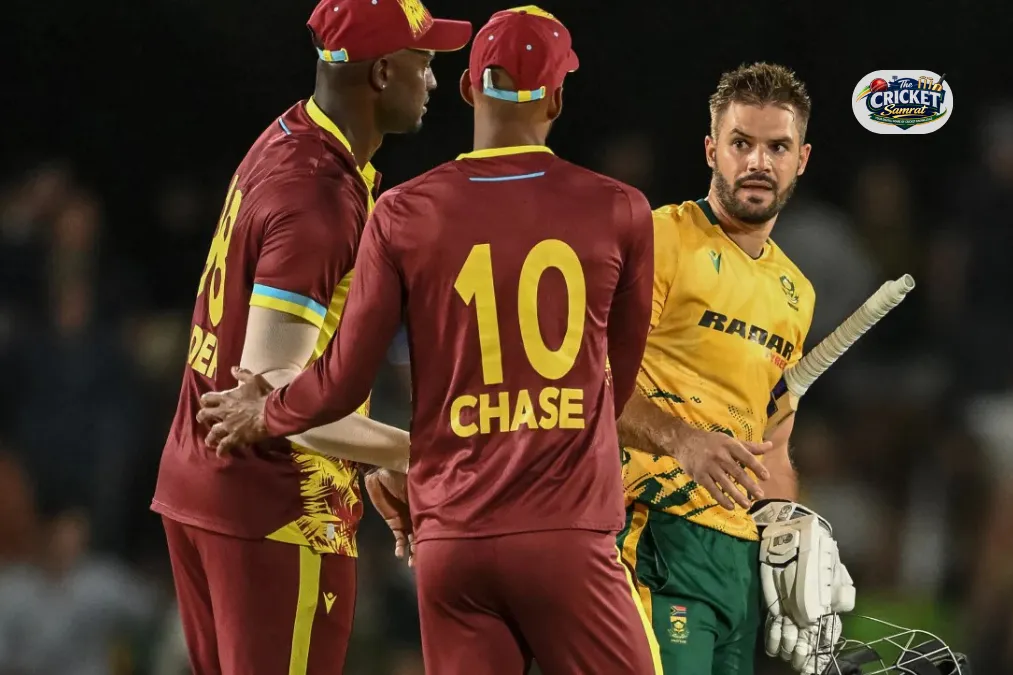
Paarl, South Africa – Full Match Report and Analysis
South Africa vs West Indies 1st T20I Highlights: South Africa delivered a commanding all-round performance to register a thumping nine-wicket victory over West Indies in the South Africa vs West Indies 1st T20I, played at the picturesque Boland Park, Paarl. With this emphatic win, the Proteas surged to a 1–0 lead in the three-match T20I series, underlining their depth, composure, and dominance on home soil.
From disciplined bowling to a ruthless run chase led by captain Aiden Markram, South Africa ticked every box on a night where West Indies showed flashes of promise but ultimately fell short in key moments.
Match Summary – South Africa vs West Indies 1st T20I
| Match | South Africa vs West Indies, 1st T20I |
|---|---|
| Venue | Boland Park, Paarl |
| Result | South Africa won by 9 wickets |
| West Indies | 173/7 (20 overs) |
| South Africa | 176/1 (17.5 overs) |
| Player of the Match | George Linde (3/25) |
| Series Status | South Africa lead 1–0 |
West Indies Bat First After Losing the Toss
Winning the toss, Aiden Markram had no hesitation in bowling first, confident in his bowling unit’s ability to exploit the conditions under lights. The pitch at Paarl offered a touch of two-paced bounce early on, which South Africa’s bowlers used cleverly.
West Indies began cautiously, aiming to build a platform before launching late. However, regular wickets disrupted their rhythm, preventing them from posting the 190-plus total their captain later admitted they were targeting.
West Indies Innings Breakdown: 173/7 in 20 Overs
A Promising Start That Slipped Away
The Caribbean side started steadily but failed to convert starts into big partnerships. At one stage, West Indies found themselves reeling at 95/5, with South Africa firmly in control.
Just when it looked like the innings might collapse, Shimron Hetmyer and Rovman Powell stepped up with a vital middle-order rescue act.
Hetmyer and Powell Provide Middle-Order Resistance
The duo stitched together a crucial 74-run partnership, injecting momentum back into the innings. Hetmyer played with flair and intent, while Powell anchored the stand with calculated aggression.
| Batter | Runs | Balls | Fours | Sixes |
|---|---|---|---|---|
| Shimron Hetmyer | 48 | — | — | — |
| Rovman Powell* | 29 | — | — | — |
Their stand ensured West Indies crossed the 170-run mark, giving their bowlers something to defend.
South Africa’s Bowling: Control Through the Middle Overs
While West Indies did manage to post a competitive total, South Africa’s bowlers ensured it never spiraled out of reach.
George Linde Leads the Way
Left-arm spinner George Linde was the standout performer, using variations in pace and flight to dismantle the West Indies middle order.
| Bowler | Overs | Runs | Wickets |
|---|---|---|---|
| George Linde | 4 | 25 | 3 |
| Keshav Maharaj | 4 | — | 2 |
| Corbin Bosch | — | — | 2 |
| Kagiso Rabada | — | — | 0 |
| Kwena Maphaka | — | — | 0 |
Linde’s figures of 3/25 earned him the Player of the Match award and played a pivotal role in keeping West Indies to a manageable score.
South Africa’s Chase: Calm, Classy, and Clinical
Chasing 174, South Africa approached the task with clarity and confidence. The opening pair of Aiden Markram and Lhuan-dre Pretorius wasted no time, racing to 50 inside the first five overs.
The target was effectively halved during the Powerplay, leaving West Indies scrambling for answers.
Opening Partnership Sets the Tone
The pair added 83 runs for the first wicket, completely shifting momentum in South Africa’s favour.
| Partnership | Runs | Overs |
|---|---|---|
| Markram & Pretorius | 83 | 8.1 |
Pretorius played the aggressor, while Markram anchored the innings with effortless timing and placement.
Pretorius Falls, Markram Marches On
Pretorius was eventually dismissed for a brisk 44 off 28 balls, but by then the damage had already been done. Enter Ryan Rickelton, who seamlessly slotted into the chase.
What followed was a batting exhibition led by the South African skipper.
Aiden Markram’s Captain’s Knock: A T20I Career Best
Markram produced one of the finest innings of his T20I career, finishing unbeaten on 86 off 47 balls. His knock was a blend of composure, innovation, and brute power.
| Batter | Runs | Balls | Strike Rate |
|---|---|---|---|
| Aiden Markram* | 86 | 47 | 182+ |
| Ryan Rickelton* | 40 | — | — |
From classical drives to audacious flat-batted sixes, Markram showcased his full repertoire, ensuring there were no late stumbles.
Final Moments: Markram Seals It in Style
The winning runs came in emphatic fashion. Facing Jason Holder, Markram read the length early and dispatched a short ball through deep mid-wicket for four, sealing a 9-wicket win with 13 balls to spare.
Moments earlier, he had thrilled the crowd with a stunning flat-batted six over long-off — arguably the shot of the match.
West Indies Bowling Struggles Continue
West Indies’ bowling lacked penetration and discipline, particularly in the Powerplay. They allowed South Africa to dictate terms early, and the game slipped away rapidly.
| Bowler | Wickets |
|---|---|
| Roston Chase | 1 |
| Others | 0 |
Injuries may have disrupted their plans, but the lack of pressure with the new ball proved costly.
Captains Speak After the Match
Aiden Markram (South Africa Captain)
Markram expressed delight at starting the series on a winning note, praising his team’s balance across departments. He highlighted the bowling effort under lights and commended Rickelton for adapting his role beautifully outside the Powerplay. Markram also spoke about the squad’s growing depth and the healthy competition for national selection spots.
Roston Chase (West Indies Captain)
Chase acknowledged South Africa’s superiority, admitting that his side fell short of the 190–195 total they were aiming for. He pointed out the lack of substantial partnerships and soft dismissals in the middle overs as major setbacks. While he felt the pitch was playable, Chase expressed hope for a quicker surface in Centurion for the next game.
Player of the Match: George Linde Reflects
Linde spoke warmly about being part of a talented South African group and shared his excitement ahead of the upcoming World Cup. He revealed that an early exit from SA20 gave him valuable rest, helping him return refreshed. While he enjoys batting, Linde emphasized his commitment to fulfilling the team’s needs as a bowler.
What Went Wrong for West Indies?
- Failure to build big partnerships
- Inability to capitalize on starts
- Ineffective Powerplay bowling
- Lack of scoreboard pressure
Despite flashes of brilliance, consistency remains a concern for the visitors.
Series Outlook: What’s Next?
| Match | Venue | Date | Time (GMT) |
|---|---|---|---|
| 2nd T20I | SuperSport Park, Centurion | Thursday, 29 January | 4:00 PM |
| 3rd T20I | — | — | — |
South Africa will look to seal the series in Centurion, while West Indies face a must-win situation to stay alive.
Conclusion:
The South Africa vs West Indies 1st T20I was a statement performance from the Proteas — composed with the ball, ruthless with the bat, and led brilliantly by their captain. For West Indies, the defeat serves as a reminder that strong finishes and disciplined bowling are non-negotiable in modern T20 cricket.
With the series still open, all eyes now turn to Centurion for what promises to be a crucial second encounter.