
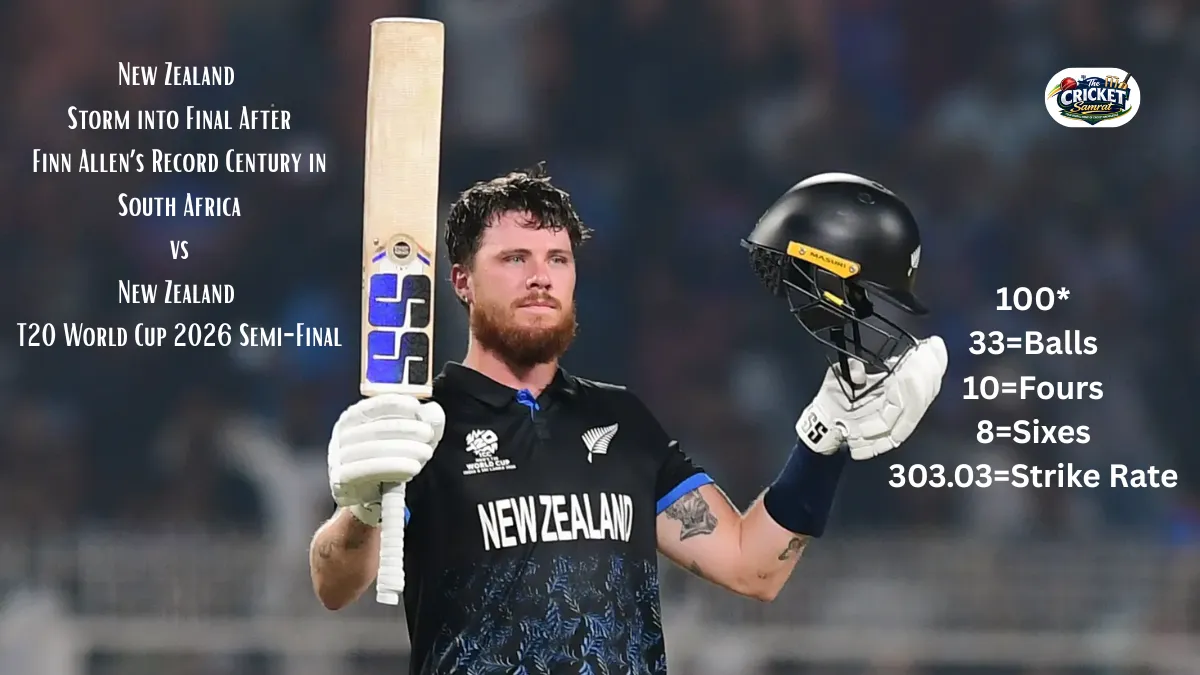
South Africa vs New Zealand: New Zealand produced a stunning performance to defeat South Africa by nine wickets in the first semi-final of the ICC T20 World Cup 2026. The match, widely discussed as the thrilling South Africa vs New Zealand clash, was dominated by an extraordinary innings from Finn Allen, who smashed the fastest century in T20 World Cup history.
Allen’s blistering knock of 100 not out from just 33 balls powered New Zealand into the tournament final in emphatic style. The Kiwi opener shattered the long-standing record previously held by Chris Gayle and delivered one of the most explosive performances ever seen in the competition.
South Africa had earlier posted a competitive total of 169 for 8 in their 20 overs. However, New Zealand’s aggressive batting lineup made the chase look effortless, reaching the target in only 12.5 overs while losing just one wicket.
𝙊𝙣𝙚 𝙨𝙩𝙚𝙥 𝙘𝙡𝙤𝙨𝙚𝙧 𝙩𝙤 𝙝𝙞𝙨𝙩𝙤𝙧𝙮 🇳🇿
— ICC (@ICC) March 4, 2026
New Zealand are through to the #T20WorldCup 2026 Final 🤩 pic.twitter.com/mu40jg4k3C
Match Summary: South Africa vs New Zealand Semi-Final
| Match | ICC T20 World Cup 2026 – 1st Semi-Final |
|---|---|
| Teams | South Africa vs New Zealand |
| Venue | T20 World Cup 2026 |
| South Africa Score | 169/8 (20 Overs) |
| New Zealand Score | 170/1 (12.5 Overs) |
| Result | New Zealand won by 9 wickets |
| Player of the Match | Finn Allen |
The South Africa vs New Zealand semi-final quickly turned into a one-sided contest once Allen began attacking the bowlers from the start of the innings.
A record-breaking knock from Finn Allen took New Zealand into the #T20WorldCup final🙌
— ICC (@ICC) March 4, 2026
He wins the @aramco POTM🏅
📝: https://t.co/nv2bu4uGh7 pic.twitter.com/SnTAU9mWX4
Finn Allen Breaks World Record with Fastest T20 World Cup Century
The highlight of the match was Finn Allen’s breathtaking century. The New Zealand opener reached his hundred in only 33 balls, setting a new record for the fastest century in T20 World Cup history.
Previously, West Indies legend Chris Gayle held the record with a 47-ball century against England during the 2016 T20 World Cup. Allen’s remarkable innings surpassed that mark by a significant margin.
Allen finished unbeaten on 100 runs, smashing 10 fours and 8 sixes in a fearless display of power hitting. His ability to find boundaries all around the ground left the South African bowlers helpless.
Finn Allen’s Record Innings
| Runs | Balls | Fours | Sixes | Strike Rate |
|---|---|---|---|---|
| 100* | 33 | 10 | 8 | 303.03 |
This incredible innings ensured that the South Africa vs New Zealand semi-final will be remembered as one of the most explosive matches in T20 World Cup history.
Finn Allen’s blazing ton in the chase gets New Zealand into their second Men’s #T20WorldCup final 🔥
— ICC (@ICC) March 4, 2026
📝: https://t.co/nv2bu4uGh7 pic.twitter.com/j4DcTSum3y
New Zealand’s Dominant Chase
New Zealand’s batting lineup showed complete control during the chase. From the opening overs, the Kiwi batters attacked the South African bowling attack with confidence.
The team reached 50 runs in just 4.1 overs and quickly accelerated towards the target. By the 7.5-over mark, New Zealand had already crossed the 100-run milestone, putting the match firmly in their control.
Tim Seifert provided strong support to Allen with an aggressive half-century. His 58 runs from 33 balls included seven fours and two sixes before he was eventually dismissed by Kagiso Rabada.
New Zealand Batting Scorecard
| Player | Runs | Balls | Fours | Sixes | Dismissal |
|---|---|---|---|---|---|
| Finn Allen | 100* | 33 | 10 | 8 | Not Out |
| Tim Seifert | 58 | 33 | 7 | 2 | Bowled (Rabada) |
| Rachin Ravindra | 13* | 11 | 2 | 0 | Not Out |
Allen also reached his half-century quickly, scoring 50 runs from just 19 balls with six fours and three sixes.
The partnership between Allen and Seifert completely changed the momentum of the South Africa vs New Zealand match, leaving South Africa without any chance of defending their total.
South Africa’s Innings: Jansen Leads the Fight
Earlier in the match, South Africa struggled to build consistent partnerships after losing early wickets. Despite the setbacks, Marco Jansen played a crucial role in helping the team reach a respectable total.
Jansen remained unbeaten on 55 runs from 30 balls, hitting two fours and five massive sixes. His late attacking innings helped South Africa push their score close to 170.
South Africa Batting Scorecard
| Player | Runs | Balls | Fours | Sixes | Dismissal |
|---|---|---|---|---|---|
| Marco Jansen | 55* | 30 | 2 | 5 | Not Out |
| Dewald Brevis | 34 | 27 | 3 | 2 | Caught |
| Tristan Stubbs | 29 | 24 | 2 | 1 | Bowled |
| Aiden Markram | 18 | 20 | 1 | 1 | Caught |
| Quinton de Kock | 10 | 8 | 1 | 1 | Out |
| David Miller | 6 | 6 | 0 | 0 | Caught |
| Ryan Rickelton | 0 | 1 | 0 | 0 | Out |
| Corbin Bosch | 2 | 3 | 0 | 0 | Out |
| Kagiso Rabada | 0 | 1 | 0 | 0 | Out |
South Africa reached the 100-run mark in 13.5 overs, but the lack of acceleration in the middle overs prevented them from posting a larger total.
New Zealand Bowling Performance
New Zealand’s bowlers managed to control South Africa’s batting lineup for most of the innings. Key wickets at crucial moments prevented the Proteas from building a big total.
Matt Henry and Lockie Ferguson were particularly effective with the ball, applying pressure during the middle overs.
Playing XI – South Africa vs New Zealand
New Zealand Team
| Player |
|---|
| Finn Allen |
| Tim Seifert |
| Rachin Ravindra |
| Glenn Phillips |
| Daryl Mitchell |
| Mark Chapman |
| Mitchell Santner (Captain) |
| Cole McConchie |
| James Neesham |
| Matt Henry |
| Lockie Ferguson |
South Africa Team
| Player |
|---|
| Aiden Markram (Captain) |
| Quinton de Kock |
| Ryan Rickelton |
| Dewald Brevis |
| David Miller |
| Tristan Stubbs |
| Marco Jansen |
| Corbin Bosch |
| Keshav Maharaj |
| Kagiso Rabada |
| Lungi Ngidi |
New Zealand captain Mitchell Santner won the toss and chose to field first, a decision that ultimately proved to be correct as the Kiwi team dominated the chase.
🚨 Change of Innings 🚨#TheProteas finish their innings at 169/8 after 20 overs following an impressive fightback. 🙌🏟
— Proteas Men (@ProteasMenCSA) March 4, 2026
A defendable total on the board, with plenty for our bowlers to work with. 🇿🇦👏#Unbreakable #T20WorldCup pic.twitter.com/BO95qdpNk8
Also read: ICC Announces Elite Match Officials for the T20 Cricket World Cup 2026 Semi-Finals
A Historic Night for New Zealand
The South Africa vs New Zealand semi-final will be remembered for Finn Allen’s extraordinary batting display. His record-breaking century not only secured New Zealand’s place in the final but also created a historic moment in T20 World Cup history.
For South Africa, the defeat was disappointing despite Marco Jansen’s strong performance. The team struggled to contain New Zealand’s aggressive batting, especially during the powerplay overs.
With this commanding victory, New Zealand now advances to the T20 World Cup 2026 final, carrying strong momentum and confidence. If Allen continues his remarkable form, the Kiwi team could be a serious contender for the championship title.