
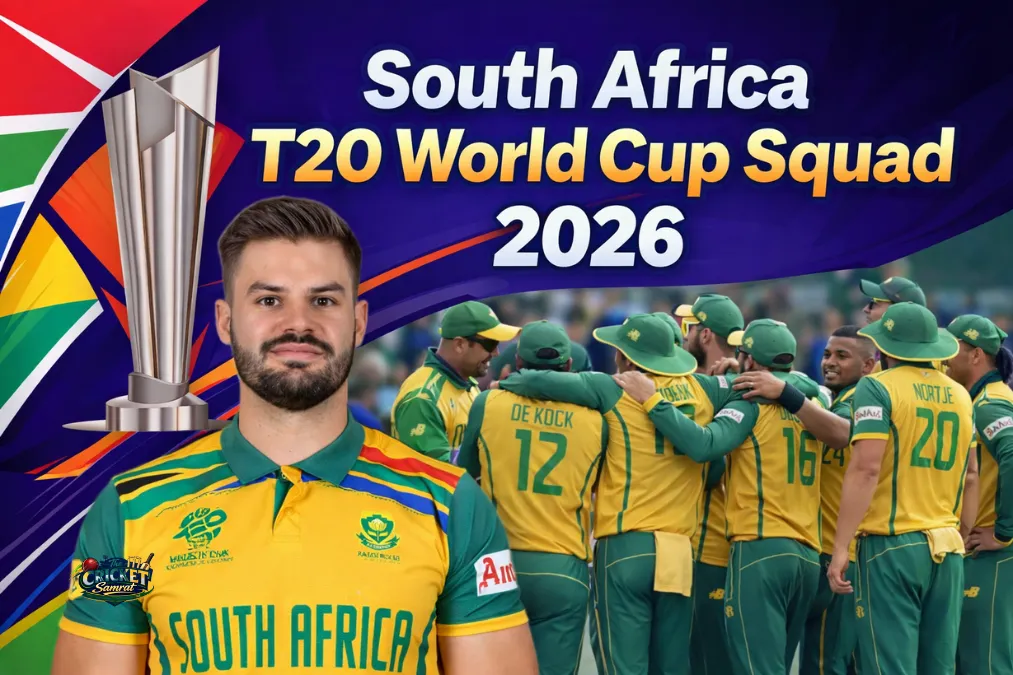
Cricket South Africa (CSA) has officially announced changes to the South Africa T20 World Cup squad 2026, bringing in Tristan Stubbs and Ryan Rickelton as replacements following a string of injury concerns that emerged during the ongoing SA20 league. The late reshuffle comes after Donovan Ferreira and Tony de Zorzi were ruled out due to injuries sustained while representing their franchises.
The ICC T20 World Cup 2026 is scheduled to begin on 7 February, with matches hosted jointly by India and Sri Lanka. South Africa, placed in Group D, will begin their campaign in Ahmedabad, hoping that timely recoveries and smart squad depth will keep their title hopes alive.
Injury Crisis Forces Changes in South Africa T20 World Cup Squad 2026
CSA confirmed on Thursday that the decision to modify the squad was purely driven by medical assessments and not tactical changes. Donovan Ferreira and Tony de Zorzi picked up injuries while playing in the high-intensity SA20 competition, leaving the national selectors with little option but to act swiftly.
Despite the last-minute nature of the changes, CSA stressed that the management remains confident in the balance and experience of the updated south africa t20 world cup squad 2026, particularly with players like Stubbs and Rickelton offering flexibility across formats.
Players Replaced and Added – Squad Changes at a Glance
| Outgoing Players | Reason | Incoming Players | Role |
|---|---|---|---|
| Donovan Ferreira | Injury (SA20) | Tristan Stubbs | Middle-order batter |
| Tony de Zorzi | Injury (SA20) | Ryan Rickelton | Wicketkeeper-batter |
Both Stubbs and Rickelton have been part of South Africa’s wider white-ball setup in recent years, making their inclusion a relatively smooth transition for team balance and strategy.
SA20 Injury Concerns Continue to Mount
The injury worries were not limited to Ferreira and de Zorzi. South Africa suffered multiple setbacks during SA20, raising concerns ahead of the global tournament.
David Miller, one of South Africa’s most experienced T20 campaigners, sustained an injury while playing for Paarl Royals. He was ruled out of the SA20 Eliminator match against Joburg Super Kings in Centurion, casting doubt over his short-term availability.
Meanwhile, fast bowler Lungi Ngidi, representing Pretoria Capitals, was unable to complete his full quota of overs in Qualifier 1. Although his injury is believed to be minor, CSA’s medical team continues to monitor his fitness closely.
Young batting sensation Dewald Brevis also suffered a finger injury after smashing a rapid 75 off 38 balls on Sunday. Despite the setback, Brevis, Ngidi, and Miller remain part of the south africa t20 world cup squad 2026, with varying recovery timelines.
CSA Explains Decision on Ngidi and Bartman
One of the more debated decisions was CSA’s choice to retain Lungi Ngidi in the squad, despite his fitness concerns. This decision meant that Ottniel Baartman, the leading wicket-taker of SA20, missed out on a World Cup call-up.
CSA clarified that medical feedback suggests both Ngidi and Brevis are likely to recover in time, whereas Miller’s injury may require extended rehabilitation. The selectors emphasized experience as a critical factor, particularly for pressure matches later in the tournament.
Ryan Rickelton to Feature Against West Indies Before World Cup
Wicketkeeper-batter Ryan Rickelton is set for a busy schedule. In addition to being named in the south africa t20 world cup squad 2026, he will also represent South Africa in the upcoming three-match T20 series against West Indies next week.
CSA confirmed that David Miller will miss the West Indies series, and if his injury worsens, Rubin Hermann could be drafted in as a replacement. Hermann impressed during SA20, scoring 205 runs in eight innings for Sunrisers, earning praise for his composure under pressure.
South Africa’s Group D Fixtures and Schedule
South Africa has been drawn into Group D, alongside Canada, Afghanistan, New Zealand, and the UAE. The Proteas will begin their World Cup journey on 9 February in Ahmedabad.
Group D Match Schedule
| Date | Match | Venue |
|---|---|---|
| 9 February | South Africa vs Canada | Ahmedabad |
| 11 February | South Africa vs Afghanistan | Ahmedabad |
| 14 February | South Africa vs New Zealand | Ahmedabad |
| 18 February | South Africa vs UAE | Delhi |
South Africa will play their first three group matches in Ahmedabad before moving to Delhi for the final group-stage fixture.
Tactical Balance in South Africa T20 World Cup Squad 2026
The updated squad reflects South Africa’s emphasis on pace bowling depth, all-round flexibility, and explosive batting options. With experienced campaigners like Kagiso Rabada, Anrich Nortje, and Quinton de Kock, combined with younger stars such as Brevis, Stubbs, and Rickelton, the team blends experience with modern T20 dynamism.
Captain Aiden Markram will shoulder leadership responsibilities while also contributing with the bat and part-time spin, a crucial asset in subcontinent conditions.
Complete South Africa T20 World Cup Squad 2026
| Player | Role |
|---|---|
| Aiden Markram (Captain) | Top-order batter |
| Corbin Bosch | All-rounder |
| Dewald Brevis | Batter |
| Quinton de Kock | Wicketkeeper-batter |
| Marco Jansen | Bowling all-rounder |
| George Linde | Spin all-rounder |
| Keshav Maharaj | Spinner |
| Kwena Maphaka | Fast bowler |
| David Miller | Middle-order batter |
| Lungi Ngidi | Fast bowler |
| Anrich Nortje | Fast bowler |
| Kagiso Rabada | Fast bowler |
| Ryan Rickelton | Wicketkeeper-batter |
| Jason Smith | All-rounder |
| Tristan Stubbs | Batter |
Also read: Bangladesh Cricket T20 World Cup 2026: ICC Issues Ultimatum Amid Participation Controversy
Conclusion: Can South Africa Overcome Injury Woes?
Despite the injury setbacks, the south africa t20 world cup squad 2026 remains competitive and well-balanced. The inclusion of Stubbs and Rickelton adds batting depth, while the fast-bowling unit continues to be one of the most feared in world cricket.
Much will depend on the fitness of senior players like Miller and Ngidi, but South Africa’s management appears confident that key players will peak at the right time. As the tournament kicks off in India and Sri Lanka, the Proteas will be aiming to finally convert potential into a long-awaited ICC title.