
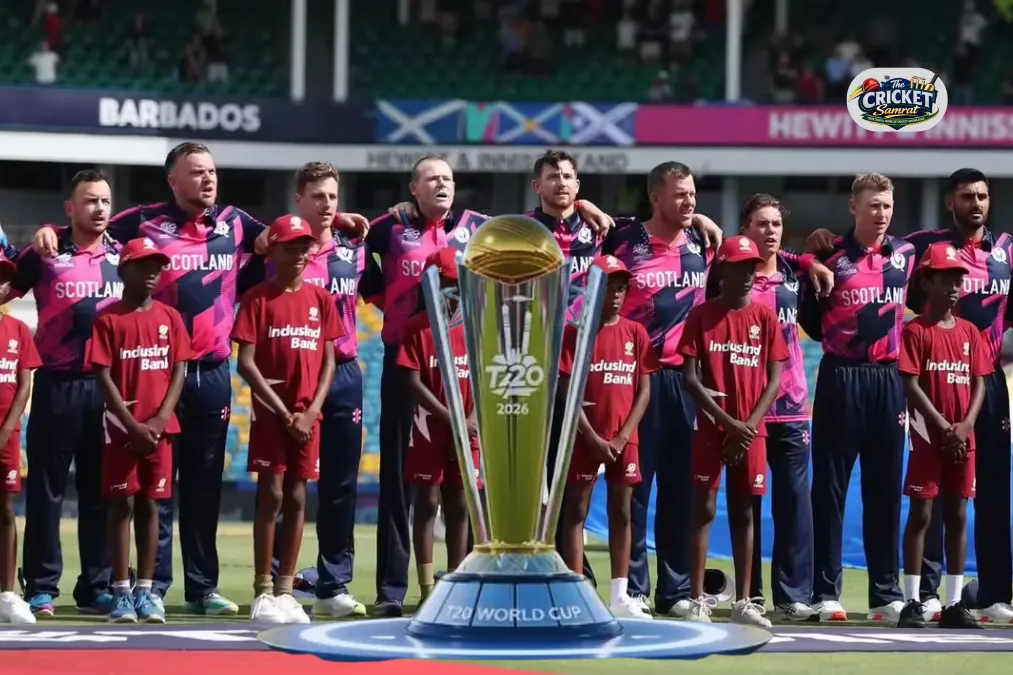
Cricket Scotland has officially unveiled the Scotland Squad T20 World Cup 2026, naming a 15-member team ahead of the global tournament in India. While the squad announcement brings clarity to Scotland’s on-field plans, uncertainty continues to surround the off-field situation, particularly regarding visa approvals for players of Pakistani origin-most notably fast bowler Safyaan Sharif.
Scotland, who replaced Bangladesh in the tournament lineup following qualification adjustments, are scheduled to travel to India later this week. However, visa-related delays have cast a shadow over the team’s preparations, forcing Cricket Scotland to work closely with the International Cricket Council (ICC) and the Board of Control for Cricket in India (BCCI) to ensure all players receive clearance in time.
Despite the uncertainty, Scottish officials remain confident that the matter will be resolved before their opening match of the tournament.
Visa Issues Cloud Scotland’s Travel Plans to India
While the Scotland Squad T20 World Cup 2026 has been confirmed, the team’s journey to India has not been entirely smooth. Several players, including Safyaan Sharif, are still awaiting visa approvals, creating last-minute anxiety ahead of departure.
Historically, visa processing for individuals with Pakistani heritage can be time-consuming due to diplomatic sensitivities between India and Pakistan. Although Safyaan Sharif was born in England and has lived in Scotland since childhood, his Pakistani lineage has reportedly contributed to delays in documentation.
Cricket Scotland has acknowledged the situation and confirmed that discussions are ongoing at the highest administrative levels.
ICC and BCCI Working Together on Visa Clearances
Cricket Scotland Chief Executive Trudy Lindblade addressed the situation, emphasizing that visa procedures are inherently unpredictable, regardless of preparation timelines.
“Visa processes are never completely certain, whether you apply three days or forty-five days in advance. Over the last 48 hours, our full focus has been on ensuring our players can travel to India on time. The ICC is actively coordinating with the BCCI and local authorities, and we remain confident that all necessary clearances will be completed before our first match.”
The ICC has reportedly assured Cricket Scotland that every possible step is being taken to expedite approvals, particularly given the proximity of the tournament’s opening fixtures.
Why Safyaan Sharif’s Case Is Especially Important
Safyaan Sharif’s situation has drawn special attention due to his importance to Scotland’s bowling attack. A proven fast bowler with international experience, Sharif has been a consistent performer for Scotland in limited-overs cricket.
Safyaan Sharif: Background Snapshot
| Detail | Information |
|---|---|
| Place of Birth | Huddersfield, England |
| Heritage | Pakistani father, British-Pakistani mother |
| Moved to Scotland | At age 7 |
| Role | Right-arm fast bowler |
| International Experience | Extensive T20I and ODI appearances |
Given his background, Cricket Scotland has taken precautionary measures by naming additional reserve players to ensure squad depth in case of last-minute travel disruptions.
Scotland Names Travel and Non-Travel Reserves
To mitigate risk, Scotland has included two travelling reserves and three non-travelling reserves in its broader World Cup setup. This ensures that the team can field a complete and competitive XI even if visa delays persist for certain players.
This contingency planning reflects the seriousness with which Scotland is approaching its World Cup campaign — particularly in a group featuring established cricketing nations.
Three Major Changes From Scotland’s Previous World Cup Squad
Compared to Scotland’s squad from the previous global event, the Scotland squad for T20 World Cup 2026 features three significant changes, blending youth, experience, and strategic depth.
1. Zainullah Ihsan – Teenage Pace Sensation
One of the most exciting inclusions is Zainullah Ihsan, a 19-year-old fast bowler born in Afghanistan. Ihsan has impressed selectors with his raw pace, athleticism, and composure beyond his years.
This tournament marks his first senior World Cup call-up, and he is widely regarded as one of Scotland’s brightest fast-bowling prospects.
2. Tom Bruce – International Experience Added
Former New Zealand international Tom Bruce, who has featured in 17 T20 internationals for the Black Caps, now dons the Scotland jersey. His inclusion adds invaluable experience and batting stability to the middle order.
Bruce’s ability to adapt quickly to high-pressure situations could prove crucial in tightly contested group matches.
3. Chris Sole Left Out
Speedster Chris Sole, known for regularly clocking speeds of over 145 km/h, has been omitted from the squad. Cricket Scotland confirmed that Sole is currently focusing on his professional career outside cricket, particularly in the recruitment sector.
While his absence is notable, selectors believe the current bowling unit offers better balance and depth.
Scotland’s Group Placement at the T20 World Cup 2026
Scotland have been placed in Group C, a challenging pool that features a mix of elite teams and emerging cricketing nations.
T20 World Cup 2026 – Group Breakdown
| Group | Teams |
|---|---|
| Group A | India, Pakistan, USA, Namibia, Netherlands |
| Group B | Australia, Sri Lanka, Zimbabwe, Ireland, Oman |
| Group C | England, West Indies, Italy, Scotland, Nepal |
| Group D | South Africa, New Zealand, Afghanistan, UAE, Canada |
Only the top two teams from each group will advance to the Super 8 stage, leaving little margin for error in the group phase.
Scotland’s Opening Match and Tournament Schedule
Scotland are set to begin their campaign on February 7 in Kolkata, where they will face West Indies in what promises to be a high-profile clash.
Before competitive action begins, the team will play two warm-up matches in Bengaluru, providing crucial acclimatization to Indian conditions.
Scotland Warm-Up Matches
| Date | Opponent | Venue |
|---|---|---|
| February 2 | Afghanistan | Bengaluru |
| February 4 | Namibia | Bengaluru |
Following these fixtures, the squad will travel to Kolkata for the official group-stage matches.
Full Scotland Squad T20 World Cup 2026
Here is the officially announced Scotland Squad T20 World Cup 2026:
Main Squad (15 Players)
| Player | Role |
|---|---|
| Richie Berrington (Captain) | All-rounder |
| Tom Bruce | Batter |
| Matthew Cross | Wicketkeeper |
| Brad Currie | Bowler |
| Ollie Davidson | Bowler |
| Chris Greaves | All-rounder |
| Zainullah Ihsan | Fast Bowler |
| Michael Jones | Batter |
| Michael Leask | All-rounder |
| Finlay McCreath | Batter |
| Brandon McMullen | All-rounder |
| George Munsey | Batter |
| Safyaan Sharif | Fast Bowler |
| Mark Watt | Spinner |
| Brad Wheal | Fast Bowler |
Reserve Players
| Category | Players |
|---|---|
| Travelling Reserves | Jasper Davidson, Jack Jarvis |
| Non-Travelling Reserves | Named internally by team management |
Also read: Pakistan Submits Preliminary Squad to ICC for T20 World Cup 2026-pakistan t20 world cup squad 2026
Tactical Outlook: What Scotland Brings to the World Cup
The Scotland Squad T20 World Cup 2026 reflects a careful balance of power-hitting batters, adaptable all-rounders, and a versatile bowling attack capable of adjusting to Indian pitches.
- Spin depth from Mark Watt and Michael Leask could be decisive on slower surfaces.
- Middle-order stability from Berrington, McMullen, and Bruce offers resilience.
- Pace variety with Sharif, Wheal, Currie, and Ihsan ensures flexibility across venues.
Scotland’s recent performances in global tournaments suggest they are no longer just participants but genuine competitors capable of upsetting higher-ranked teams.
Confidence High Despite Off-Field Challenges
Although visa concerns remain unresolved for some players, Cricket Scotland remains optimistic. Officials believe that administrative hurdles will be cleared well before match day, allowing the squad to focus entirely on cricket.
With warm-up matches, a settled core, and strategic depth across departments, Scotland enters the T20 World Cup determined to make a strong impression on the global stage.
As anticipation builds, all eyes will remain on visa developments-particularly surrounding Safyaan Sharif -while fans eagerly await Scotland’s opening clash in Kolkata.
Also read: England T20 World Cup Squad Announced Ahead of Key Sri Lanka Tour
Conclusion:
The announcement of the Scotland Squad T20 World Cup 2026 marks a significant milestone for Scottish cricket. While logistical challenges have tested preparations, the team’s composition, planning, and confidence suggest Scotland is ready to compete fearlessly against the world’s best.
If administrative issues are resolved in time, Scotland could emerge as one of the tournament’s most intriguing teams-blending youth, experience, and ambition on cricket’s biggest stage.