
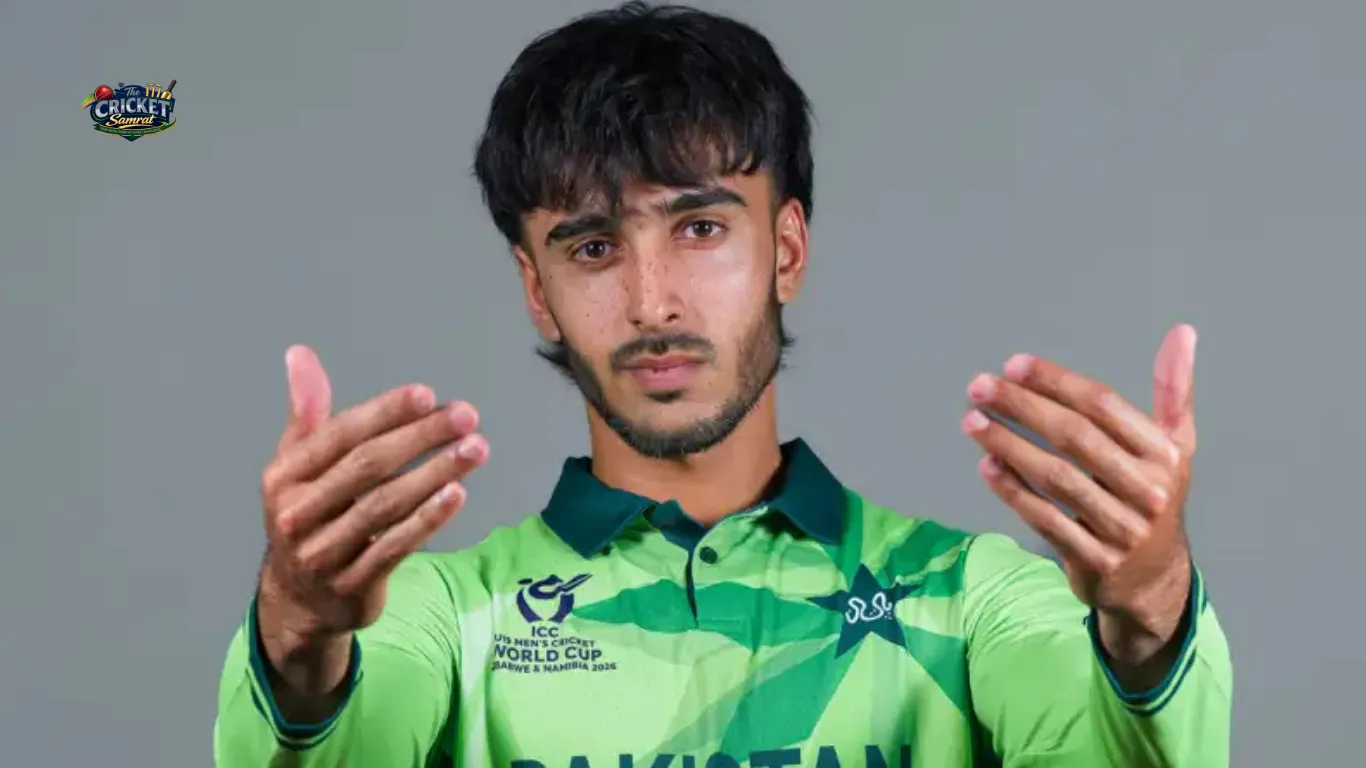
Sameer Ahmed Minhas: In an era where young batters are often defined by brute strength and boundary-hitting power, Sameer Ahmed Minhas stands out as a refreshing exception. At just 19, the Pakistan Under-19 opener has already captured the imagination of fans, former players and analysts across the cricketing world. His meteoric rise has not been built on raw muscle or reckless aggression, but on intelligence, timing, and a deep understanding of the craft of batting.
From the narrow lanes of Multan to record-breaking performances on the international youth stage, the story of Sameer Ahmed Minhas is one of discipline, family support, and an old-school approach thriving in a modern game.
A Childhood Memory That Shaped a Cricketer
Sameer Ahmed Minhas still laughs when he recalls one of his earliest cricketing memories, a moment that unknowingly foreshadowed the fearless composure he would later display on much bigger stages.
At just nine years old, Minhas found himself facing his elder brother Arafat in a local single-wicket tournament in Multan. The odds were firmly stacked against him. Arafat, older and more experienced, confidently set a target of 10 to 12 runs in an over. When the contest came down to the final ball, young Sameer needed four or five runs to win.
“I hit him for a six,” Minhas recalls with a grin. “Everyone went into wild celebrations.”
That instinct to rise under pressure, even as a child, has remained a defining feature of Sameer Ahmed Minhas’ cricketing journey.
From Multan Streets to Continental Glory
A decade after that backyard triumph, Sameer Ahmed Minhas delivered a performance that echoed across Pakistan and beyond. In the final of the Under-19 Asia Cup at the ICC Academy in Dubai, he played one of the most remarkable innings in youth cricket history.
Facing arch-rivals India on a high-pressure stage, Minhas produced a stunning 172 off 113 balls. The innings was not just about the numbers. It was about how he scored those runs.
He struck 17 fours and nine sixes, but none of them looked forced. Every boundary flowed from timing, balance and placement. Cuts, drives, flicks, pulls and sweeps came effortlessly, as if he was batting in a practice session rather than a continental final.
One shot in particular stood out. In the ninth over, fast bowler Deepesh Devendran pitched it up, and Minhas responded with a perfectly checked on-drive that sailed over the boundary for six. It was a stroke that spoke volumes about his control and confidence.
There was no area of the ground he failed to access that morning.
A Nation Takes Notice
That innings instantly catapulted Sameer Ahmed Minhas into the national spotlight. Social media lit up with praise from former and current cricketers, political figures and public personalities. The fact that the knock came against India, during a year of heightened political tensions between the two countries, only amplified its impact.
For Minhas himself, however, the day was about routine and belief rather than hype.
“It is a memorable innings for me,” he said later from Zimbabwe, ahead of the 2026 Under-19 World Cup. “There was pressure, no doubt, but I told myself to bat the same way I had throughout the tournament – staying cool, calm and fearless.”
He described the day as no different from any other match.
“I woke up, took a shower, had breakfast, went to the ground, put on my spikes and crossed the rope believing we would win the Asia Cup. I didn’t have any special plans. I just wanted to contribute to the team.”
Consistency Before the Final
The Asia Cup final was not an isolated masterpiece. It was the culmination of a tournament dominated by Sameer Ahmed Minhas.
Just nine days earlier, in his very first match for Pakistan Under-19s, Minhas had smashed 177 not out off 148 balls against Malaysia. Over five innings in the tournament, he amassed an astonishing 471 runs at an average of 157 and a strike rate of over 117.
He finished as Player of the Tournament, hitting the most fours (41) and the second-most sixes (19).
Sameer Ahmed Minhas – Asia Cup Performance Summary
| Statistic | Number |
|---|---|
| Matches | 5 |
| Runs | 471 |
| Average | 157.00 |
| Strike Rate | 117+ |
| Fours | 41 |
| Sixes | 19 |
| Highest Score | 177* |
Such numbers marked him as a potentially generational talent.
Records Continue to Fall
The momentum did not stop after the Asia Cup. Eight days after his heroics against India, Minhas struck another century – 142 off fewer than a run a ball – against Zimbabwe in a washed-out Under-19 tri-series match in Harare.
A week later, he went even further. In the final of the same series, Sameer Ahmed Minhas smashed the fastest hundred in Youth ODIs, reaching the landmark in just 42 balls. He finished with 114 off 51 deliveries as Pakistan chased down 159 in under 17 overs.
Once again, Minhas was named Player of the Series.
Learning from Failure
Ironically, the foundation for that record-breaking knock was laid in failure.
Two days before his 142 against Zimbabwe, Minhas suffered a two-ball duck against Afghanistan in his first match after the Asia Cup final.
“I learned from that zero,” he said candidly. “You cannot score runs every day. It teaches you how fortunes fluctuate as a batter.”
Rather than letting the disappointment linger, he used it as a reminder of cricket’s unpredictability.
A Batter Who Thinks the Game
What sets Sameer Ahmed Minhas apart is his understanding of batting as a process rather than a highlight reel.
At a time when fearless cricket is often interpreted as relentless aggression, Minhas offers a more nuanced definition.
“Some people think fearless cricket means hit, hit, hit,” he explained. “For me, it is about maximising scoring opportunities. If the ball is in my zone, whether it’s the first ball or the last, I will attack it.”
He is comfortable absorbing pressure, playing maidens, and waiting for the right moment to accelerate.
“I know I can score 100 if I play 150 balls,” he said. “Once I am settled, my strike rate improves naturally because I start timing the ball better.”
A Cricketing Family from Multan
Cricket runs deep in the Minhas household. Sameer’s elder brother Arafat is already an international, having made his senior T20I debut during the 2023 Asian Games. Arafat has also represented Pakistan in a previous Under-19 World Cup and played four PSL matches for Karachi Kings.
Growing up, the brothers created their own testing conditions at home.
“We used to tape half the tennis ball to make it swing,” Minhas recalled. “We bowled fast at each other on wet tiles. If you edged it or hit it out of the house, you were out.”
Their father, Kashif Minhas, also played a crucial role. A former tape-ball fast bowler himself, he enrolled both sons at Crescent Cricket Club in Multan and encouraged them to switch to leather-ball cricket early.
During Covid-19 lockdowns, Kashif even rolled a pitch on the roof of their house and covered it with nets. A thunderstorm destroyed it after two days, but the intent spoke volumes about the family’s commitment.
From Legspinner to Elite Batter
Sameer Ahmed Minhas began his competitive journey in 2018, representing Multan in the PCB Under-13 tournament. Initially a legspinner, he was Southern Punjab’s leading wicket-taker in one season.
Over time, however, he discovered a greater passion for batting.
Under coach Tahir Mahmood Faiz, Minhas underwent a technical transformation. He learned to loosen his grip, play with soft hands and focus on timing rather than force.
“I realised I am not a power-hitter,” Minhas said. “I am a good timer of the ball.”
Youth ODI Dominance
Since his debut, no batter has been more prolific in Youth ODIs than Sameer Ahmed Minhas.
Most Runs in Youth ODIs (Since December 2025)
| Player | Runs |
|---|---|
| Sameer Ahmed Minhas | 654 |
| Vaibhav Sooryavanshi | 419 |
| Aaron George | 371 |
| Usman Khan | 326 |
| Faisal Shinozada | 249 |
He also boasts the best average in that period and the second-best strike rate, placing him alongside legends like Babar Azam and Shahzaib Khan in terms of Youth ODI centuries for Pakistan.
Handling Pressure and Expectations
With Pakistan beginning their Under-19 World Cup campaign against England, hopes are high that Sameer Ahmed Minhas can help end the country’s two-decade drought in the tournament.
Despite the expectations, Minhas remains grounded.
“I feel confident because of my form,” he said. “I don’t focus on social media or news. I am here to represent my country.”
Balancing Cricket and Education
Away from the field, Minhas is also preparing for life beyond cricket. At his mother’s insistence, he has enrolled for A Levels, choosing Business Studies, Urdu and Sociology to balance academics with a demanding cricket schedule.
“I cleared my O Level in Computer Science, which was tough to manage with cricket,” he said.
Eyes on All Formats
While many young players gravitate towards T20 riches, Sameer Ahmed Minhas has his heart set on all formats.
“I love Test cricket,” he said. “It tests your temperament over five days. I want to represent Pakistan in all three formats for a long time.”
In a world increasingly obsessed with power, Sameer Ahmed Minhas is proving that timing, temperament and thoughtfulness can still define greatness.