
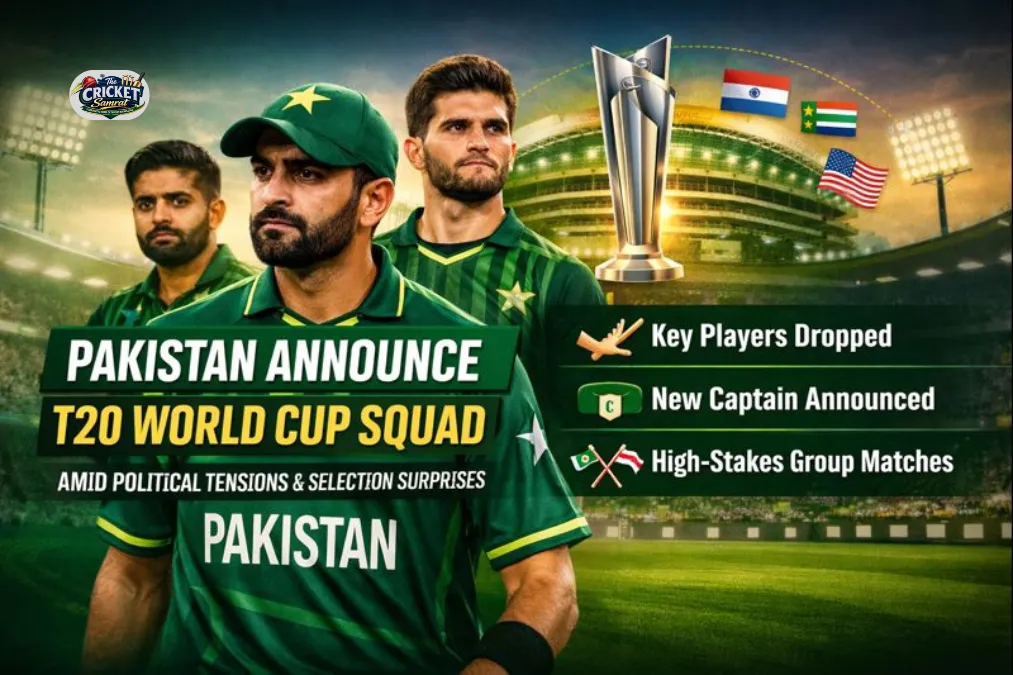
Pakistan announce T20 World Cup squad for the 2026 edition of the tournament, drawing global attention not only for major selection calls but also for the political and administrative drama that unfolded just days earlier. The announcement came shortly after Pakistan Cricket Board (PCB) chairman Mohsin Naqvi publicly questioned Pakistan’s participation following Bangladesh’s removal from the competition, sparking intense debate across the cricketing world.
Despite the uncertainty created by boycott-related statements and diplomatic rhetoric, the PCB moved forward and confirmed a 15-member squad, signalling Pakistan’s intent to compete while also making bold changes to its team composition. The exclusion of senior players Mohammad Rizwan and Haris Rauf, coupled with the retention of Babar Azam despite recent struggles, has made this squad one of the most discussed in recent memory.
Background: ICC Decision and Bangladesh’s Exit
The build-up to the T20 World Cup 2026 has been anything but smooth. The controversy began when Bangladesh refused to travel to India for the tournament, citing security concerns. Their stance prompted an extensive review process by the International Cricket Council (ICC), which commissioned independent security assessments from both internal and external experts.
According to ICC sources, these assessments found no credible or verifiable security threat to the Bangladesh national team, team officials, or supporters during the event. Despite assurances, Bangladesh maintained its reluctance to participate, leaving the ICC with little choice but to act in order to protect the tournament’s integrity and schedule.
As a result, Bangladesh were officially removed from the competition and replaced by Scotland, a decision that immediately drew mixed reactions from cricket boards and fans alike.
Mohsin Naqvi’s Strong Response and Boycott Talk
PCB chairman Mohsin Naqvi emerged as one of the strongest voices in support of Bangladesh. Publicly criticising the ICC’s handling of the situation, Naqvi described the decision as unfair and hinted that Pakistan’s participation in the T20 World Cup 2026 would depend on approval from the Pakistani government.
His comments triggered speculation about a possible boycott and raised concerns about another politically charged tournament scenario involving Pakistan. For nearly 24 hours, uncertainty loomed over whether Pakistan would even field a team, with media outlets worldwide reporting on the escalating tension.
However, the PCB moved swiftly to calm speculation. Just a day after Naqvi’s remarks, the board released Pakistan’s official squad list, effectively confirming the team’s participation and shifting the focus back to cricket.
Pakistan Announce T20 World Cup Squad: Major Selection Calls
When Pakistan announce T20 World Cup squad, the selection choices often become a talking point — and this year is no exception. The 2026 squad reflects a strategic shift toward flexibility, youth, and recent form rather than seniority alone.
Key Omissions
Two of the most notable exclusions are:
- Mohammad Rizwan
- Haris Rauf
Rizwan, a long-time pillar of Pakistan’s T20 batting line-up, has not featured in the national T20I setup for over a year. His last appearance in the format came in 2024, and selectors appear to have moved on in search of a different balance.
Haris Rauf’s omission is equally significant. The fast bowler struggled in high-pressure moments, most notably during the Asia Cup 2025 final, where his performance came under heavy criticism. The selectors have opted for other pace options, suggesting a no-compromise approach to recent form.
Babar Azam Retained Despite Form Concerns
One of the most debated decisions in the squad announcement is the retention of Babar Azam. The former captain endured a difficult stint in the Big Bash League (BBL) 2025–26 in Australia, where he failed to produce consistent scores.
Despite those struggles, the selectors have shown faith in Babar’s experience and ability to perform on the global stage. His presence adds stability to the batting order and leadership depth, even though he will not captain the side.
For many analysts, this decision underlines Pakistan’s belief that proven international class still holds value in major tournaments.
Salman Ali Agha Appointed Captain
In a notable leadership shift, Salman Ali Agha has been named captain for the T20 World Cup 2026. Known for his calm temperament and tactical awareness, Agha represents a new-generation leadership approach for Pakistan.
His appointment signals trust in players who have consistently delivered across formats and have shown adaptability in modern T20 cricket. Under his leadership, Pakistan are expected to play a more aggressive and flexible brand of cricket.
Pakistan’s Group and Tournament Schedule
Pakistan have been placed in Group A, where they will face a diverse set of opponents that includes established teams and emerging cricketing nations.
Group A Teams
| Group A Teams |
|---|
| Pakistan |
| India |
| Netherlands |
| USA |
| Namibia |
Pakistan will begin their campaign against the Netherlands on 7 February in Colombo, a fixture that will set the tone for the rest of their tournament. Matches against India and the USA are expected to draw significant global attention, especially given the political and sporting narratives surrounding the event.
Pre-Tournament Preparation: Australia Series
Ahead of the World Cup, Pakistan will host Australia for a three-match T20I series at the Gaddafi Stadium in Lahore. This series is viewed as a critical preparation phase for the squad.
Australia vs Pakistan T20I Series Schedule
| Match | Date | Venue |
|---|---|---|
| 1st T20I | 29 January 2026 | Gaddafi Stadium, Lahore |
| 2nd T20I | 31 January 2026 | Gaddafi Stadium, Lahore |
| 3rd T20I | 1 February 2026 | Gaddafi Stadium, Lahore |
The national training camp will begin on 25 January, giving the squad limited but focused preparation time before the tournament opener.
Full Pakistan Squad for T20 World Cup 2026
When Pakistan announce T20 World Cup squad, fans immediately look for balance, versatility, and depth. The final 15 reflects a mix of youth, experience, and multi-skilled players.
Pakistan T20 World Cup 2026 Squad
| Player | Role |
|---|---|
| Salman Ali Agha | Captain, All-rounder |
| Abrar Ahmed | Spin Bowler |
| Babar Azam | Top-order Batter |
| Faheem Ashraf | Fast Bowling All-rounder |
| Fakhar Zaman | Opening Batter |
| Khawaja Mohammad Nafay | Wicketkeeper-Batter |
| Mohammad Nawaz | Spin All-rounder |
| Mohammad Salman Mirza | Pace Bowler |
| Naseem Shah | Fast Bowler |
| Sahibzada Farhan | Wicketkeeper-Batter |
| Saim Ayub | Top-order Batter |
| Shaheen Shah Afridi | Fast Bowler |
| Shadab Khan | All-rounder |
| Usman Khan | Wicketkeeper-Batter |
| Usman Tariq | Spin Bowler |
Tactical Balance and Squad Analysis
The squad composition suggests Pakistan are prioritising:
- Multiple all-rounders for flexibility
- Variety in bowling, including express pace and quality spin
- Three wicketkeeping options to cover contingencies
- Aggressive top-order batting to adapt to modern T20 demands
With Shaheen Afridi and Naseem Shah leading the pace attack, Pakistan retain wicket-taking ability in powerplays and at the death. The spin department, featuring Shadab Khan, Abrar Ahmed, and Mohammad Nawaz, provides control in middle overs on subcontinental pitches.
Also read: T20 World Cup 2026: Bangladesh Officially Ruled Out as Scotland Earns Surprise Entry
Political Noise vs Cricketing Focus
While the build-up to the tournament was dominated by off-field developments, the squad announcement has helped refocus attention on cricket. By officially confirming participation, the PCB has effectively drawn a line under boycott speculation, at least for now.
However, the broader implications of Bangladesh’s removal and the ICC’s decision-making process are likely to continue influencing discussions around governance, fairness, and player safety in international cricket.
What Lies Ahead for Pakistan
As Pakistan announce T20 World Cup squad, expectations are mixed. Supporters see promise in the fresh leadership and balanced squad, while critics question the exclusion of proven performers and the reliance on players with inconsistent recent form.
Ultimately, success will depend on execution, adaptability, and how quickly the team gels under Salman Ali Agha’s captaincy. With high-profile group matches and intense global scrutiny, Pakistan’s journey in the T20 World Cup 2026 is set to be one of the tournament’s most closely watched storylines.
Also read: ICC Warns Pakistan Over Bangladesh Support, Asia Cup Exclusion and Sanctions Loom
Conclusion:
The announcement marks a decisive moment for Pakistan cricket — one where political uncertainty, selection bravery, and strategic planning intersect. Whether these choices lead to silverware or further debate will only be answered on the field, starting in Colombo on 7 February.
For now, one thing is clear: Pakistan announce T20 World Cup squad, and the countdown to one of cricket’s biggest stages has officially begun.