
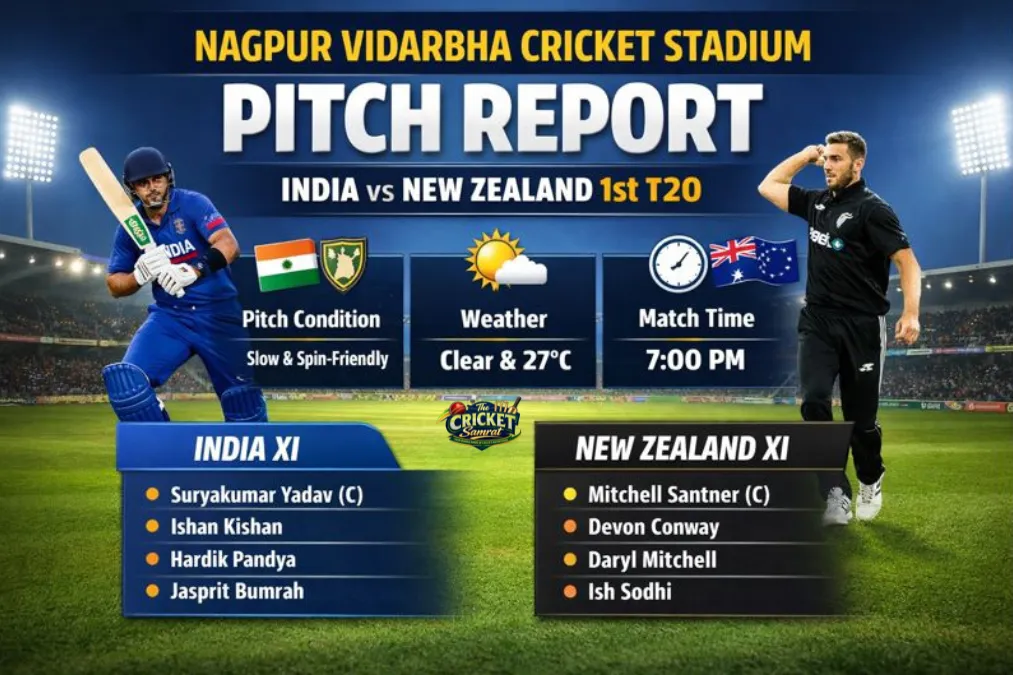
Nagpur Vidarbha Cricket Stadium Pitch Report: The Indian cricket team will face New Zealand in the first match of the five-match T20 series on Wednesday, January 21, at the Vidarbha Cricket Association (VCA) Stadium in Nagpur. The game is scheduled to begin at 7:00 PM IST, with the toss set for 6:30 PM IST. Fans are eagerly awaiting this exciting clash as both teams gear up for what promises to be a thrilling opening encounter.
Over the years, the VCA Stadium has hosted several T20 matches, but it has rarely witnessed extremely high scores. Historically, teams have found scoring big here challenging, making this venue a contest that favors bowlers, especially spinners.
In the past, India has played four T20 matches at Nagpur, winning two and losing two. This sets the stage for an intense battle between bat and ball as both teams look to kick off the series on a strong note.
Nagpur Vidarbha Cricket Stadium Pitch Report
The Nagpur vidarbha cricket stadium pitch report indicates that the game will be played on a slow, low-bounce pitch composed of dark soil. Here’s a detailed breakdown of pitch characteristics:
| Feature | Details |
|---|---|
| Pitch Type | Black soil, slow |
| Batting | Moderate help; early batting possible but scoring difficult |
| Bowling | Assists bowlers, particularly spinners |
| Bounce | Low; fast bowlers may not get extra carry |
| Degradation | Minimal; will not break early, but may slow further by the second innings |
| Advantage | Slightly favors bowlers; spinners likely to dominate |
The pitch at Nagpur generally provides assistance to spin bowlers due to its lower bounce. Fast bowlers may find it challenging to extract pace and carry, but disciplined line and length can still produce results. Key bowlers to watch include India’s Axar Patel and New Zealand captain Mitchell Santner, both of whom thrive in these conditions.
Weather Forecast in Nagpur for Match Day
Weather is a critical factor in T20 cricket, and the Nagpur vidarbha cricket stadium pitch report is incomplete without considering atmospheric conditions. According to AccuWeather, the forecast for match day is as follows:
| Time of Day | Temperature (°C) | Conditions |
|---|---|---|
| Morning | 23°C | Sunny, clear skies |
| Afternoon | 27°C | Warm, mild sun |
| Evening | 14°C | Cooling down, clear |
No rain is expected, and the weather is likely to remain clear throughout the match. Considering these conditions, the team winning the toss may prefer to bat first, taking advantage of predictable pitch behavior in the early overs.
Probable Playing XI
Based on team announcements and recent performances, the probable line-ups for the first T20 between India and New Zealand are as follows:
India Probable XI
| Player | Role |
|---|---|
| Abhishek Sharma | Batsman |
| Sanju Samson | Wicketkeeper-batsman |
| Ishan Kishan | Batsman |
| Suryakumar Yadav (C) | Batsman, Captain |
| Shivam Dube | All-rounder |
| Hardik Pandya | All-rounder |
| Rinku Singh | Batsman |
| Axar Patel / Kuldeep Yadav | Spinner |
| Varun Chakravarthy | Spinner |
| Jasprit Bumrah | Fast Bowler |
| Arshdeep Singh | Fast Bowler |
New Zealand Probable XI
| Player | Role |
|---|---|
| Tim Robinson | Batsman |
| Devon Conway | Batsman |
| Rachin Ravindra | All-rounder |
| Mark Chapman | Batsman |
| Daryl Mitchell | All-rounder |
| Michael Bracewell | All-rounder |
| James Neesham | All-rounder |
| Mitchell Santner (C) | Spinner, Captain |
| Ish Sodhi | Spinner |
| Matt Henry | Fast Bowler |
| Jacob Duffy | Fast Bowler |
The battle between India’s experienced spinners and New Zealand’s dynamic all-rounders is expected to be decisive on this pitch.
Historical Context: India at Nagpur VCA Stadium
The Vidarbha Cricket Association Stadium has hosted numerous T20s, IPL matches, and other domestic fixtures. India’s track record here is mixed, with four T20 matches yielding two wins and two losses. Historically, high scores above 180 have been rare due to the pitch’s slow nature and low bounce, making it a bowler-friendly venue.
| Year | Match | Result | Highest Team Score | Notable Performer |
|---|---|---|---|---|
| 2018 | India vs West Indies T20 | India won | 175/5 | Jasprit Bumrah 3/20 |
| 2019 | India vs Bangladesh T20 | India lost | 160/6 | Shakib Al Hasan 4/25 |
| 2021 | IPL: MI vs RCB | MI won | 172/4 | Suryakumar Yadav 78* |
| 2022 | IPL: DC vs CSK | DC lost | 165/7 | Ravindra Jadeja 3/18 |
This historical insight emphasizes that matches at Nagpur often hinge on bowling strength and spin mastery, making toss-winning strategies crucial.
Toss and Match Strategy
Winning the toss at Nagpur can be a game-changer. Considering the slow pitch and pleasant weather, the team batting first often prefers to set a total and leverage the pitch’s gradual slowdown. Early wickets are vital as chasing becomes trickier in the second innings when the pitch starts to slow further.
Key Strategies for Teams
India:
- Utilize spinners like Axar Patel and Varun Chakravarthy early.
- Keep wickets in hand in the first 10 overs to accelerate later.
- Fast bowlers to maintain disciplined lines to control run flow.
New Zealand:
- Leverage Mitchell Santner and Ish Sodhi to contain batsmen.
- All-rounders like Daryl Mitchell and Michael Bracewell can stabilize innings if early wickets fall.
- Matt Henry and Jacob Duffy to focus on death overs containment.
Players to Watch
- Suryakumar Yadav (India): Known for innovative strokeplay and ability to accelerate scoring in the middle overs.
- Jasprit Bumrah (India): Can swing the game with early breakthroughs.
- Mitchell Santner (NZ): Spin wizard, likely to exploit the low-bounce pitch.
- Daryl Mitchell (NZ): Key all-rounder capable of anchoring the innings and contributing crucial wickets.
Expert Analysis
Cricket analysts suggest that this T20 encounter could favor the bowlers initially due to the nature of the Nagpur pitch. Spinners are likely to dominate, and teams may adopt a conservative start in the first six overs. With a clear weather forecast and no rain interruptions, the first innings total is expected to be moderate, probably in the 150–170 run range, making it a competitive chase for the team batting second.
The Nagpur vidarbha cricket stadium pitch report further notes that the pitch is unlikely to deteriorate drastically, meaning that batting in the second innings is feasible if teams handle spinners carefully. Captaincy decisions and field placements will play a pivotal role in determining the match outcome.
Conclusion
The first T20 between India and New Zealand at the Vidarbha Cricket Association Stadium promises to be a thrilling contest, shaped heavily by spin-friendly conditions, disciplined bowling, and strategic batting. Fans can expect:
- A competitive match with mid-range totals.
- Critical contributions from spinners.
- Key performances from all-rounders and death-over specialists.
With both teams boasting balanced squads and world-class players, the match outcome remains unpredictable, adding excitement to this highly anticipated T20 opener.
The Nagpur vidarbha cricket stadium pitch report, combined with the favorable weather forecast and strategic team composition, sets the stage for an exciting start to the T20 series.