
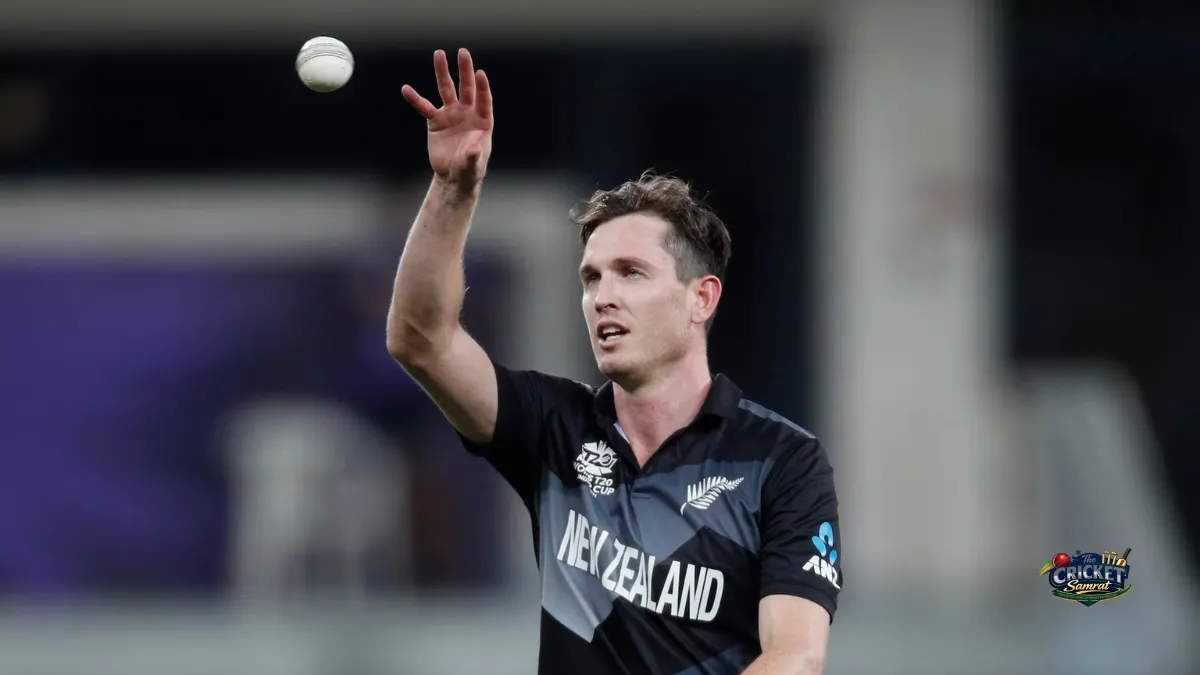
Milne Ruled: New Zealand have suffered a significant setback ahead of the ICC Men’s T20 World Cup 2026, with fast bowler Adam Milne ruled out of the tournament due to a hamstring injury sustained during the SA20 league. The injury, confirmed after medical scans, has forced team management to make a last-minute change, bringing experienced pacer Kyle Jamieson into the World Cup squad.
The development comes at a crucial stage of New Zealand’s preparations, just weeks before the global tournament begins across India and Sri Lanka. Milne’s absence is a blow not only to the team’s bowling plans but also to the player himself, who had been in strong form and working intensively toward peak fitness for the World Cup.
Injury During SA20 Ends Milne’s World Cup Hopes
Adam Milne suffered the injury while representing Sunrisers Eastern Cape in the South Africa T20 (SA20) league. The incident occurred last Sunday during a match against MI Cape Town, when Milne pulled up midway through his very first over. Visible discomfort forced him to leave the field immediately, raising early concerns among team staff and fans.
Subsequent medical assessments confirmed that the hamstring strain was more severe than initially hoped. After reviewing scan results and consulting with medical experts, New Zealand Cricket concluded that Milne would not recover in time to safely participate in the T20 World Cup. As a result, Milne ruled out of the tournament, ending what was expected to be a key campaign for the experienced fast bowler.
Milne had been enjoying an impressive SA20 season, showcasing pace, control, and consistency across multiple matches. His ability to bowl at high speed in the powerplay and return at the death made him an important component of New Zealand’s bowling strategy.
Kyle Jamieson Drafted Into World Cup Squad
Following Milne’s withdrawal, New Zealand selectors moved quickly to name Kyle Jamieson as his replacement. Jamieson was already part of the World Cup setup as a travelling reserve, making the transition smooth and compliant with ICC regulations.
At present, Jamieson is also involved in New Zealand’s ongoing international series against India, where he has been working his way back into competitive rhythm following previous injury concerns of his own. His inclusion brings additional bounce, height, and experience to the squad, offering a different bowling dynamic compared to Milne.
The ICC’s deadline for making changes to T20 World Cup squads is 31 January. After this date, any replacement would require formal approval from the ICC’s event technical committee. New Zealand Cricket confirmed that Jamieson’s addition was completed within the permitted timeframe.
Official Reaction From New Zealand Camp
New Zealand head coach Rob Walter expressed disappointment over Milne’s injury, acknowledging the hard work the fast bowler had put in ahead of the tournament.
“We’re all incredibly disappointed for Adam,” Walter said. “He has worked extremely hard to prepare himself for this World Cup and was in excellent form for Sunrisers Eastern Cape. To lose him at this stage is unfortunate, and the timing couldn’t be worse. We wish him a full and speedy recovery.”
Walter also praised Jamieson’s readiness to step in, noting that his familiarity with the squad and recent match exposure would help maintain continuity.
Adam Milne’s SA20 Performance Snapshot
Milne’s strong form in the SA20 league made his absence even more painful for New Zealand supporters. His performances suggested he was peaking at the right time ahead of the World Cup.
| Category | Details |
|---|---|
| Team | Sunrisers Eastern Cape |
| Matches Played | 8 |
| Key Strengths | High pace, death overs, powerplay impact |
| Injury Occurred | Against MI Cape Town |
| Injury Type | Hamstring strain |
| World Cup Status | Milne ruled out |
Jamieson’s Role and What He Brings
Kyle Jamieson offers New Zealand a different skill set. Standing well over six feet tall, he generates steep bounce that can trouble batters on subcontinental pitches, particularly under lights. While his raw pace may not match Milne’s consistently, his ability to extract movement and hit awkward lengths makes him a valuable option.
Jamieson’s experience in ICC tournaments and bilateral series gives team management confidence that he can adapt quickly to high-pressure situations.
Updated New Zealand Squad for T20 World Cup 2026
With Milne ruled out and Jamieson officially added, New Zealand’s updated squad for the T20 World Cup now looks settled heading into the final phase of preparations.
| Player | Role |
|---|---|
| Mitchell Santner (Captain) | All-rounder |
| Finn Allen | Batter |
| Michael Bracewell | All-rounder |
| Mark Chapman | Batter |
| Devon Conway | Wicketkeeper-batter |
| Jacob Duffy | Fast bowler |
| Lockie Ferguson | Fast bowler |
| Matt Henry | Fast bowler |
| Kyle Jamieson | Fast bowler |
| Daryl Mitchell | All-rounder |
| James Neesham | All-rounder |
| Glenn Phillips | Batter |
| Rachin Ravindra | All-rounder |
| Tim Seifert | Wicketkeeper-batter |
| Ish Sodhi | Spinner |
Tournament Overview: T20 World Cup 2026
The ICC Men’s T20 World Cup 2026 will begin on 7 February, jointly hosted by India and Sri Lanka. Matches will be played across seven cities and eight venues, with a packed schedule of 55 matches over 29 days.
New Zealand are set to play their opening match on 8 February, facing Afghanistan in what is expected to be a competitive group-stage encounter.
T20 World Cup 2026 Key Facts
| Detail | Information |
|---|---|
| Start Date | 7 February 2026 |
| Host Nations | India & Sri Lanka |
| Total Matches | 55 |
| Duration | 29 days |
| Venues | 8 |
| New Zealand’s First Match | 8 February vs Afghanistan |
Impact of Milne’s Absence on New Zealand’s Campaign
Milne ruled out of the T20 World Cup forces New Zealand to rethink certain tactical combinations. Milne’s express pace and proven death-over skills were expected to complement Lockie Ferguson and Matt Henry, forming a balanced fast-bowling trio.
Without him, New Zealand may rely more heavily on variations, swing, and bounce rather than outright speed. Jamieson’s inclusion suggests a strategic shift rather than a direct like-for-like replacement.
Selectors will also be mindful of managing workloads carefully, especially on subcontinental pitches that can be physically demanding for fast bowlers.
Conclusion:
While the loss of Adam Milne is undeniably a setback, New Zealand remain optimistic about their chances in the tournament. The squad still boasts a strong mix of experience, youth, all-round depth, and leadership under Mitchell Santner.
For Milne, the focus now shifts to rehabilitation and recovery, with hopes that he can return stronger for future international assignments. For Jamieson, the World Cup represents an opportunity to re-establish himself as a key figure in New Zealand’s white-ball plans.
As the tournament approaches, all eyes will be on how the Black Caps adapt to this late change—and whether they can turn adversity into momentum on the global stage.