
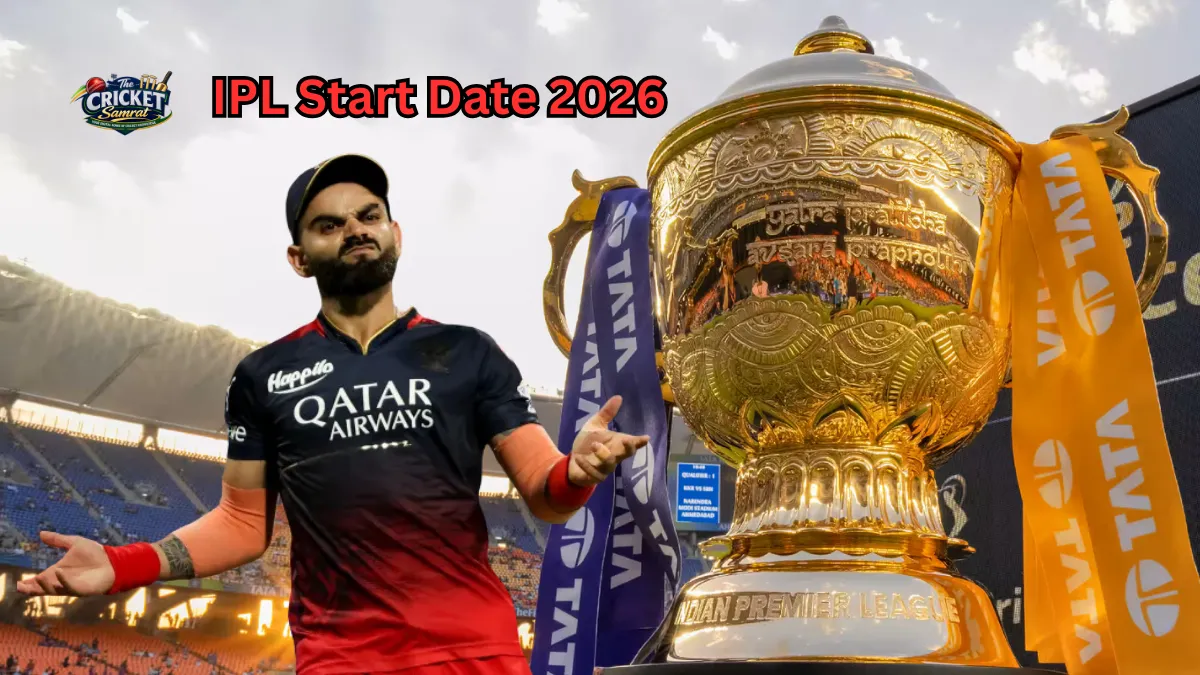
Ipl start date 2026: The countdown to the next chapter of the world’s most popular T20 league has officially begun, with fresh details emerging about the much-anticipated Indian Premier League 2026. According to reports, the Ipl start date 2026 has been tentatively set for March 26, with the tournament expected to run through May 31, when the final will be played. If confirmed, this timeline will mark another action-packed season of elite cricket, global stars, high-stakes auctions, and intense rivalries that continue to define the IPL’s global appeal.
The Board of Control for Cricket in India (BCCI) is said to have shared these key dates with all ten IPL franchises during a formal briefing held ahead of the IPL 2026 auction in Abu Dhabi. While an official public announcement from the BCCI is still awaited, the information has already generated significant buzz among fans, franchises, broadcasters, and sponsors across India and overseas, particularly in cricket-loving markets such as the UK, Australia, and the United States.
IPL Start Date 2026: Tournament Expected to Begin on March 26
As per the report, the Ipl start date 2026 is likely to be March 26, with the opening match expected to feature defending champions Royal Challengers Bengaluru (RCB). After finally lifting their maiden IPL trophy in the previous season, RCB are set to begin their title defence in what promises to be a high-voltage opening clash.
The choice of March 26 aligns with the IPL’s traditional window, allowing the tournament to conclude before the onset of the international cricket calendar and the Indian monsoon season. Over the years, the IPL has maintained a similar timeframe, helping it secure uninterrupted attention from global audiences and ensuring maximum availability of international players.
The 2026 edition will be the 19th season of the Indian Premier League, further cementing its legacy as one of the most successful sporting leagues in the world. Since its inception in 2008, the IPL has evolved into a multi-billion-dollar sporting property, attracting top talent from across continents and reshaping the economics of modern cricket.
IPL 2026 Final Date: May 31 Set for the Title Clash
If the current plan holds, the IPL 2026 final will be played on May 31, bringing the two-month cricketing extravaganza to a dramatic close. The final is traditionally one of the most-watched sporting events globally, drawing millions of viewers from India, the UK, the US, Australia, and beyond.
While the venue for the final has not yet been confirmed, the BCCI is expected to choose a location with world-class infrastructure, security arrangements, and high seating capacity. In recent years, the board has rotated final venues across major Indian cities, ensuring fans nationwide get a chance to witness IPL history.
RCB’s Opening Match and Home Venue Uncertainty
One of the most talked-about aspects surrounding the IPL 2026 opener is Royal Challengers Bengaluru’s home ground situation. While RCB are expected to kick off the tournament as defending champions, it remains unclear whether they will be able to host home matches at the iconic M. Chinnaswamy Stadium in Bengaluru.
The uncertainty stems from a tragic stampede incident that occurred during RCB’s victory celebrations following their maiden IPL title win a few months ago. The incident raised serious concerns about crowd management, safety protocols, and stadium preparedness for large-scale events.
According to reports, the Karnataka State Cricket Association (KSCA) has received conditional approval from the state government to host IPL matches at the venue. However, this clearance is subject to strict compliance with enhanced safety, security, and crowd-control measures. Until all stipulated conditions are met and formally approved, the final decision on RCB’s home venue remains pending.
If the Chinnaswamy Stadium is deemed unavailable, RCB may have to identify an alternative home ground for the early part of the tournament, a scenario that could impact logistics, fan engagement, and team preparations.
BCCI Briefs Franchises Ahead of Abu Dhabi Auction
The IPL 2026 dates were reportedly communicated to franchise officials by Hemang Amin, the IPL’s Chief Development Officer (CDO), during a pre-auction briefing in Abu Dhabi. This meeting took place on the eve of the IPL 2026 auction, which is scheduled to be held at the Etihad Arena.
The decision to inform franchises in advance allows teams to plan their strategies, logistics, and player availability more effectively. It also helps broadcasters and commercial partners align their schedules well ahead of the tournament’s start.
IPL Auctions Outside India: A Continuing Trend
The IPL 2026 auction in Abu Dhabi will mark the third consecutive year that the event is being held outside India. After Dubai hosted the auction in 2024 and Jeddah in 2025, Abu Dhabi has emerged as the latest international destination for the high-profile event.
Hosting auctions overseas reflects the IPL’s growing global footprint and its appeal as a truly international sporting brand. The Middle East, with its world-class venues, connectivity, and strong South Asian diaspora, has become a preferred location for such marquee cricketing events.
Player Pool Finalised: 19 Late Additions Before Auction
Just hours before the auction, the BCCI finalised the IPL 2026 player pool by adding 19 players to the list. These late inclusions have added an extra layer of intrigue to the auction proceedings, with franchises reassessing their strategies at the last moment.
Among the notable late additions are:
- Abhimanyu Easwaran (India/Bengal)
- Ben Sears (New Zealand)
- Ethan Bosch (South Africa)
These players bring a mix of domestic consistency and international promise, making them attractive options for teams looking to strengthen their squads with reliable depth.
IPL 2026 Auction: All Eyes on Marquee Names
As the auction unfolds, the spotlight will be firmly on several high-profile players who are expected to attract fierce bidding wars. Among them, Cameron Green, Liam Livingstone, and Ravi Bishnoi stand out as potential game-changers.
With all ten franchises eager to assemble championship-winning squads, aggressive bidding is expected across categories, particularly for all-rounders and impact players who can influence matches in multiple phases.
Cameron Green: The Most Coveted Player?
Australian all-rounder Cameron Green is widely tipped to be the biggest attraction at the IPL 2026 auction. With his ability to contribute with both bat and ball, Green fits the modern T20 blueprint perfectly.
Given the limited availability of elite seam-bowling all-rounders and the mini-auction format, industry insiders believe bids for Green could soar beyond ₹25 crore, making him one of the most expensive buys in IPL history.
His adaptability across conditions, experience in international cricket, and proven IPL performances make him a prized asset for any franchise aiming to dominate the tournament starting from the Ipl start date 2026.
Strong Interest Expected in Livingstone, Bishnoi, and Others
Apart from Green, several other players are expected to draw significant interest:
- Liam Livingstone (England): Known for his explosive batting and part-time spin.
- Ravi Bishnoi (India): One of India’s most promising young leg-spinners.
- Jamie Smith (England): A dynamic wicketkeeper-batter.
- Matt Henry (New Zealand): A reliable fast bowler in white-ball cricket.
- Tim Seifert (New Zealand): A proven T20 wicketkeeper-batter.
- David Miller (South Africa): A seasoned finisher with vast IPL experience.
- Matheesha Pathirana (Sri Lanka): The slingy pacer released by Chennai Super Kings.
Pathirana’s release by CSK has particularly surprised fans, given his impact performances in previous seasons. His availability is expected to trigger a bidding contest among teams seeking a death-overs specialist.
Squad Vacancies: Which Teams Need Players the Most?
A total of 77 slots are up for grabs in the IPL 2026 auction, including 31 overseas positions. The distribution of vacancies varies significantly across franchises.
- Kolkata Knight Riders (KKR), three-time IPL champions, have the highest number of vacancies with 13 slots to fill.
- Sunrisers Hyderabad (SRH), winners of the 2016 edition, follow with 10 available slots.
Other franchises have fewer gaps but are still expected to actively participate in the auction to fine-tune their squads ahead of the Ipl start date 2026.
Shortlisted Players: Breakdown of the Final List
From an initial pool of 1,355 registered players, the IPL governing council shortlisted 359 cricketers for the auction:
- 244 Indian players
- 115 overseas players
This shortlist represents a carefully curated mix of youth, experience, and international pedigree, ensuring competitive balance across teams.
Notably, 40 players have entered the auction at the maximum base price of ₹2 crore. Among Indian players, only Ravi Bishnoi and Venkatesh Iyer feature in this elite bracket, highlighting their rising stature in the T20 ecosystem.
Strategic Importance of the IPL 2026 Auction
The IPL 2026 auction carries added significance as teams look to build stable cores that can deliver long-term success. With the tournament’s format rewarding consistency and depth, franchises are placing greater emphasis on scouting, analytics, and squad balance.
The timing of the auction, well ahead of the Ipl start date 2026, allows teams ample preparation time, including training camps, player conditioning, and tactical planning.
IPL’s Global Reach Continues to Expand
As anticipation builds for the IPL 2026 season, the league’s global popularity shows no signs of slowing down. Broadcast partnerships, digital streaming platforms, and social media engagement have ensured that IPL matches reach audiences across continents.
In markets like the UK and the US, where cricket continues to grow steadily, the IPL plays a crucial role in attracting new fans to the sport. The confirmation of the Ipl start date 2026 provides international broadcasters and advertisers with a clear roadmap to plan their coverage.
Also read: IPL 2026 IPL auction: Three Players CSK Could Have Considered Instead of Sarfaraz Khan
What Lies Ahead for IPL 2026
With the likely start date of March 26 and the final scheduled for May 31, IPL 2026 promises to be another blockbuster season filled with drama, record-breaking performances, and unforgettable moments.
From the uncertainty surrounding RCB’s home venue to the high-stakes auction battles in Abu Dhabi, every development adds to the excitement ahead of the tournament. As franchises finalize their squads and fans count down to the opening match, the stage is set for yet another unforgettable edition of the Indian Premier League.
While official confirmation from the BCCI is still awaited, one thing is certain: once the Ipl start date 2026 arrives, the cricketing world will once again come to a standstill, united by the spectacle that only the IPL can deliver.