
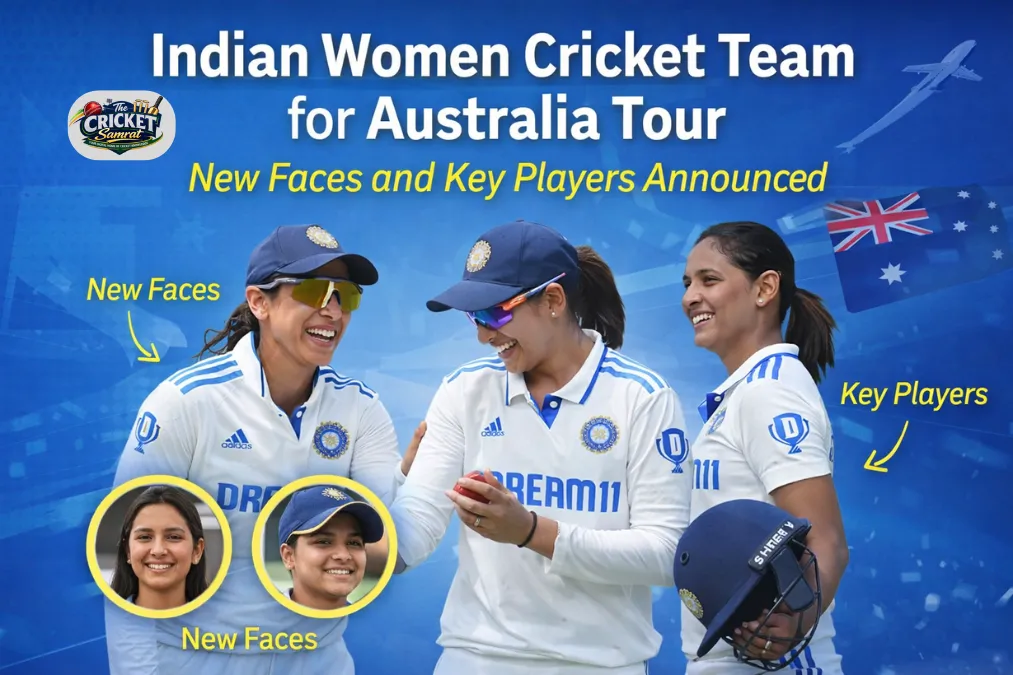
The Board of Control for Cricket in India (BCCI) has officially announced the Indian Women Cricket team for Australia tour, marking an exciting chapter in Indian women’s cricket. The squad, selected for the one-off Test match against Australia, features several fresh faces, including Pratika Rawal, Vaishnavi Sharma, and Kranti Gaud, who have all received their maiden call-ups to India’s Test side. This selection underscores India’s commitment to blending experienced campaigners with promising young talent ahead of a crucial tour Down Under.
The much-anticipated Test match is scheduled to be played from 6th to 9th March 2026 in Perth, following the white-ball leg of the tour, which includes three T20 Internationals and three One-Day Internationals. Veteran campaigner Harmanpreet Kaur will lead the team as captain, supported by Smriti Mandhana as vice-captain.
New Faces in the Test Squad
Pratika Rawal Earns Test Call-Up
Pratika Rawal, the talented middle-order batter, has been rewarded for her consistent performances in the One-Day format. In 24 ODIs, Rawal has scored 1,110 runs at an impressive average of 50.45, including two centuries and seven half-centuries. Her inclusion in the Test squad was widely expected after her prolific run in recent limited-overs matches.
Rawal’s selection also signals her return to full fitness after recovering from a knee injury that sidelined her during the semi-final and final of the Women’s ODI World Cup last year. However, she has not been selected for the upcoming white-ball leg of the tour, indicating a cautious approach to manage her workload.
Vaishnavi Sharma and Kranti Gaud: First Test Call-Ups
The 20-year-old Vaishnavi Sharma, a left-arm spinner, played a key role in India’s Under-19 World Cup triumph in early 2025 and made her senior debut in December 2025 against Sri Lanka in the home T20I series. Sharma has featured in five T20Is to date and has impressed selectors with her composure and wicket-taking abilities.
Kranti Gaud, a fast bowler, debuted for India last year and has since played 15 ODIs and 4 T20Is, claiming 23 wickets in the ODI format. Gaud’s ability to generate pace and maintain accuracy will be crucial in the Test format, especially on Australian pitches.
Mumbai’s Fast Bowler Sayali Satghare Also Included
Sayali Satghare, the 25-year-old pace bowler from Mumbai, has been given another opportunity after playing three ODIs against Ireland in January 2025. Her inclusion means veteran Arundhati Reddy misses out, highlighting a shift towards fresh talent in the squad.
Wicket-Keeper Adjustments
In the wicket-keeping department, young keeper G. Kamalini has withdrawn from the Australia tour due to injury. Uma Chetri has been drafted in as her replacement for both the T20I and ODI squads, ensuring India has experienced hands behind the stumps.
Full Indian Women’s Test Squad for Australia Tour 2026
| Player Name | Role |
|---|---|
| Harmanpreet Kaur | Captain |
| Smriti Mandhana | Vice-Captain |
| Shafali Verma | Batter |
| Jemimah Rodrigues | Batter |
| Amanjot Kaur | All-Rounder |
| Richa Ghosh | Wicket-Keeper |
| Uma Chetri | Wicket-Keeper |
| Pratika Rawal | Batter |
| Harleen Deol | All-Rounder |
| Deepti Sharma | All-Rounder |
| Renuka Thakur | Bowler |
| Sneh Rana | All-Rounder |
| Kranti Gaud | Fast Bowler |
| Vaishnavi Sharma | Spinner |
| Sayali Satghare | Fast Bowler |
This squad represents a balance of youth and experience, with players capable of performing in both the Test and limited-overs formats. The team combines hard-hitting batters, versatile all-rounders, and a strong pace-spin bowling combination suitable for Australian conditions.
India vs Australia 2026: Complete Tour Schedule
India’s tour of Australia features a white-ball leg followed by the historic one-off Test. The schedule is as follows:
T20I Series
| Match | Date | Venue |
|---|---|---|
| 1st T20I | 15 February 2026 | Sydney |
| 2nd T20I | 19 February 2026 | Canberra |
| 3rd T20I | 21 February 2026 | Adelaide |
One-Day International Series
| Match | Date | Venue |
|---|---|---|
| 1st ODI | 24 February 2026 | Brisbane |
| 2nd ODI | 27 February 2026 | Hobart |
| 3rd ODI | 1 March 2026 | Hobart |
Test Series
| Match | Date | Venue |
|---|---|---|
| 1st Test | 6–9 March 2026 | Perth |
This structure allows players to acclimatize to Australian conditions in limited-overs formats before tackling the demands of the longer format Test match.
Key Players to Watch
Harmanpreet Kaur: Captain and Experienced Leader
Harmanpreet Kaur continues to be India’s backbone, combining aggressive batting with tactical leadership. Her experience will be invaluable in guiding the young players through challenging Australian conditions.
Smriti Mandhana: Vice-Captain and Opener
Smriti Mandhana remains India’s premier opener. Her ability to anchor the innings while accelerating when needed makes her a vital component of India’s batting lineup.
Pratika Rawal: Returning Star
Rawal’s inclusion in the Test squad marks her return from injury. Known for her elegant stroke play and consistency, she is expected to provide stability in the middle order.
Vaishnavi Sharma and Kranti Gaud: Rising Talents
Both Sharma and Gaud bring fresh energy and skill to the team. Sharma’s spin variations and Gaud’s pace will pose challenges for Australian batters unaccustomed to Indian conditions.
Sayali Satghare: Young Pace Option
Satghare adds depth to the fast-bowling department. Her ability to generate movement off the pitch could prove crucial, particularly in Perth, where bounce and pace often dominate play.
Strategic Outlook for the Tour
The Indian Women Cricket team for Australia tour aims to achieve a fine balance between giving opportunities to promising talent and relying on experienced campaigners. The one-off Test is not only a chance to gain points in the ICC rankings but also a platform for young players to showcase their skills in international cricket’s most challenging format.
Selectors have clearly prioritized player fitness and form. Pratika Rawal’s careful management, along with the inclusion of Vaishnavi Sharma and Kranti Gaud, highlights a long-term strategy aimed at building depth in both batting and bowling line-ups.
Also read: ICC Men’s T20 World Cup 2026 Schedule: Full Details, Venues, and Key Fixtures
Historical Context and Importance
India’s women’s cricket team has grown significantly over the past decade, achieving success in T20 and ODI formats. However, Tests remain a rare opportunity for Indian women cricketers to demonstrate endurance and technique in the longest format. Matches in Australia, known for fast pitches and bounce, are particularly demanding, making this tour both challenging and crucial for India’s developmental goals.
The addition of young talents like Rawal, Sharma, and Gaud reflects a strategic intent to prepare India for future World Cup tournaments while maintaining competitiveness in bilateral series.
Fans’ Expectations
Fans are eagerly anticipating the Australia tour, especially given India’s recent successes in white-ball cricket. Social media and cricket forums are buzzing with excitement over the inclusion of fresh talent, and many analysts predict that Pratika Rawal and Vaishnavi Sharma could become household names if they perform well.
The tour will also test India’s bench strength, with new players potentially making significant contributions in high-pressure situations.
Conclusion
The announcement of the Indian Women Cricket team for Australia tour signals an exciting phase in Indian women’s cricket. With a mix of experienced leaders like Harmanpreet Kaur and Smriti Mandhana, combined with the debutants Pratika Rawal, Vaishnavi Sharma, and Kranti Gaud, India is sending a well-balanced squad capable of competing at the highest level.
The one-off Test in Perth, along with the T20 and ODI series, will provide ample opportunities for players to adapt to Australian conditions, showcase their talent, and strengthen India’s position in women’s international cricket.
As fans and analysts gear up for a competitive and thrilling series, this tour promises to be a defining moment for Indian women’s cricket, blending youth, experience, and ambition in equal measure.