
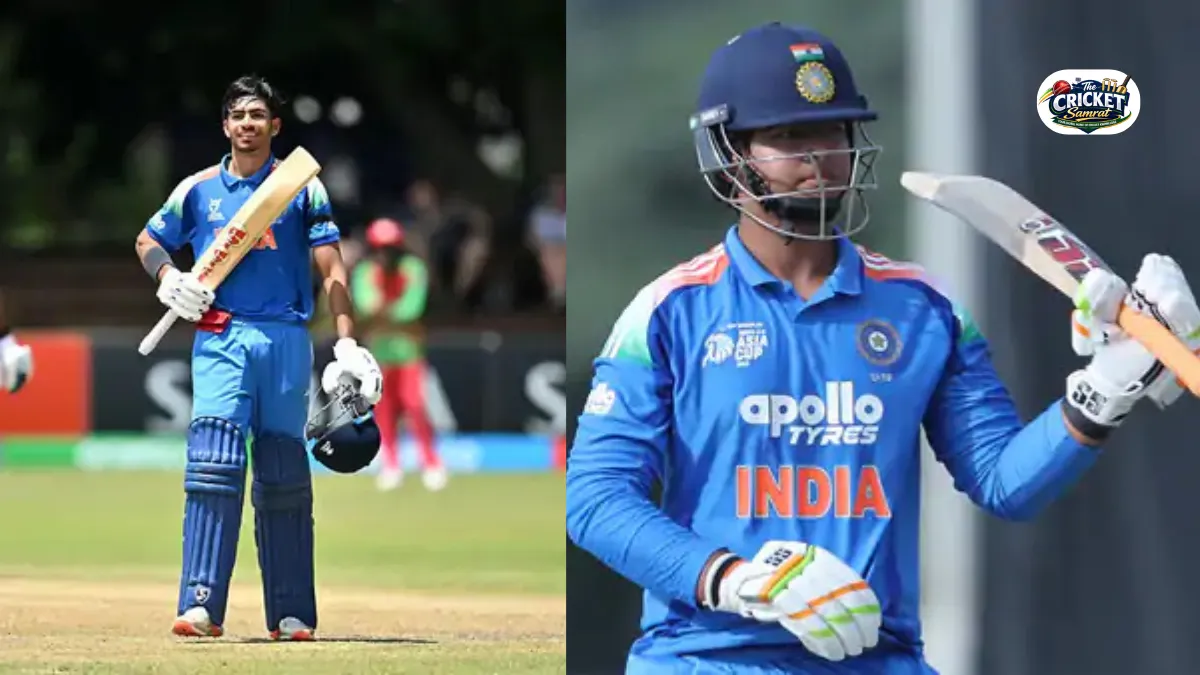
India vs Zimbabwe Under 19: India delivered a commanding all-round performance against Zimbabwe in the Under-19 World Cup Super-6 stage, securing a massive 204-run victory and underlining their status as one of the tournament’s strongest contenders. Batting depth, explosive strokeplay, disciplined bowling, and sharp fielding came together as India overwhelmed Zimbabwe in every department.
The match stood out not only for the margin of victory but also for the emergence of young stars who showcased maturity far beyond their age. A fluent century, a record-breaking rapid fifty, and a relentless bowling attack combined to produce one of the most one-sided contests of the competition.

India’s Batting Masterclass Sets an Unreachable Target
Batting first after Zimbabwe opted to bowl, India laid the foundation early with positive intent at the top. Despite losing an early wicket, the Indian innings never lost momentum. The openers applied pressure from the outset, forcing Zimbabwe’s bowlers onto the defensive and opening up scoring opportunities across the field.
Vaibhav Suryavanshi’s Fearless Assault
One of the defining moments of the match came from 14-year-old Vaibhav Suryavanshi, who played with fearless confidence against experienced opposition. His innings was a blend of clean hitting and intelligent placement, allowing India to accelerate rapidly during the early overs.
Vaibhav reached his half-century at breathtaking speed, recording the third fastest fifty of the tournament. His ability to pick gaps and clear the boundary repeatedly disrupted Zimbabwe’s bowling plans and shifted the momentum decisively in India’s favour.
Though his innings ended soon after crossing fifty, the damage had already been done. His knock ensured India maintained a run rate that kept Zimbabwe under constant pressure.
Vihan Malhotra Anchors the Innings with an Unbeaten Century
While Vaibhav provided fireworks, Vihan Malhotra played the role of the anchor with remarkable composure. Batting through the innings, Malhotra produced a calm yet authoritative unbeaten century that formed the backbone of India’s massive total.
He rotated the strike efficiently, punished loose deliveries, and showed excellent awareness of the match situation. As wickets fell at the other end, Malhotra remained steady, guiding younger teammates and ensuring India capitalised on every phase of the innings.
His century was not rushed but built on patience and precision—an innings that reflected leadership, maturity, and technical excellence.
Key Middle-Order Partnership Strengthens India’s Total
India’s middle order continued the momentum with a crucial partnership between Vihan Malhotra and Abhigyan Kundu. The pair added over a hundred runs together, stabilising the innings after a brief cluster of wickets.
Kundu played a measured knock, balancing caution with aggression. His ability to find boundaries without unnecessary risks complemented Malhotra’s steady approach. Together, they pushed India well beyond the 300-run mark, effectively taking the game out of Zimbabwe’s reach.
India’s Final Total: A Statement of Intent
India closed their innings at 352 runs, a formidable score that reflected dominance across all batting phases. Late-order contributions ensured there was no slowdown in the final overs, with boundaries flowing consistently until the very end.
India Batting Summary
| Player | Runs |
|---|---|
| Vihan Malhotra | 109* |
| Vaibhav Suryavanshi | 52 |
| Abhigyan Kundu | 61 |
| Ayush Mhatre | 21 |
| Aaron George | 23 |
Zimbabwe’s bowlers struggled to contain the run flow, though Tatenda Chimugoro stood out with three wickets, supported by Panashe Mazai and Captain Simbarashe Mudzingere, who picked up two each.
Innings Break!
— BCCI (@BCCI) January 27, 2026
Vihaan Malhotra's brilliant century leads India U19's charge against Zimbabwe U19 in the Super Six clash 💯👊
Over to our bowlers as we defend 3⃣5⃣2⃣ runs 🎯
Scorecard ▶️https://t.co/juFENSDomr #U19WorldCup pic.twitter.com/f4YB9ulNkB
Zimbabwe’s Chase Falters Under Early Pressure
Chasing a massive target, Zimbabwe needed a near-perfect start. Instead, they were immediately pushed onto the back foot by India’s disciplined new-ball bowling. Early breakthroughs dismantled Zimbabwe’s top order, leaving them scrambling to rebuild.
The pressure of the required run rate forced risky shots, resulting in regular wickets. India’s bowlers maintained tight lines and lengths, offering no easy scoring opportunities.
India’s Bowlers Dominate with Precision and Control
The Indian bowling unit executed their plans flawlessly. Seamers and spinners worked in tandem, applying pressure through dot balls and striking at regular intervals.
Standout Bowling Performances
- Udhav Mohan delivered crucial breakthroughs and finished with three wickets.
- Captain Ayush Mhatre led by example, also claiming three wickets and contributing with both pace and control.
- R.S. Ambrish provided vital support with two wickets.
- Henil Patel and Khilan Patel chipped in with one wicket each, ensuring Zimbabwe never found momentum.
Zimbabwe’s Brief Resistance
Despite the collapse, Zimbabwe did show moments of resilience. Leroy Chivawula played a fighting knock, reaching a well-deserved half-century. His innings was marked by determination and composure, standing out amid a struggling batting lineup.
He found brief support from Kian Blignaut and Tatenda Chimugoro, but the lack of partnerships proved costly. No other batter managed to cross double figures, highlighting the dominance of India’s bowling attack.
Zimbabwe Batting Highlights
| Player | Runs |
|---|---|
| Leroy Chivawula | 62 |
| Kian Blignaut | 37 |
| Tatenda Chimugoro | 29 |
Zimbabwe were eventually bowled out for 148 runs, sealing a comprehensive victory for India.
Captaincy and Fielding: India’s Complete Performance
India’s performance was not limited to batting and bowling alone. The fielding effort was sharp and energetic, with clean catching and quick movement inside the circle. Captain Ayush Mhatre’s tactical decisions—bowling changes, field placements, and pressure management—played a key role in sustaining Zimbabwe’s collapse.
The team displayed excellent discipline, rarely conceding easy runs and consistently backing up their bowlers.
Impact on the Tournament Standings
The emphatic win strengthened India’s position in the Super-6 stage, placing them at the top of their group based on superior performance and net run rate. The result not only boosted India’s confidence but also sent a strong message to other contenders in the tournament.
With multiple players contributing across departments, India demonstrated depth and balance—qualities essential for success in knockout stages.
Team Line-ups
India Under 19
| Players |
|---|
| Ayush Mhatre (Captain) |
| Aaron George |
| Vaibhav Suryavanshi |
| Vihan Malhotra |
| Abhigyan Kundu (Wicketkeeper) |
| Vedant Trivedi |
| Kanishk Chauhan |
| R.S. Ambrish |
| Khilan Patel |
| Henil Patel |
| Udhav Mohan |
Zimbabwe Under 19
| Players |
|---|
| Simbarashe Mudzingere (Captain) |
| Nathaniel Halabangana (Wicketkeeper) |
| Dhruv Patel |
| Kian Blignaut |
| Webster Madhidhi |
| Takudzwa Makoni |
| Leroy Chivawula |
| Brandon Senzere |
| Michael Blignaut |
| Tatenda Chimugoro |
| Panashe Mazai |
Conclusion: India vs Zimbabwe Under 19 – A Match to Remember
The India vs zimbabwe under 19 clash will be remembered as a showcase of India’s dominance, preparation, and emerging talent. From explosive batting to relentless bowling and intelligent leadership, India delivered a near-perfect performance.
For Zimbabwe, the match offered valuable lessons and glimpses of promise, particularly through individual efforts. For India, it reinforced their credentials as tournament favourites and highlighted a generation of players ready to make their mark on the global stage.
As the Under-19 World Cup progresses, performances like this underline why India continue to set the benchmark in youth cricket—combining skill, temperament, and fearless ambition in equal measure.