
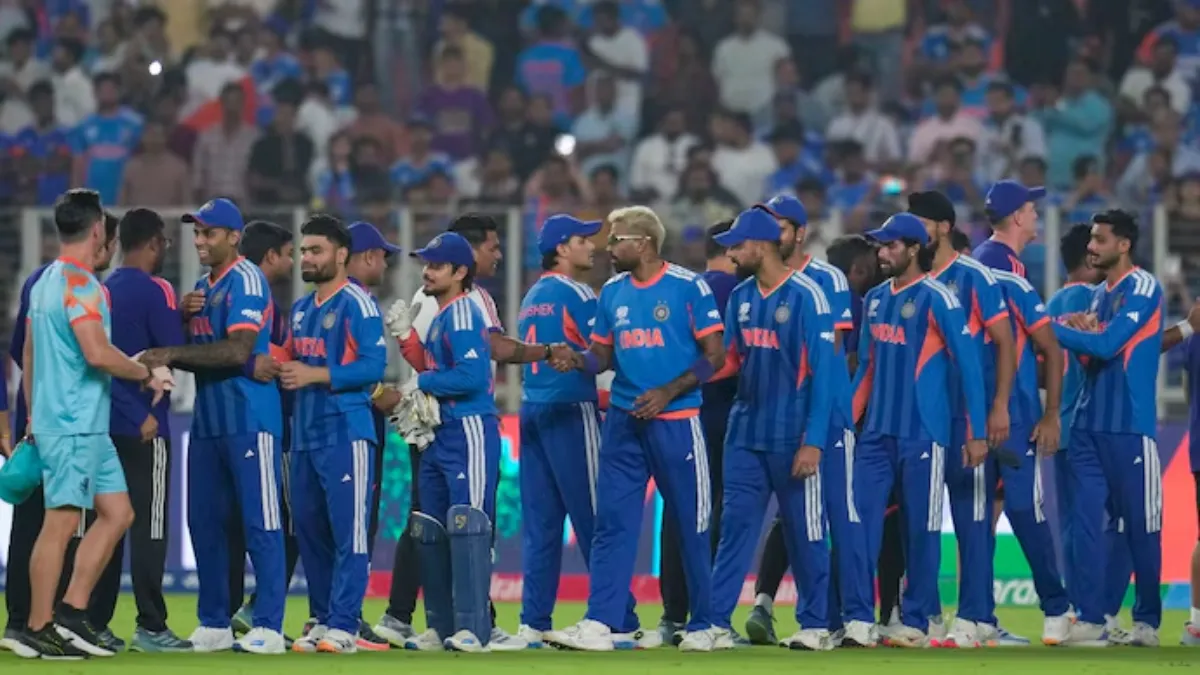
The India vs New Zealand T20 World Cup Final scorecard will be remembered as one of the most explosive performances in the history of T20 cricket. India produced a breathtaking display of batting and disciplined bowling to defeat New Zealand by 96 runs, securing the ICC T20 World Cup 2026 title.
Playing at the world’s largest cricket stadium, the Narendra Modi Stadium in Ahmedabad, Team India delivered a dominant performance from start to finish. Batting first, India posted a massive 255/5 in 20 overs, putting enormous pressure on New Zealand.
In response, the Black Caps struggled to keep up with the required run rate and were eventually bowled out for 159 in 19 overs, handing India a historic victory and their second consecutive T20 World Cup title.
The match saw stunning performances from Sanju Samson, Abhishek Sharma, and Ishan Kishan, while Jasprit Bumrah’s four-wicket haul ensured that New Zealand never truly threatened the massive target.
India vs New Zealand T20 World Cup Final Scorecard
Match Summary
| Match | ICC T20 World Cup 2026 Final |
|---|---|
| Venue | Narendra Modi Stadium, Ahmedabad |
| Date | March 8, 2026 |
| Result | India won by 96 runs |
| India Score | 255/5 (20 overs) |
| New Zealand Score | 159 all out (19 overs) |
| Player of the Match | Sanju Samson |
India’s Explosive Batting Performance
India’s batting lineup delivered an incredible performance in the final. From the very beginning, the Indian openers attacked aggressively, setting the tone for a record-breaking total.
The opening partnership between Abhishek Sharma and Sanju Samson was electric. The duo punished the New Zealand bowlers with fearless stroke play, smashing boundaries across the ground.
Within just five overs, India had already reached 72 runs without losing a wicket, placing immense pressure on the opposition.
Key Indian Batting Highlights
- Sanju Samson scored 89 runs from 46 balls
- Abhishek Sharma smashed 52 runs from just 21 balls
- Ishan Kishan added 54 runs from 25 balls
- India crossed 200 runs in just 15 overs
This aggressive batting display helped India post one of the highest totals ever seen in a T20 World Cup final.
India Batting Scorecard
| Batsman | Runs | Balls | Fours | Sixes |
|---|---|---|---|---|
| Abhishek Sharma | 52 | 21 | 6 | 3 |
| Sanju Samson | 89 | 46 | 5 | 8 |
| Ishan Kishan | 54 | 25 | 4 | 4 |
| Suryakumar Yadav | 0 | 1 | 0 | 0 |
| Hardik Pandya | 18 | 13 | 1 | 1 |
| Tilak Varma | 8 | 6 | 1 | 0 |
| Shivam Dube | 2 | 2 | 0 | 0 |
Total: 255/5 in 20 overs
Sanju Samson’s Masterclass in the Final
One of the standout performances in the India vs New Zealand T20 World Cup Final scorecard was Sanju Samson’s sensational innings.
The Indian wicketkeeper-batsman delivered a remarkable performance, smashing 89 runs off just 46 balls.
His innings included:
- 5 boundaries
- 8 massive sixes
- Strike rate above 190
Samson dominated the New Zealand bowling attack and played the role of anchor as well as aggressor throughout the innings.
His batting helped India maintain a high scoring rate and build a massive total.
Abhishek Sharma’s Record-Breaking Half Century
Young Indian opener Abhishek Sharma produced one of the fastest half-centuries in a T20 World Cup final.
He reached his 50 runs in just 18 balls, putting the New Zealand bowlers under immense pressure.
His explosive knock included:
- 6 fours
- 3 sixes
This innings gave India a dream start and ensured the team reached nearly 100 runs within the first seven overs.
Ishan Kishan’s Aggressive Middle-Order Contribution
After the dismissal of Abhishek Sharma, Ishan Kishan joined Sanju Samson and continued the aggressive approach.
Kishan smashed 54 runs from just 25 balls, including:
- 4 fours
- 4 sixes
His fearless batting ensured that India crossed the 200-run mark well before the final overs.
India’s Late Overs Acceleration
Despite losing a few quick wickets in the 16th over, India continued scoring rapidly.
Key moments included:
- Hardik Pandya’s quick 18 runs
- Tilak Varma’s finishing touches
- Shivam Dube adding runs in the final overs
India eventually finished at 255 runs, one of the biggest totals in a T20 World Cup final.
New Zealand’s Challenging Chase
Chasing 256 runs in a T20 final is always a daunting task, and New Zealand needed a perfect start to stay in the contest.
However, India’s bowling attack quickly took control of the game.
New Zealand lost early wickets, which significantly slowed their momentum.
New Zealand Batting Scorecard
| Batsman | Runs | Balls | Fours | Sixes |
|---|---|---|---|---|
| Finn Allen | 9 | 7 | 1 | 0 |
| Tim Seifert | 52 | 26 | 2 | 5 |
| Rachin Ravindra | 1 | 2 | 0 | 0 |
| Glenn Phillips | 5 | 4 | 0 | 0 |
| Mark Chapman | 3 | 5 | 0 | 0 |
| Daryl Mitchell | 17 | 15 | 2 | 0 |
| James Neesham | 8 | 7 | 1 | 0 |
| Mitchell Santner | 14 | 10 | 1 | 1 |
| Matt Henry | 2 | 3 | 0 | 0 |
Total: 159 all out (19 overs)
Jasprit Bumrah’s Match-Winning Spell
India’s star pacer Jasprit Bumrah delivered an outstanding performance in the final.
He picked up four crucial wickets, including a brilliant moment when he dismissed two players in consecutive balls.
His key dismissals included:
- James Neesham
- Matt Henry
- Mitchell Santner
This spell effectively sealed the victory for India.
India Bowling Scorecard
| Bowler | Overs | Runs | Wickets |
|---|---|---|---|
| Jasprit Bumrah | 4 | 22 | 4 |
| Axar Patel | 4 | 30 | 2 |
| Varun Chakravarthy | 4 | 28 | 1 |
| Hardik Pandya | 3 | 25 | 1 |
| Arshdeep Singh | 2 | 24 | 1 |
| Shivam Dube | 2 | 20 | 0 |
Key Turning Points of the Match
Several moments defined the India vs New Zealand T20 World Cup Final scorecard.
1. India’s Powerplay Dominance
India scored 92 runs in the powerplay, which gave them an enormous advantage.
2. Samson and Kishan Partnership
Their aggressive partnership pushed India beyond 200 runs.
3. Bumrah’s Double Wicket
Two wickets in two balls completely broke New Zealand’s resistance.
Playing XI – India vs New Zealand Final
India Playing XI
| Player |
|---|
| Abhishek Sharma |
| Sanju Samson |
| Ishan Kishan |
| Suryakumar Yadav (Captain) |
| Tilak Varma |
| Hardik Pandya |
| Shivam Dube |
| Axar Patel |
| Varun Chakravarthy |
| Arshdeep Singh |
| Jasprit Bumrah |
New Zealand Playing XI
| Player |
|---|
| Tim Seifert |
| Finn Allen |
| Rachin Ravindra |
| Glenn Phillips |
| Mark Chapman |
| Daryl Mitchell |
| James Neesham |
| Mitchell Santner (Captain) |
| Matt Henry |
| Lockie Ferguson |
| Jacob Duffy |
Pitch Report – Narendra Modi Stadium
The pitch at Ahmedabad’s Narendra Modi Stadium played a major role in the match.
The surface was made from a mix of red and black soil, which typically provides:
- Good bounce
- High scoring opportunities
- Some assistance for fast bowlers early in the innings
This pitch proved perfect for aggressive batting, which is why the final turned into a high-scoring encounter.
Ahmedabad Weather Report on Match Day
According to weather forecasts:
| Time | Temperature |
|---|---|
| Morning | 34°C |
| Afternoon | 41°C |
| Evening | 29°C |
There was no rain forecast, but dew in the evening slightly influenced the conditions.
India vs New Zealand ICC Final Rivalry
The final added another chapter to the intense rivalry between India and New Zealand in ICC tournaments.
Over the past few years, the two teams have met in several major finals.
| Year | Tournament | Winner |
|---|---|---|
| 2000 | Champions Trophy | New Zealand |
| 2021 | World Test Championship | New Zealand |
| 2025 | Champions Trophy | India |
| 2026 | T20 World Cup | India |
Historic Moments from the Final
Several historic moments were recorded in the India vs New Zealand T20 World Cup Final scorecard:
- India scored 255 runs, one of the highest totals in a T20 World Cup final.
- Abhishek Sharma’s 18-ball fifty became one of the fastest in a final.
- Sanju Samson’s 89 runs became one of the highest scores in a T20 World Cup final.
- Jasprit Bumrah took 4 wickets, dominating New Zealand’s batting lineup.
Entertainment and Grand Finale Atmosphere
The T20 World Cup final was not just about cricket. The event also featured spectacular entertainment performances.
International and Indian artists including:
- Ricky Martin
- Sukhbir
- Falguni Pathak
performed before the match, creating a festival-like atmosphere at the stadium.
More than 100,000 fans filled the Narendra Modi Stadium, making the final one of the most memorable cricket events ever hosted in India.
Also read: IND vs NZ: Team India Creates Record Storm in T20 World Cup 2026 Final with Historic Batting Display
India’s Journey to the T20 World Cup 2026 Title
India’s path to the final was impressive. The team dominated throughout the tournament with consistent performances from both batters and bowlers.
Key players throughout the tournament included:
- Sanju Samson
- Abhishek Sharma
- Varun Chakravarthy
- Jasprit Bumrah
- Hardik Pandya
Their combined efforts helped India reach the final and eventually win the trophy.
Conclusion
The India vs New Zealand T20 World Cup Final scorecard tells the story of a spectacular cricket match that showcased India’s dominance in modern T20 cricket.
From explosive batting by Sanju Samson, Abhishek Sharma, and Ishan Kishan to match-winning bowling by Jasprit Bumrah, India delivered a complete performance.
With this victory, India has once again proven why it remains one of the strongest teams in international cricket.
The 2026 T20 World Cup final will be remembered for its record-breaking runs, thrilling moments, and India’s historic triumph over New Zealand.