
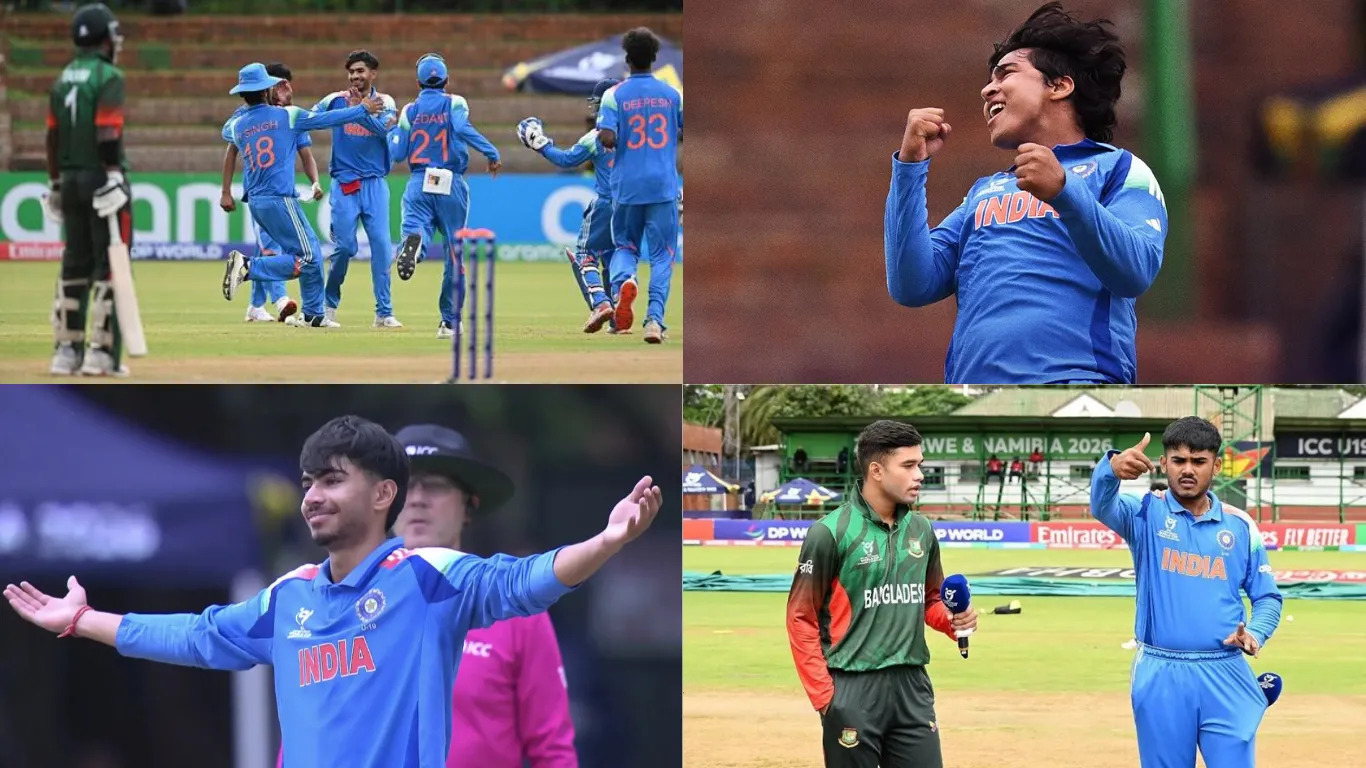
India vs Bangladesh U19 2026: India continued their impressive run in the ICC Under-19 World Cup with a hard-fought and dramatic victory over Bangladesh, securing an 18-run win in a rain-affected encounter on Saturday. The match, which swung back and forth until the final overs, showcased outstanding young talent, moments of brilliance in the field, and strong leadership under pressure. With this result, India registered their second consecutive win in the tournament, strengthening their position in the group stage of the India vs Bangladesh U19 2026 contest and reinforcing their status as one of the tournament favourites.
The clash was played in Bulawayo, where weather interruptions added an extra layer of complexity to an already intense rivalry. Bangladesh won the toss and opted to bowl first, hoping to take advantage of early conditions. What followed was a gripping contest that underlined why the India-Bangladesh rivalry at the Under-19 level remains one of the most competitive in world cricket.
India’s Batting Effort: Fifties from Suryavanshi and Abhigyan
Batting first, India posted a total of 238 runs before being bowled out in 48.4 overs. While the surface offered something for both batters and bowlers, India’s innings was built on composure, calculated aggression, and crucial partnerships at key moments.
The standout performers with the bat were Vaibhav Suryavanshi and Abhigyan Kundu, both of whom played mature innings well beyond their years. Suryavanshi scored a fluent 72, combining timing with intelligent shot selection, while Abhigyan anchored the innings with a well-crafted 80, ensuring stability through the middle overs.
Vaibhav Suryavanshi’s knock once again highlighted his exceptional potential. Already making headlines as the youngest batter to score a half-century in Under-19 World Cup history, he showed remarkable temperament against disciplined bowling. His ability to rotate the strike and punish loose deliveries allowed India to maintain momentum despite losing wickets at regular intervals.
Abhigyan Kundu, on the other hand, played the role of the stabiliser. As the wicketkeeper-batter, he displayed excellent awareness of the match situation, choosing when to attack and when to consolidate. His partnership with Suryavanshi proved decisive in pushing India to a competitive total.
Despite their efforts, Bangladesh’s bowlers ensured India never fully broke free. Tight lines and well-directed short spells prevented a late flourish, and India were eventually bowled out just short of the 50-over mark.
Rain Changes the Equation
As rain interrupted play, the match was reduced under the Duckworth-Lewis-Stern (DLS) method. Bangladesh were set a revised target of 165 runs in 29 overs, changing the dynamics of the chase entirely. The reduced overs meant Bangladesh needed to score at a brisk pace from the start, while India were tasked with defending a target that required discipline and sharp fielding.
The revised conditions made the contest even more intriguing, with momentum capable of shifting rapidly in such a shortened chase.
Bangladesh’s Chase and Early Pressure
Bangladesh began their chase with intent, knowing that the required run rate left little room for caution. However, India’s bowlers struck at regular intervals, ensuring the pressure never eased.
The turning point of the match came in the 26th over of Bangladesh’s innings, producing one of the most memorable moments of the tournament so far.
Vaibhav’s Surya-Like Catch Changes the Game
With Bangladesh attempting to accelerate, Vaibhav Suryavanshi produced a stunning catch on the boundary, drawing immediate comparisons to Suryakumar Yadav’s iconic effort in the final of the T20 World Cup 2024. Positioned near the ropes, Vaibhav timed his jump perfectly, caught the ball inches from the boundary, and maintained balance to complete a breathtaking dismissal.
The catch resulted in the wicket of Mohammad Samiun Basir Ratul, who departed for just 2 runs. More importantly, it completely shifted the momentum of the match. What could have been a crucial scoring opportunity for Bangladesh instead became a moment of inspiration for India.
The young Indian players celebrated with visible energy, while Bangladesh found themselves under immense pressure following the dismissal. It was a reminder of how fielding brilliance can be just as decisive as runs or wickets, especially in high-stakes tournament matches like India vs Bangladesh U19 2026.
Vihan Malhotra’s Four-Wicket Haul Seals the Win
While the catch grabbed headlines, the bowling performance of Vihan Malhotra ultimately sealed the victory for India. Delivering with pace, accuracy, and intelligence, Vihan dismantled Bangladesh’s batting lineup with a superb spell, finishing with four wickets.
His ability to strike at crucial moments ensured Bangladesh never settled into a comfortable rhythm. Each time the opposition threatened to rebuild, Vihan stepped up to break the partnership, maintaining India’s control over the game.
Supported well by the rest of the bowling unit, India restricted Bangladesh to 146 runs in 28.3 overs, falling 18 runs short of the revised target. The disciplined bowling effort highlighted India’s depth and preparation, qualities that have long been associated with their success at the Under-19 level.
Controversy at the Toss: BCB Issues Clarification
The match also witnessed a brief moment of controversy even before the first ball was bowled. At the toss, Bangladesh vice-captain Jawad Abrar, who represented the team due to captain Azizul Hakim Tamim’s illness, did not shake hands with Indian captain Ayush Mhatre. The incident quickly caught attention and sparked discussion on social media.
The Bangladesh Cricket Board (BCB) later issued a clarification, stating that the incident was entirely unintentional and not meant to disrespect the opposing team.
According to the BCB, the regular captain was unwell and unable to attend the toss, which is why the vice-captain stepped in. The board further emphasized that players had been reminded to uphold sportsmanship at all times and that there was no ill intent behind the moment.
The issue was swiftly addressed, allowing the focus to return to the cricket itself.
Leadership and Team Effort Shine for India
Indian captain Ayush Mhatre played a calm and composed role throughout the match, making smart bowling changes and backing his players in pressure situations. His leadership ensured the team remained focused despite weather interruptions and the shifting match conditions.
The win was a collective effort, with contributions coming from all departments. From the top-order resilience and middle-order stability to the disciplined bowling and exceptional fielding, India displayed the hallmark of a well-rounded side.
Vihaan Malhotra was the pick of India's successful bowling effort in Bulawayo 👊
— ICC (@ICC) January 17, 2026
He wins the @aramco POTM award for his spell of 4/14 🎖️ pic.twitter.com/kbu9OqY1ux
Playing XIs
India (IND):
Ayush Mhatre (captain), Vaibhav Suryavanshi, Vedant Trivedi, Vihan Malhotra, Abhigyan Kundu (wicketkeeper), Harvansh Pangalia, RS Ambarish, Kanishk Chauhan, Henil Patel, Deepesh Devendran, Khilan Patel.
Bangladesh (BAN):
Azizul Hakim Tamim (captain), Rifat Baig, Jawad Abrar, Kalam Siddiqui Alin, Mohammad Rizan Hossain, Mohammad Farid Hassan Faisal, Mohammad Samiun Basir Ratul, Sheikh Pawez Jibon, Al Fahad, Saad Islam Rajin, Iqbal Hossain.
What This Win Means for India
With two consecutive victories, India have taken a strong step toward qualification for the knockout stages. The match against Bangladesh once again highlighted India’s ability to handle pressure, adapt to changing conditions, and rely on young match-winners when it matters most.
For Bangladesh, the loss will be disappointing, but the fight they showed under challenging circumstances suggests they remain a dangerous side capable of bouncing back.
As the Under-19 World Cup progresses, encounters like India vs Bangladesh U19 2026 continue to captivate cricket fans worldwide, offering a glimpse into the future stars of international cricket.
India will now look to carry this momentum forward, while Bangladesh will aim to regroup and respond strongly in their upcoming fixtures. One thing is certain: the rivalry at the Under-19 level remains as intense and compelling as ever.