
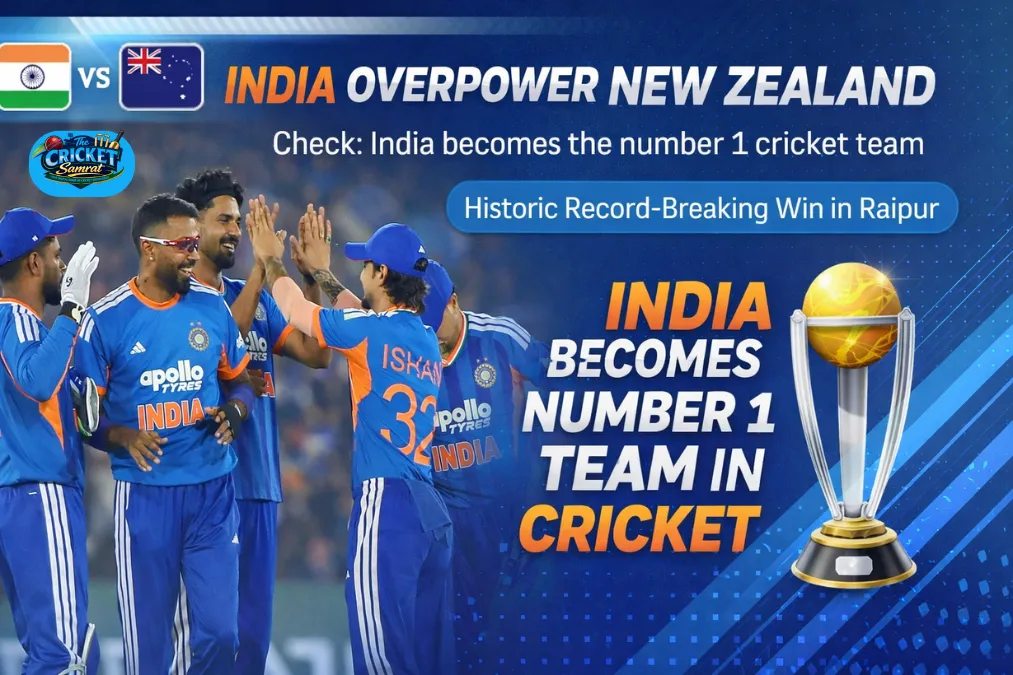
India New Zealand Cricket: India delivered a dominant performance in the second T20 International against New Zealand, rewriting the record books and asserting their supremacy in world cricket. In a high-scoring encounter at Raipur, India chased down a daunting 209-run target with remarkable ease, defeating New Zealand by seven wickets and taking an unassailable 2–0 lead in the series.
The match was not just another victory for India new zealand cricket rivalry—it was a historic night that saw India surpass Pakistan to become the fastest team to chase a 200-plus target in T20 internationals, measured by balls remaining. Led by an exceptional unbeaten innings from captain Suryakumar Yadav and a fluent knock from Ishan Kishan, India turned what looked like a pressure-filled chase into a one-sided affair.
India’s Commanding Chase Despite Early Setbacks
Chasing a massive target of 209 runs, India appeared momentarily unsettled when they lost two wickets for just six runs early in the innings. New Zealand’s bowlers struck quickly, raising hopes of a competitive contest. However, those hopes were short-lived.
Captain Suryakumar Yadav, known for his fearless stroke play and calm leadership, walked in and immediately took control of the situation. He was joined by Ishan Kishan, whose aggressive yet calculated approach ensured the momentum never shifted back to New Zealand.
The duo stitched together a match-defining partnership, dismantling the Kiwi bowling attack with clean hitting, sharp running between the wickets, and excellent shot selection. Boundaries flowed freely as India raced ahead of the required run rate.
By the time Suryakumar Yadav finished unbeaten on 82 runs, and Ishan Kishan contributed a superb 76, the contest was effectively over. India completed the chase in just 15.2 overs, with 28 balls to spare, sending the Raipur crowd into celebration.
Breaking Pakistan’s Long-Standing World Record
This emphatic win carried historic significance. With the victory, India became the number one team in the world in terms of the fastest successful chase of a 200-plus target in T20 internationals.
Previously, this record belonged to Pakistan, who had chased down a 205-run target against New Zealand in Auckland in 2025 with 24 balls remaining. India not only surpassed that benchmark but did so convincingly, leaving 28 deliveries unused.
Fastest Successful 200+ Run Chases (By Balls Remaining)
| Rank | Team | Opponent | Venue | Year | Target | Balls Remaining |
|---|---|---|---|---|---|---|
| 1 | India | New Zealand | Raipur | 2026 | 209 | 28 |
| 2 | Pakistan | New Zealand | Auckland | 2025 | 205 | 24 |
| 3 | Australia | West Indies | Basseterre | 2025 | 215 | 23 |
| 4 | South Africa | West Indies | Johannesburg | 2007 | 206 | 14 |
This achievement further highlights India’s growing dominance in white-ball cricket and their ability to thrive under pressure against top international sides.
India Overtake South Africa in Elite T20 List
India’s chase in Raipur was not just about speed—it was also about consistency at the highest level. This victory marked the sixth time India have successfully chased a 200-plus total in T20 internationals, allowing them to move past South Africa in the all-time list.
Only Australia now sit above India in this elite category, underlining how far Indian T20 cricket has evolved over the past decade.
Most Successful 200+ Target Chases in T20 Internationals
| Rank | Team | Successful Chases |
|---|---|---|
| 1 | Australia | 7 |
| 2 | India | 6 |
| 3 | South Africa | 5 |
| 4 | Pakistan | 4 |
| 5 | England | 3 |
This consistency reflects India’s depth in batting, adaptability to conditions, and ability to handle high-pressure run chases—key traits for success in modern T20 cricket.
Suryakumar Yadav’s Leadership Shines Bright
Suryakumar Yadav’s unbeaten 82 was a captain’s knock in every sense. Coming in when the team was under early pressure, he showed composure, tactical awareness, and trademark flair. His innings featured a blend of innovative stroke play and traditional cricketing shots, keeping the fielding side constantly guessing.
More importantly, Suryakumar paced his innings to perfection. He ensured that the run rate never escalated, allowing Ishan Kishan to play freely at the other end. The partnership was a masterclass in T20 batting strategy and showcased why India new zealand cricket encounters remain among the most thrilling in the sport.
Ishan Kishan’s Aggression Sets the Tone
While Suryakumar anchored the chase, Ishan Kishan’s 76 runs provided the firepower needed to dominate New Zealand’s bowlers. His aggressive intent forced fielding changes and disrupted the opposition’s plans.
Kishan targeted both pace and spin with equal confidence, hitting boundaries at crucial moments and keeping the scoreboard ticking. His innings ensured that India stayed well ahead of the required rate, turning the chase into a comfortable exercise rather than a tense finish.
India’s Biggest Successful T20 Run Chases
India’s chase of 209 runs in Raipur now stands among the greatest in their T20 history. Over the years, India have repeatedly proven their ability to hunt down massive totals, often against strong opponents.
Highest Successful Run Chases by India in T20 Internationals
| Runs Chased | Opponent | Venue | Year |
|---|---|---|---|
| 209 | New Zealand | Raipur | 2026 |
| 209 | Australia | Visakhapatnam | 2023 |
| 208 | West Indies | Hyderabad | 2018 |
| 207 | Sri Lanka | Mohali | 2009 |
| 204 | New Zealand | Auckland | 2020 |
| 202 | Australia | Rajkot | 2013 |
This list underlines India’s reputation as one of the most dangerous chasing teams in world cricket.
Read also: Milne Ruled Out of T20 World Cup 2026 After Hamstring Injury, Kyle Jamieson Named as Replacement
New Zealand Outplayed Despite Competitive Total
New Zealand, to their credit, had posted a competitive total of over 200 runs, a score that would normally put any chasing side under immense pressure. Their top-order batting showed intent, and they capitalised on batting-friendly conditions in Raipur.
However, their bowling lacked penetration once the initial breakthroughs were achieved. The inability to contain Suryakumar Yadav and Ishan Kishan proved costly, and fielding lapses further compounded their troubles.
Despite the loss, New Zealand remain a formidable side, and the India new zealand cricket rivalry continues to produce high-quality, high-intensity matches.
Series Impact and What Lies Ahead
With this victory, India secured a 2–0 lead in the T20 series, effectively sealing the contest. The performance sends a strong message ahead of future global tournaments, reinforcing India’s status as a top contender in the shortest format of the game.
The match also highlighted the team’s bench strength, leadership maturity, and adaptability—qualities that will be crucial as international cricket becomes increasingly competitive.
Conclusion: A Statement Win for India
India’s emphatic victory in Raipur was more than just a series-clinching performance—it was a statement of intent. By chasing down a 209-run target with 28 balls remaining, India not only defeated New Zealand but also rewrote T20 history.
From Suryakumar Yadav’s composed leadership to Ishan Kishan’s explosive batting, every aspect of India’s performance reflected confidence, clarity, and class. As the India new zealand cricket rivalry continues to evolve, this match will be remembered as one of the finest examples of modern T20 dominance.
India now stand at the top, not just on paper, but in performance—and the rest of the cricketing world has been put on notice.