
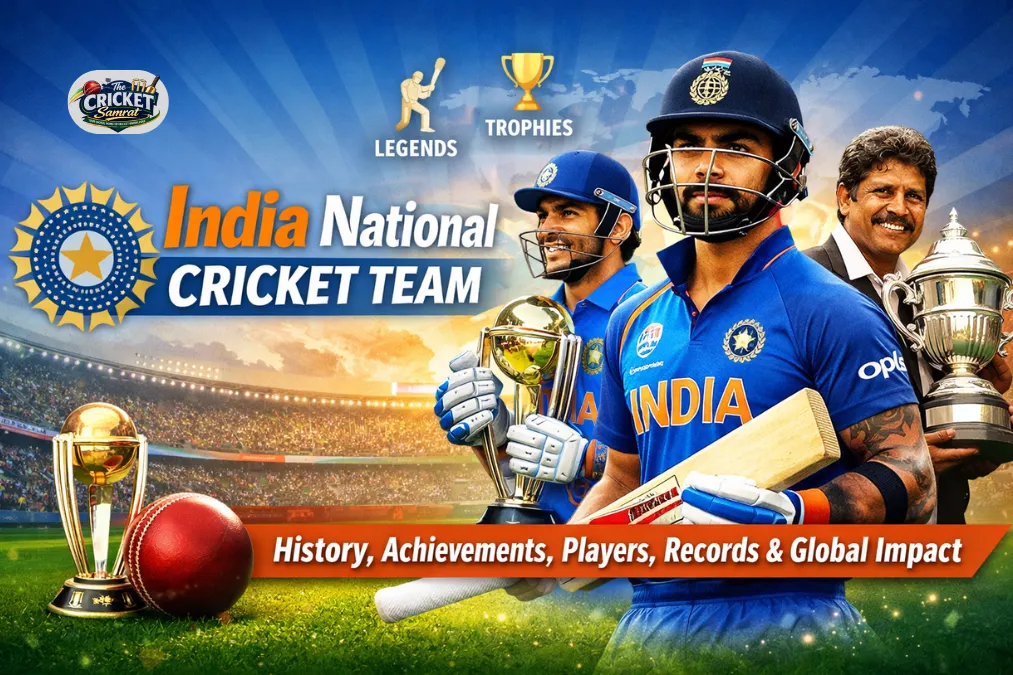
India national cricket team is one of the most successful and influential teams in world cricket, representing a nation where the sport is followed with unmatched passion and pride.
From dusty streets to world-class stadiums, cricket is deeply rooted in Indian culture. Over the decades, the India national cricket team has transformed from a beginner side into a dominant global force through talent, discipline, and continuous growth.
Early History of the India National Cricket Team
The India national cricket team played its first official Test match in 1932 against England at Lord’s. During the early years, the team struggled due to lack of experience and limited facilities.
Despite challenges, India gradually built a strong cricketing base. Early legends like C. K. Nayudu, Vijay Merchant, and Vinoo Mankad laid the foundation of Indian cricket.
India’s Early Test Journey
| Year | Event |
|---|---|
| 1932 | First Test match vs England |
| 1947 | First series after independence |
| 1952 | First Test win against England |
| 1968 | First overseas Test win in New Zealand |
These milestones marked the slow but steady rise of the India national cricket team.
Rise of Indian Cricket After Independence
After independence, Indian cricket began developing rapidly. The team gained confidence and improved performance, especially on home soil.
The 1970s saw India winning Test series in England and the West Indies, proving its growing strength in international cricket.
1983 World Cup: A Turning Point
The biggest transformation came in 1983 when India won the Cricket World Cup under Kapil Dev’s captaincy.
This victory completely changed Indian cricket’s future. Cricket became the most followed sport in the country, and the India national cricket team gained global recognition.
1983 World Cup Final Summary
| Category | Details |
|---|---|
| Opponent | West Indies |
| Venue | Lord’s |
| India Score | 183 all out |
| West Indies Score | 140 all out |
| Result | India won by 43 runs |
| Captain | Kapil Dev |
This historic win inspired millions and laid the foundation for modern Indian cricket.
The 1990s and the Arrival of Legends
The 1990s marked the rise of legendary players who redefined Indian cricket.
Sachin Tendulkar emerged as a global icon. Alongside him, players like Mohammad Azharuddin, Anil Kumble, Rahul Dravid, and Sourav Ganguly strengthened the team.
Indian cricket gained consistency and confidence during this decade.
The Ganguly Era and Team Rebuilding
Sourav Ganguly’s leadership brought aggression and belief into the India national cricket team.
The famous 2001 Test series win against Australia remains one of the greatest moments in cricket history.
2001 Border-Gavaskar Trophy Highlights
| Match | Result |
|---|---|
| 1st Test | Australia won |
| 2nd Test | India won after follow-on |
| 3rd Test | India won |
| Series Result | India won 2–1 |
This series established India as a mentally strong and competitive team.
The MS Dhoni Era: Golden Years
MS Dhoni became one of the most successful captains in cricket history. Under his calm leadership, the India national cricket team achieved unmatched success.
Major ICC Titles Won Under MS Dhoni
| Tournament | Year |
|---|---|
| ICC T20 World Cup | 2007 |
| ICC Cricket World Cup | 2011 |
| ICC Champions Trophy | 2013 |
Dhoni also led India to the number one Test ranking and built a strong team culture.
Virat Kohli and the Fitness Revolution
Virat Kohli introduced a new fitness standard in Indian cricket. The India national cricket team became one of the fittest teams in the world.
India developed a powerful fast-bowling unit capable of winning overseas matches.
Key Achievements Under Virat Kohli
| Achievement | Details |
|---|---|
| Test Series Win in Australia | 2018–19 |
| Consecutive Overseas Wins | England, Australia, South Africa |
| Longest Test No.1 Ranking | Multiple years |
Kohli’s aggressive approach made India fearless in all conditions.
Current Era of the India National Cricket Team
The present India national cricket team combines experience with young talent. Under Rohit Sharma’s leadership, the team continues to perform strongly across formats.
India now has exceptional bench strength, allowing smooth player rotation without affecting results.
Formats Played by the India National Cricket Team
Test Cricket
India is one of the strongest Test teams, especially at home. Spin bowlers and disciplined fast bowlers play a major role in success.
One Day Internationals
India remains a dominant ODI side with a strong top order and balanced bowling attack.
Twenty20 Internationals
India’s T20 team focuses on aggressive batting, all-rounders, and flexible strategies.
India Performance by Format
| Format | Matches Played | Major Strength |
|---|---|---|
| Test | 500+ | Strong batting depth |
| ODI | 1000+ | Top-order dominance |
| T20I | 200+ | Power-hitting and pace |
Legendary Players of the India National Cricket Team
Greatest Indian Cricketers
| Player | Role | Key Achievement |
|---|---|---|
| Sachin Tendulkar | Batsman | 100 international centuries |
| Kapil Dev | All-rounder | 1983 World Cup captain |
| Rahul Dravid | Batsman | Over 13,000 Test runs |
| Anil Kumble | Bowler | 619 Test wickets |
| MS Dhoni | Wicketkeeper | 3 ICC trophies |
| Virat Kohli | Batsman | Among highest run-scorers |
| Rohit Sharma | Batsman | 3 ODI double centuries |
These players shaped the identity of the India national cricket team.
Major Records of the India National Cricket Team
India holds many international records across formats.
Team Records
| Record | Details |
|---|---|
| Highest ODI Score | 418 vs West Indies |
| Most ICC Finals Appearances | Among top teams |
| Longest Home Test Winning Streak | 12+ years |
Indian players dominate modern cricket statistics due to consistency and volume of matches.
Domestic Cricket Structure in India
A strong domestic system is the backbone of Indian cricket.
Key Domestic Tournaments
| Tournament | Purpose |
|---|---|
| Ranji Trophy | First-class cricket |
| Vijay Hazare Trophy | One Day format |
| Syed Mushtaq Ali Trophy | T20 format |
| Duleep Trophy | Elite competition |
These tournaments continuously supply talent to the India national cricket team.
Indian Premier League and Its Impact
The IPL revolutionized Indian cricket by improving skills, confidence, and global exposure.
Young players get opportunities to perform under pressure and learn from international stars.
The league has significantly improved India’s fielding standards and tactical awareness.
Fan Base and Cultural Influence
The India national cricket team enjoys the largest fan base in world cricket. Matches often stop daily life across the country.
Cricket unites people beyond language, religion, and region. Victories are celebrated nationwide, and players are treated as national icons.
Famous Rivalries
India vs Pakistan
One of the most watched sporting rivalries in the world, known for intense competition and massive viewership.
India vs Australia
A rivalry defined by competitive cricket, strong personalities, and historic Test series.
India vs England
A traditional rivalry dating back to India’s first international match.
Challenges and Future Vision
Despite consistent success, the India national cricket team aims to improve performance in major ICC knock-out matches.
With young stars like Shubman Gill, Yashasvi Jaiswal, Jasprit Bumrah, Rishabh Pant, and Hardik Pandya, the future looks strong.
Also read: Who Is the Best Cricketer in the World? Complete Analysis With Records, Stats, and Comparisons
Coaching, Management, and Technology
Modern Indian cricket relies heavily on data analysis, sports science, and fitness management.
Coaches, analysts, and support staff play a vital role in preparation, workload management, and strategic planning.
Global Influence of the India National Cricket Team
Today, the India national cricket team holds immense influence in world cricket. Its commercial power, fan following, and performance standards shape the global cricket ecosystem.
Indian cricket sets benchmarks in professionalism, infrastructure, and player development.
Also read: What Is a Diamond Duck in Cricket? Complete Meaning, Rules, Examples, and Facts
Conclusion
The story of the India national cricket team is a journey of belief, struggle, and excellence. From its humble beginning in 1932 to becoming a global cricket giant, India’s rise reflects dedication and unity.
With legendary players, passionate fans, and a powerful system, the India national cricket team continues to inspire generations and remains one of the strongest pillars of international cricket.