
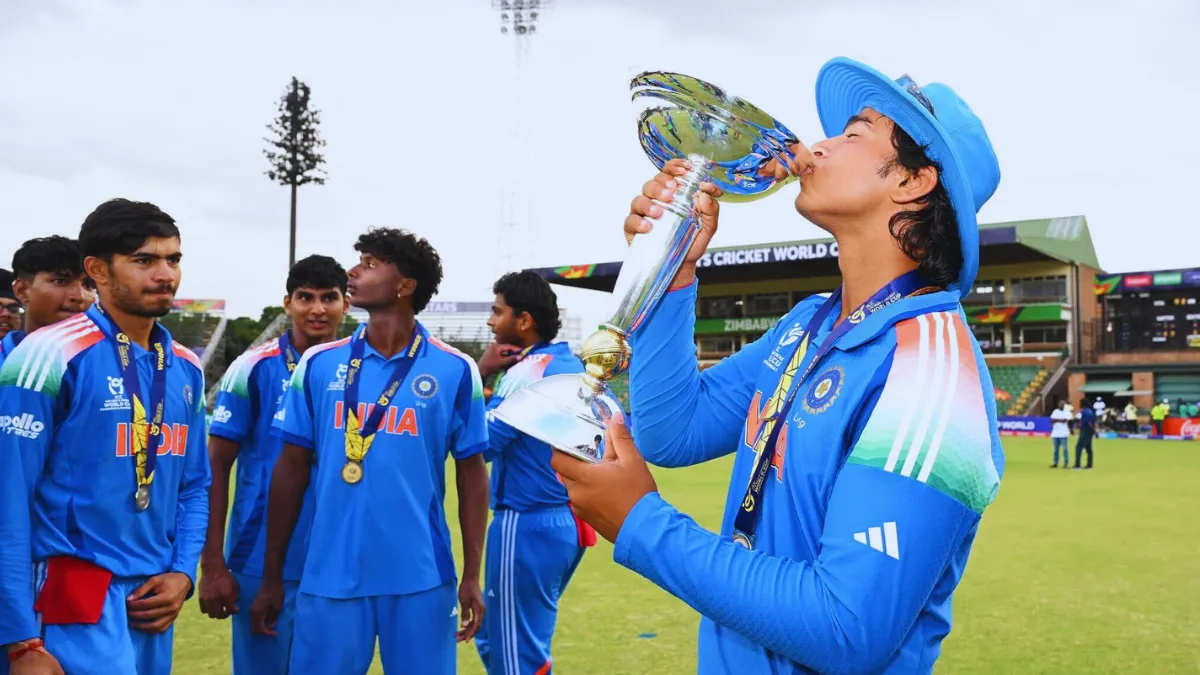
The International Cricket Council has officially announced the ICC U19 World Cup 2026 Team of the Tournament, recognising the most outstanding young performers from a memorable Under-19 Cricket World Cup. The final selection reflects consistent brilliance across batting, bowling, and all-round performances, with India and England emerging as the most represented nations in the elite XI.
India’s teenage sensation Vaibhav Suryavanshi, who played a decisive role in the final, headlines the team after producing one of the most remarkable tournaments in Under-19 World Cup history. However, one of the biggest talking points from the announcement is the absence of India’s title-winning captain Ayush Mhatre, who failed to make the cut despite leading the side to glory.
India’s Strong Presence in the Team of the Tournament
India, the champions of the ICC U19 World Cup 2026, have three players selected in the Team of the Tournament. Leading the list is explosive opener Vaibhav Suryavanshi, joined by all-rounder Kanishk Chauhan and left-arm spinner Henil Patel.
Suryavanshi’s performance throughout the competition was nothing short of extraordinary. At just 14 years of age, the young batter displayed maturity far beyond his years, consistently dominating bowling attacks on the biggest stage.
In the final against England, Suryavanshi delivered a once-in-a-generation innings that tilted the match decisively in India’s favour. His fearless stroke play laid the foundation for India’s commanding victory and ultimately helped the team secure their sixth Under-19 World Cup title.
Vaibhav Suryavanshi’s Tournament to Remember
Vaibhav Suryavanshi finished the tournament as one of the leading run-scorers, amassing 439 runs in seven matches, including a sensational century. His standout performance came in the final, where he smashed 175 runs off just 80 balls, an innings filled with breathtaking power and precision.
The knock featured 15 sixes and 15 fours, making it one of the most destructive innings ever seen in Under-19 World Cup history. His consistency at the top of the order and ability to perform under pressure made his inclusion in the ICC U19 World Cup 2026 Team of the Tournament an obvious choice.
India’s Other Selections: Kanishk Chauhan and Henil Patel
All-rounder Kanishk Chauhan earned his place after contributing significantly with both bat and ball. His ability to provide crucial breakthroughs while also adding valuable runs in the middle order made him a vital asset for India throughout the competition.
Spinner Henil Patel impressed with his control and wicket-taking ability. He finished the tournament with 11 wickets, including a memorable five-wicket haul against the United States. Patel’s calm temperament and consistency in pressure situations played a key role in India’s title run.
England’s Trio Earn Recognition Despite Final Loss
Despite finishing as runners-up, England also placed three players in the ICC’s Team of the Tournament, highlighting their strong and well-balanced campaign.
Wicketkeeper-batter Thomas Rew was named captain of the Team of the Tournament. Rew enjoyed a superb World Cup, scoring 330 runs at an average of 66, including a match-winning century in the semi-final against Australia.
England’s bowling attack was represented by Manny Lumsden, the tournament’s leading wicket-taker with 16 wickets, while batting sensation Ben Mayes made headlines by scoring 444 runs, the most by any player in the competition.
Mayes came agonisingly close to breaking the all-time highest individual score record at the ICC Under-19 World Cup. His innings of 191 runs against Scotland left him just one run short of the record set days earlier by Sri Lanka’s Veeran Chamuditha.
Sri Lanka, Afghanistan Also Feature in the Elite XI
Sri Lankan batter Veeran Chamuditha, who etched his name into the record books with a historic 192-run innings against Japan, was also included in the Team of the Tournament. His innings featured 26 boundaries and one six, showcasing remarkable control and stamina.
Afghanistan’s impressive campaign, which ended in the semi-finals, was recognised with the inclusion of Faisal Khan Shinizada and Nooristani Umarzai.
Faisal Khan finished the tournament on a high note by scoring back-to-back centuries against Ireland and India, while Umarzai emerged as a key bowler with 14 wickets, including an outstanding five-wicket haul for just nine runs against Tanzania.
ICC U19 World Cup 2026 Team of the Tournament – Full List
Below is the officially announced ICC U19 World Cup 2026 Team of the Tournament, presented in a clear table format:
| Player Name | Country | Role | Key Performance |
|---|---|---|---|
| Vaibhav Suryavanshi | India | Opener | 439 runs, 175 in final |
| Ben Mayes | England | Top-order Batter | 444 runs, 191 vs Scotland |
| Veeran Chamuditha | Sri Lanka | Batter | 192 vs Japan |
| Faisal Khan Shinizada | Afghanistan | Batter | Back-to-back centuries |
| Thomas Rew (Captain, WK) | England | WK-Batter | 330 runs, avg 66 |
| Kanishk Chauhan | India | All-rounder | Key runs & wickets |
| Nooristani Umarzai | Afghanistan | Bowler | 14 wickets |
| Manny Lumsden | England | Bowler | 16 wickets |
| Henil Patel | India | Spinner | 11 wickets |
| — | — | — | — |
| — | — | — | — |
(Final composition as announced by ICC)
Ayush Mhatre’s Absence Raises Questions
One of the most debated decisions surrounding the ICC U19 World Cup 2026 Team of the Tournament is the omission of India’s captain Ayush Mhatre. Despite leading the team to championship success, Mhatre scored 217 runs in seven matches, including three half-centuries, which the selectors seemingly felt fell short compared to other standout performers.
While leadership is often a factor, the Team of the Tournament primarily focuses on individual impact and match-winning contributions, which may explain his exclusion.
A Tournament That Celebrated Emerging Global Talent
The ICC U19 World Cup 2026 proved once again why it remains one of the most important platforms for identifying future international stars. From Vaibhav Suryavanshi’s fearless batting to England’s consistency and Afghanistan’s rise as a competitive force, the tournament showcased exceptional depth of young talent across nations.
The ICC U19 World Cup 2026 Team of the Tournament stands as a reflection of performances that not only shaped matches but also hinted at the next generation of global cricketing icons.
As these young players move forward in their careers, many of them are expected to make the transition to senior international cricket sooner rather than later, carrying with them the confidence and experience gained on the world’s biggest Under-19 stage.