
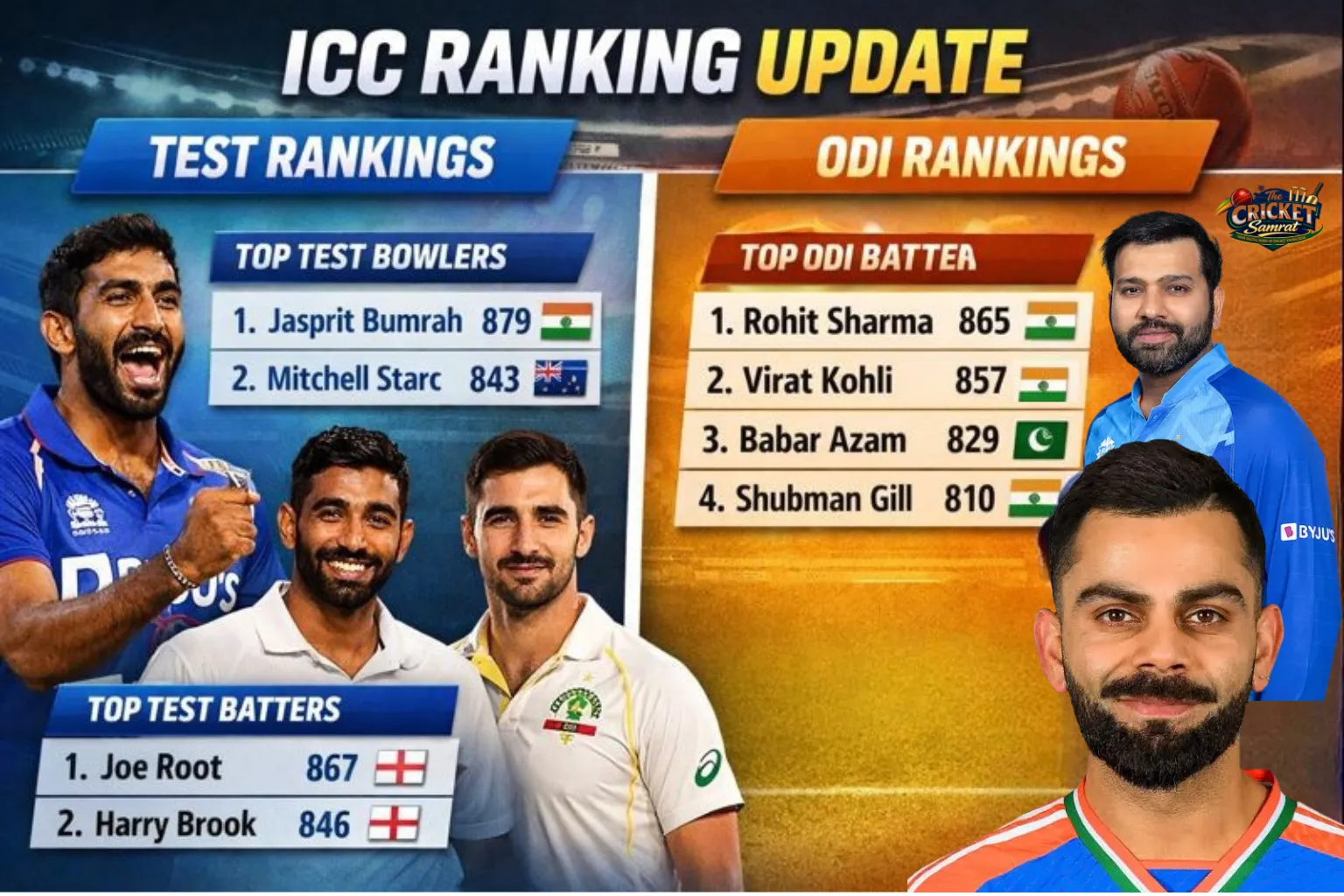
In the latest ICC rankings released on Wednesday, pace bowlers from Australia and England emerged as the biggest gainers, showcasing the impact of stellar performances in the fourth Ashes Test played in Melbourne. Australian left-arm fast bowler Mitchell Starc has soared to second place in the ICC Test bowling rankings, highlighting his exceptional contribution to the series and cementing his status as one of the world’s leading pacers.
Starc Narrowly Trails Bumrah
Mitchell Starc now has 843 rating points, just 36 points behind India’s Jasprit Bumrah, who retains the number one spot with 879 points. The Melbourne Test witnessed a total of 36 wickets, with fast bowlers claiming 35 of them-a factor that significantly boosted the ICC rankings for both Australian and English pacers.
Despite his rise, Starc faces a challenging road ahead to claim the top spot, primarily because the Australian team has no upcoming Test matches scheduled in the near future, limiting his opportunities to accumulate additional points.
England’s Josh Tong Makes Big Jump
England’s Josh Tong made a remarkable impact in the Melbourne Test, taking 7 wickets in total (5/45 and 2/44). This performance propelled him 13 places up the ICC Test bowling rankings, moving him to 30th place with 573 rating points. Tong’s contribution was pivotal in helping England secure their first victory of the Ashes series.
Meanwhile, Gus Atkins impressed with the new ball, dismissing Travis Head and claiming a total of 3 wickets, which earned him a 4-place jump to joint 13th position with 698 rating points.
Other Notable Movers in Bowling Rankings
Several other bowlers also saw substantial improvements in the ICC Test bowling rankings:
| Player | Team | Previous Rank | New Rank | Rating Points | Notable Performance |
|---|---|---|---|---|---|
| Scott Boland | Australia | 9 | 7 | 810 | Career-best ranking after strong Melbourne Test performance |
| Brydon Carse | England | 29 | 23 | 638 | Took 5 wickets, also gained in all-rounder rankings (8th, 238 points) |
Scott Boland climbed 2 spots to 7th, marking his career-best position, while Brydon Carse’s five-wicket haul propelled him six places up to 23rd, reflecting a significant boost in his ICC ranking and also benefiting his standing in the all-rounder category.
Harry Brook Rises Among Test Batters
England’s Harry Brook was the standout performer among batters, climbing 3 positions to second place in the ICC Test batting rankings with 846 points. Brook’s consistent form in the Melbourne Test, scoring 41 in the first innings and an unbeaten 18 in the second, was crucial in securing England’s win.
Brook now surpasses Australian stalwarts Steve Smith (811 points), Travis Head (816 points), and New Zealand’s Kane Williamson (816 points). The top position, however, remains occupied by England’s Joe Root (867 points), keeping the battle for the number one ranking fiercely competitive.
Indian Dominance in ODI Batting Rankings
While the Test rankings saw significant movement, India continues to dominate the One-Day International (ODI) batting rankings. Four Indian batsmen feature in the top 10:
| Rank | Player | Country | Rating Points |
|---|---|---|---|
| 1 | Rohit Sharma | India | 865 |
| 2 | Virat Kohli | India | 857 |
| 5 | Shubman Gill | India | 810 |
| 10 | Shreyas Iyer | India | 788 |
Rohit Sharma retains his number one position, with Virat Kohli close behind in second place. Captain Shubman Gill and Shreyas Iyer secure fifth and tenth positions respectively, reinforcing India’s stronghold over ODI batting.
Analysis: Why Fast Bowlers Benefited
The recent ICC rankings update reflects a clear advantage for pace bowlers due to several factors:
- Wickets dominated by pacers – In the Melbourne Test, 35 out of 36 wickets were taken by fast bowlers.
- Match-winning performances – Bowlers like Starc, Tong, Boland, and Carse made crucial contributions that directly influenced match outcomes.
- Limited opportunities for batsmen – While batters had individual successes, the high impact of bowlers in terms of match-winning spells has led to more pronounced changes in rankings.
This trend highlights the dynamic nature of the ICC rankings, where consistent high-impact performances in Test cricket can rapidly alter a player’s position.
Context: Ashes Series Impact
The Melbourne Test was pivotal for both Australia and England. England’s win in this match allowed several of their bowlers to gain significant ground in the ICC Test rankings. For Australia, Starc’s exceptional bowling reinforced his reputation as a world-class pacer and narrowed the gap with Bumrah.
Historically, ICC rankings reward players not only for statistical performance but also for the match context, giving extra weight to contributions that lead to victories or affect the course of a series. This is why the Melbourne Test had such a pronounced impact on the rankings.
ICC Rankings – Key Takeaways
- Test Cricket: Mitchell Starc (#2) and Harry Brook (#2) are the biggest movers; Bumrah (#1) and Root (#1) retain their positions.
- ODIs: India maintains a dominant presence with four batsmen in the top 10; Rohit Sharma (#1) and Virat Kohli (#2) continue their strong form.
- Rising Stars: Josh Tong and Scott Boland showcased that new talent can climb quickly with consistent performances.
- Bowling Supremacy: Fast bowlers clearly benefited from recent matches, highlighting the evolving landscape of ICC rankings.
Expert Opinions
Cricket analysts suggest that Starc’s rise to second place demonstrates the growing importance of strike rate and wicket-taking ability in the modern game. According to former cricketer and commentator Michael Vaughan:
“Mitchell Starc has always been a game-changer. His ability to take wickets in crucial moments is exactly what the ICC rankings reward. Even though he hasn’t reached the top spot yet, performances like Melbourne put him within striking distance.”
Similarly, England’s bowling coach praised the performances of Scott Boland and Josh Tong:
“It’s a testament to their skill and preparation. They’ve taken full advantage of home conditions, and the rankings now reflect that effort.”
What’s Next for ICC Rankings?
Looking ahead, the ICC rankings will continue to evolve with the upcoming international fixtures. Factors that may influence future changes include:
- Scheduled Tests and ODIs – Players who are active in more matches have a higher chance to gain points.
- Series outcomes – Victories and standout performances can lead to significant jumps in ranking.
- Injury and absence – Extended breaks or injuries can cause players to drop in points due to inactivity.
For fans tracking ICC rankings, the upcoming home series for England and Australia and the India ODI schedule will be particularly important in determining the next movement in rankings for both batters and bowlers.
Conclusion
The latest ICC rankings demonstrate the ever-shifting dynamics of international cricket. With Mitchell Starc climbing to second in Test bowling, England’s Harry Brook rising among batters, and India maintaining a dominant presence in ODI batting, the rankings reflect both individual brilliance and team performance.
As the cricketing calendar progresses, players like Starc, Bumrah, Rohit Sharma, and Virat Kohli will continue to be closely watched, with every match carrying potential implications for their ICC ranking positions.
The ICC rankings not only recognize statistical performance but also capture the impact of players in crucial moments, providing a comprehensive measure of international cricketing excellence.