
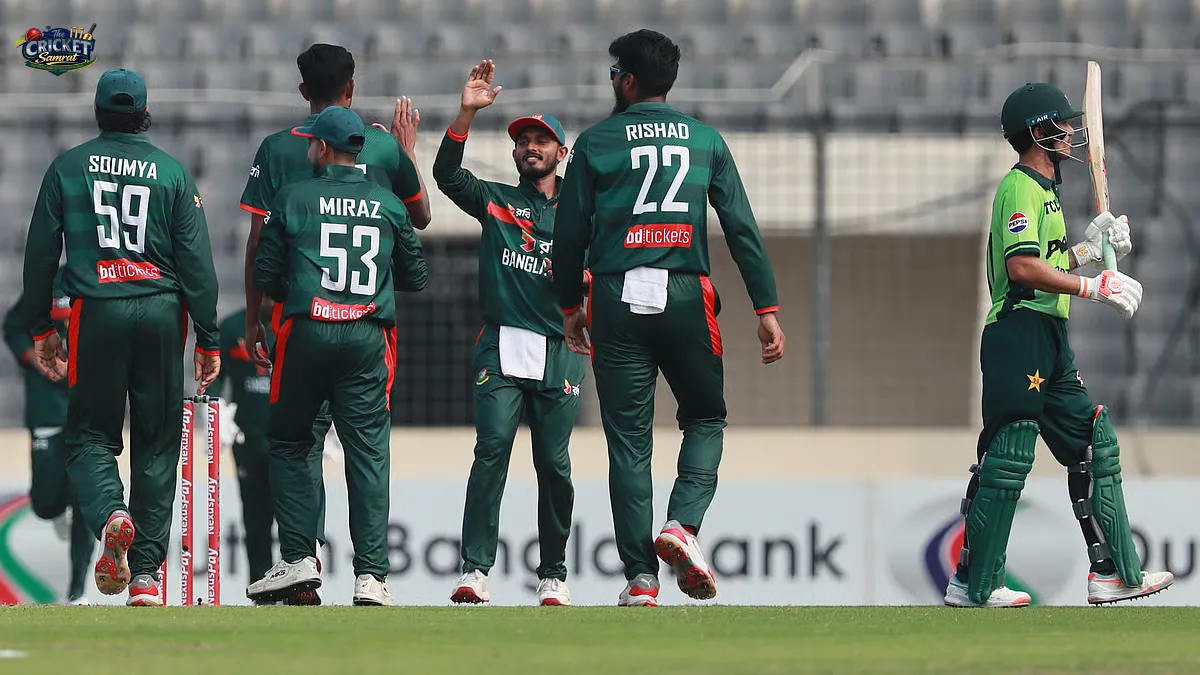
The latest Bangladesh vs Pakistan ODI clash in Mirpur has sparked a major controversy after Pakistan raised serious concerns over an umpiring decision that they believe went against the rules. The Pakistan cricket team management has officially lodged a complaint with match referee Neeyamur Rashid regarding an incident involving the Decision Review System (DRS) during the final moments of the third ODI.
According to Pakistan, on-field umpire Kumar Dharmasena incorrectly allowed Bangladesh to take an LBW review after television replays had already appeared on the stadium’s big screen. The incident has triggered debate about whether the review process followed the correct protocols during the high-pressure finish of the match.
The dramatic moment occurred during the closing stage of the game when Pakistan was chasing a challenging target. With only two deliveries remaining, the visitors needed 12 runs to secure victory. What followed was a sequence of events that not only changed the match result but also led to an official protest by the Pakistan Cricket Board (PCB).
A thrilling showdown ends with the Tigers claiming victory over Pakistan! From fiery bowling to stellar batting, every moment brought the crowd to its feet. Celebration, passion, and pride.#BCB #Cricket #Bangladesh #Pakistan #ODI pic.twitter.com/8a9pfgncBW
— Bangladesh Cricket (@BCBtigers) March 15, 2026
Pakistan Raises Concerns Over DRS Protocol
Pakistan’s team management argued that Bangladesh’s review decision did not follow the official guidelines of the DRS system. According to the complaint, the Bangladesh players appeared to request the review only after watching the replay on the stadium’s giant screen.
Under ICC rules, players must decide whether to request a review within a short window—generally 15 seconds—and the decision must be made without any assistance from external sources such as television replays or big screen footage.
Pakistan claims that once the replay showing the ball passing near Shaheen Afridi’s bat appeared on the big screen, Bangladesh’s captain approached the umpire to request a review for an LBW decision.
The Pakistani team believes that this sequence of events violated the spirit and the rules of the DRS process.
Key Incident in the Final Over
The controversial moment came on the second-last delivery of the innings. Pakistan required 12 runs from two balls to win the match.
Bangladesh spinner Rishad Hossain bowled a delivery that went past Shaheen Afridi toward the leg side. The on-field umpire initially signaled it as a wide ball, which would have benefited Pakistan in their chase.
However, Bangladesh players gathered for a quick discussion and then decided to challenge the decision by asking for an LBW review.
Pakistan later argued that the Bangladesh players had already seen the replay on the big screen before making the review request.
DRS Outcome Changed the Match Situation
After the review was initiated, the third umpire examined the footage using Hawk-Eye technology. The analysis revealed that the ball had made contact with the lower edge of Shaheen Afridi’s bat before passing him.
As a result, the original wide decision was overturned.
Although Bangladesh’s LBW appeal was ultimately rejected, the crucial point was that the wide call was removed. This significantly altered the equation of the match.
With the wide cancelled, Pakistan was left needing 12 runs from the final delivery, a much more difficult task than before.
Shaheen Afridi Stumped on Final Ball
The tension continued into the last ball of the match. Shaheen Afridi attempted an aggressive shot in an effort to score the required runs but missed the delivery.
Bangladesh wicketkeeper quickly collected the ball and completed a stumping, ending Pakistan’s hopes of victory.
Bangladesh ultimately won the match by 11 runs, sealing the Bangladesh vs Pakistan ODI series 2–1 in their favor.
Match Summary
| Match | Venue | Result | Series Outcome |
|---|---|---|---|
| 3rd ODI | Mirpur | Bangladesh won by 11 runs | Bangladesh won series 2–1 |
The result ensured that Bangladesh secured the series after an intense and closely contested battle between the two teams.
PCB Demands Explanation from Officials
The Pakistan Cricket Board (PCB) is reportedly treating the issue seriously. According to sources, the board has asked the match referee to investigate the incident and clarify whether the proper review protocols were followed.
Pakistan believes the situation had a direct impact on the outcome of the match. Had the wide decision remained unchanged, Pakistan would have received an additional run and an extra delivery, which could have altered the final result.
PCB officials are reportedly expecting a formal acknowledgment if any procedural errors occurred during the decision-making process.
Second Controversy in the Series
This is not the first time that the Bangladesh vs Pakistan series has been overshadowed by controversy. Earlier in the series, the second ODI also saw a heated moment involving Pakistan’s Salman Agha.
During that match, Salman Agha was given run out after stepping out of his crease while attempting to hand the ball back to Bangladesh spinner Mehidy Hasan Miraz.
The dismissal sparked arguments between the players and officials, with Pakistan questioning the spirit of the decision.
Following the incident, match officials imposed penalties on both players.
Disciplinary Actions in the Second ODI
| Player | Team | Incident | Penalty |
|---|---|---|---|
| Salman Agha | Pakistan | Reaction to run-out decision | 50% match fee fine |
| Mehidy Hasan Miraz | Bangladesh | Involvement in the incident | 20% match fee fine |
The disciplinary actions highlighted the tense atmosphere that existed throughout the series.
Also Read: Pakistan vs Bangladesh: Two Asian Rivals Begin a Fresh Journey with Eyes on the 2027 World Cup
Growing Debate Around DRS Usage
The latest controversy has once again raised questions about how the DRS system should be used in international cricket. While the technology is designed to assist umpires and improve accuracy, disputes sometimes arise over the timing and process of reviews.
In high-pressure matches like the Bangladesh vs Pakistan ODI series decider, even a small procedural error can significantly influence the outcome of a game.
Cricket analysts and fans have since debated whether stricter monitoring of the review timing and stadium screen usage is required to prevent similar incidents in the future.
Also Read: The Hundred 2026 Auction Sparks Debate as World No.1 Bowler Sadia Iqbal Goes Unsold
A Dramatic End to an Intense Series
Despite the controversy, the Bangladesh vs Pakistan series delivered thrilling cricket, close finishes, and dramatic moments that kept fans engaged until the final ball.
Bangladesh’s victory in the third ODI not only secured the series but also demonstrated their ability to perform under pressure in crucial situations.
However, Pakistan’s complaint means that the discussion surrounding the Mirpur match is unlikely to end anytime soon. The final word will likely come from the match referee’s report and any further clarification provided by cricket’s governing authorities.
For now, the Mirpur ODI will be remembered not only for Bangladesh’s narrow victory but also for the umpiring controversy that unfolded during the final moments of the match.