
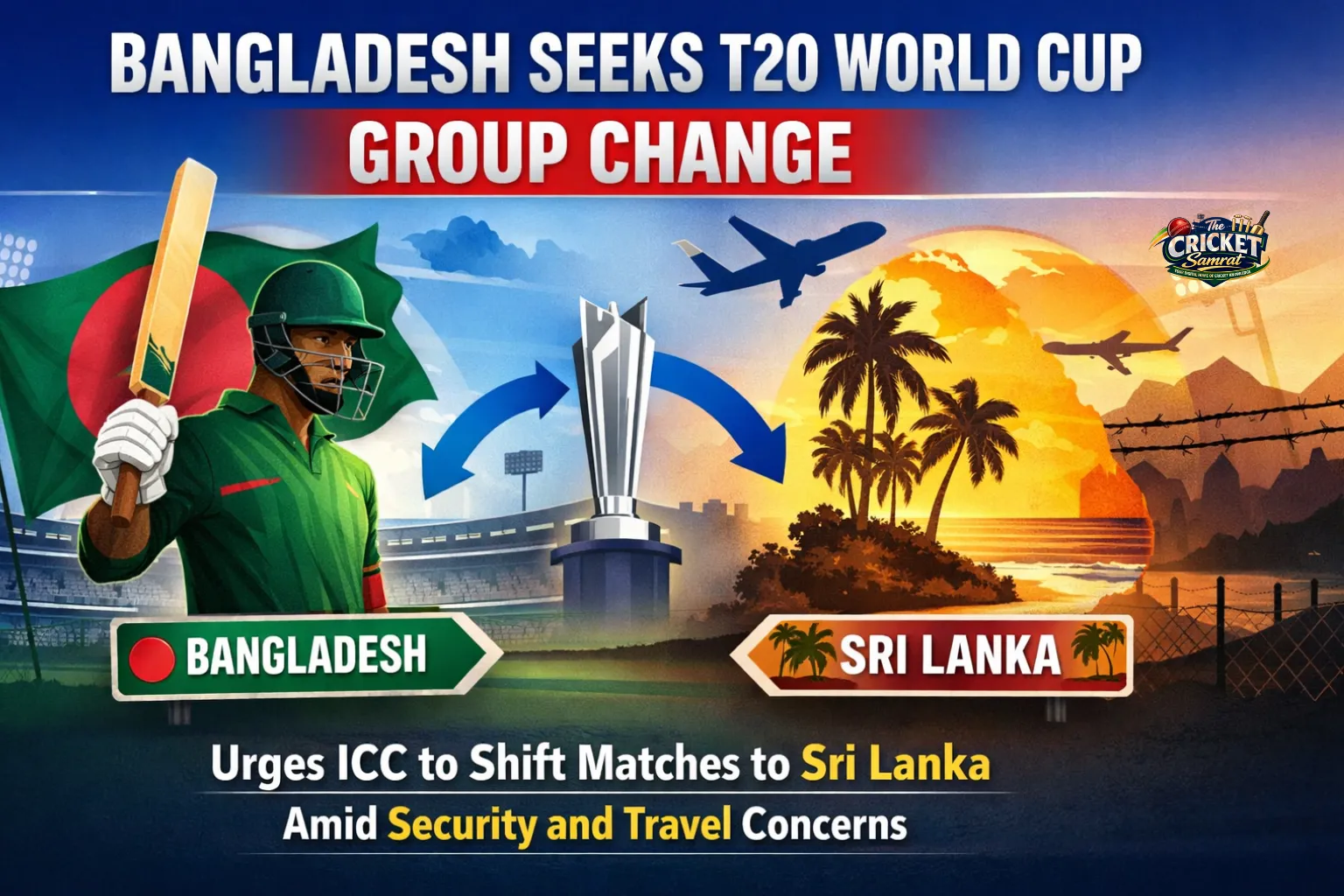
As preparations intensify for the upcoming T20 World Cup, Bangladesh cricket has taken an unexpected and significant step by formally requesting a change in its tournament group allocation. The Bangladesh Cricket Board (BCB) has approached the International Cricket Council (ICC) with a proposal to move Bangladesh from Group C to Group B, citing logistical, travel, and security considerations as the primary reasons behind the request.
The development has added a new layer of complexity to the planning of the global tournament, which is scheduled to begin on 7 February. While the ICC has not yet issued a final decision, the request has already sparked widespread debate within international cricketing circles and among fans worldwide.
Why Bangladesh Wants a Group Change in the T20 World Cup
According to officials from the Bangladesh Cricket Board, the key motivation behind the proposal is to ensure that all of Bangladesh’s T20 World Cup group-stage matches are played in Sri Lanka, rather than being split across multiple countries and cities.
BCB representatives argue that playing all league matches in a single country would significantly reduce:
- Travel fatigue for players
- Logistical complications
- Security-related risks for the team, support staff, media, and fans
The proposal was formally presented during a meeting with ICC officials held in Dhaka on Saturday, 17 January.
BCB’s Core Argument
The BCB believes that if Bangladesh replaces Ireland in Group B, the tournament schedule would require minimal changes. Under this revised arrangement, Bangladesh could play all its league matches in Sri Lanka, similar to Ireland’s current itinerary in Group B.
A senior BCB official stated that the request is not intended to disrupt the tournament structure but to ensure smoother operations and enhanced safety.
Current Group Structure and Match Venues
Under the existing T20 World Cup schedule, Bangladesh is placed in Group C, while Ireland competes in Group B. The two groups have markedly different travel requirements.
Bangladesh’s Current Group C Schedule
| Match Date | Opponent | Venue | City |
|---|---|---|---|
| 7 Feb | West Indies | Eden Gardens | Kolkata |
| 9 Feb | Italy | Eden Gardens | Kolkata |
| 14 Feb | England | Eden Gardens | Kolkata |
| 17 Feb | Nepal | Wankhede Stadium | Mumbai |
This schedule requires Bangladesh to travel between two major Indian cities, increasing logistical complexity.
Ireland’s Current Group B Schedule
| Match Date | Opponent | Venue | City |
| TBC | Sri Lanka | Colombo | Sri Lanka |
| TBC | Australia | Colombo | Sri Lanka |
| TBC | Oman | Colombo | Sri Lanka |
| TBC | Zimbabwe | Pallekele | Kandy |
Ireland’s matches are largely concentrated within Sri Lanka, with only a single venue change.
BCB believes that swapping Bangladesh and Ireland between these groups would allow Bangladesh to benefit from a similar centralized schedule.
Security Concerns Raised by Bangladesh Government
In its official communication to the ICC, the BCB emphasized that the request is backed by concerns raised by the Bangladesh government regarding the safety of:
- Players
- Team officials
- Bangladeshi supporters
- Media personnel traveling with the team
In an official statement released on Saturday evening, the BCB confirmed that it had once again urged the ICC to consider hosting all of Bangladesh’s matches in Sri Lanka during the T20 World Cup.
The statement noted that Sri Lanka offers a comparatively more stable environment in terms of security logistics and travel coordination.
Political Tensions Spill Into Cricket
The situation surrounding Bangladesh’s request cannot be viewed in isolation. Recent political and social tensions have played a role in shaping the current atmosphere.
Mustafizur Rahman IPL Controversy
Bangladesh fast bowler Mustafizur Rahman became the center of a major controversy after the Board of Control for Cricket in India (BCCI) denied him permission to participate in the Indian Premier League (IPL).
- On 16 December, Kolkata Knight Riders (KKR) purchased Mustafizur Rahman for ₹9.20 crore at the IPL mini-auction.
- However, following protests in India linked to the killing of Hindu civilians in Bangladesh, opposition grew against his participation.
- Reports indicate that seven Hindu citizens were killed in Bangladesh during this period, triggering diplomatic and public outrage in India.
- On 3 January, acting on BCCI’s directive, KKR released Mustafizur from the squad.
Bangladesh’s Reaction to the IPL Decision
The IPL decision caused widespread anger in Bangladesh. In response:
- The Bangladesh government imposed a ban on IPL broadcasts within the country.
- Officials cited concerns about the safety of Bangladeshi players abroad.
- Shortly after, the issue of T20 World Cup venue security was formally raised with the ICC.
These events have directly influenced Bangladesh’s insistence on minimizing cross-border travel during the World Cup.
BCB’s Official Statement Explained
In its statement, the BCB clarified that its request is not political, but rather rooted in practical considerations.
Key points highlighted by the BCB include:
- Ensuring uninterrupted preparation for the T20 World Cup
- Avoiding unnecessary strain on players
- Maintaining consistent training and recovery schedules
- Reducing exposure to security risks
The board reiterated that Sri Lanka has previously hosted international tournaments under challenging circumstances and possesses strong infrastructure to manage large-scale events.
ICC’s Dilemma: Logistics vs Precedent
The ICC now faces a complex decision. While the governing body routinely considers security assessments, granting a group change at this stage of the T20 World Cup could set a precedent for future tournaments.
Factors the ICC must consider include:
- Fairness to other teams
- Broadcast and sponsorship commitments
- Venue readiness
- Ticketing and fan logistics
At present, the ICC has neither accepted nor rejected Bangladesh’s proposal, but discussions are reportedly ongoing.
Bangladesh’s T20 World Cup Campaign at a Glance
Despite the uncertainty, Bangladesh remains focused on its on-field objectives.
Bangladesh Group Matches (As Scheduled)
| Date | Match | Venue |
| 7 Feb | Bangladesh vs West Indies | Kolkata |
| 9 Feb | Bangladesh vs Italy | Kolkata |
| 14 Feb | Bangladesh vs England | Kolkata |
| 17 Feb | Bangladesh vs Nepal | Mumbai |
Bangladesh is expected to face tough competition, particularly against England and West Indies, two former world champions.
Impact on Players and Fans
Players have largely refrained from making public comments, but insiders suggest that many would welcome a single-country schedule. Fans, meanwhile, are divided:
- Some support the move for safety and convenience.
- Others worry it could undermine the competitive integrity of the T20 World Cup.
Cricket analysts have also pointed out that playing in Sri Lankan conditions may influence pitch behavior, potentially impacting team strategies.
What Happens Next?
The ICC is expected to review security reports and consult with host boards before issuing a final verdict. Any decision will need to be communicated quickly to avoid disruptions in travel planning and team preparations.
If approved, Bangladesh would officially move into Group B, while Ireland would shift to Group C, marking a rare late-stage structural change in a major ICC event.
Conclusion
Bangladesh’s request to change its group in the T20 World Cup highlights how modern international cricket is influenced not only by sport, but also by geopolitics, security considerations, and logistical realities.
As the world’s attention turns toward the tournament, the ICC’s handling of this issue will be closely watched. Whether the proposal is accepted or declined, the situation underscores the evolving challenges of hosting truly global sporting events in a complex world.
For now, Bangladesh awaits the ICC’s decision, hoping for clarity and stability ahead of one of the most important tournaments in international cricket.