
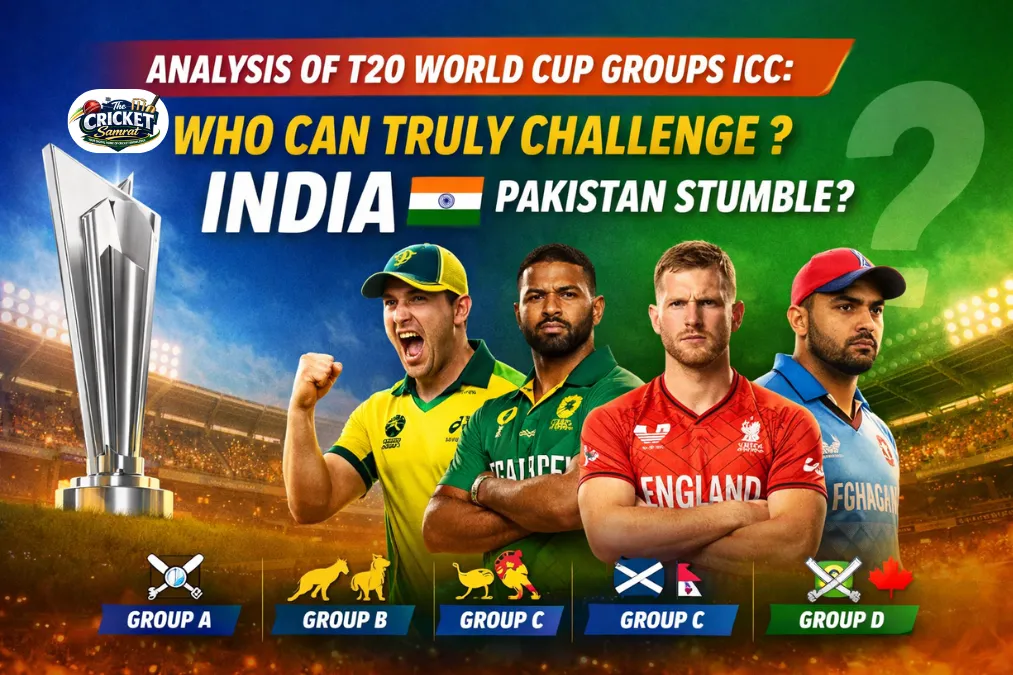
Analysis of T20 World Cup Groups ICC: The ICC Men’s T20 World Cup 2026 is set to begin on 7 February, marking the start of another high-stakes global cricket spectacle. With 20 teams, four competitive groups, and a format that leaves no room for error, the tournament promises drama from the very first ball.
While much of the global conversation revolves around the traditional rivalry between India and Pakistan, a deeper analysis of T20 World Cup groups ICC reveals a far more complex picture. The rise of associate nations, the unpredictability of the T20 format, and recent historic upsets suggest that power dynamics are shifting fast.
This detailed analysis explores all four groups, their strengths, weaknesses, historical records, squads, and the teams most likely to challenge India’s dominance—especially if Pakistan fail to go deep in the tournament.
Tournament Format Explained: Why Every Match Matters
Before diving into group-wise analysis, understanding the structure of the tournament is crucial.
- 20 teams are divided into 4 groups (A–D)
- Each team plays 4 group-stage matches
- Top two teams from each group qualify for the Super 8
- Super 8 teams are divided into two new groups
- Top two teams from each Super 8 group reach the semi-finals
- The final will be played on 8 March in Ahmedabad
In such a compressed format, one bad over or one tactical error can end a title dream.
Group A: India, Pakistan, and the Ever-Present Upset Threat
Group A instantly grabs global attention, not just because it includes India and Pakistan, but because recent history proves this group is far from predictable.
Group A Teams
- India
- Pakistan
- USA
- Namibia
- Netherlands
Why Group A Is More Dangerous Than It Looks
On paper, India and Pakistan appear as clear favourites. However, T20 cricket has repeatedly exposed the danger of underestimating associate teams.
The USA’s historic Super Over victory over Pakistan in the previous T20 World Cup still resonates across the cricketing world. That single match changed perceptions and proved that no team can afford complacency.
Namibia and the Netherlands have also shown steady improvement, often pushing full-member nations into uncomfortable territory.
Group A Squads Overview (Key Strengths)
- India boast unmatched depth, explosive batting, and elite pace bowling.
- Pakistan combine raw pace with unpredictability, though inconsistency remains a concern.
- USA bring confidence, fearlessness, and growing tactical discipline.
- Netherlands rely on smart all-rounders and fielding excellence.
- Namibia thrive on disciplined bowling and low-pressure performances.
Group A – T20 World Cup Historical Record
| Team | Titles | Matches | Wins | Losses | No Result | Win % |
|---|---|---|---|---|---|---|
| India | 2 | 52 | 36 | 15 | 1 | 69.20 |
| Pakistan | 1 | 51 | 30 | 21 | 0 | 58.82 |
| USA | 0 | 7 | 2 | 4 | 1 | 21.43 |
| Namibia | 0 | 15 | 5 | 10 | 0 | 36.67 |
| Netherlands | 0 | 27 | 10 | 16 | 1 | 37.03 |
Verdict on Group A
If Pakistan falter, India’s biggest threat may not be Pakistan at all—but a fearless associate team capable of repeating history. Group A rewards discipline and punishes arrogance.
Group B: The Sleeper Group That Could Shock the World
Group B does not feature India or England, but calling it “easy” would be a grave mistake.
Group B Teams
- Australia
- Sri Lanka
- Ireland
- Zimbabwe
- Oman
This is the classic sleeper group—balanced, dangerous, and unpredictable.
Why Group B Is So Tricky
Australia are masters of tournament cricket, especially under pressure. Sri Lanka, despite inconsistency, remain one of the most tactically dangerous T20 sides. Ireland, Zimbabwe, and Oman have all produced major upsets in recent ICC events.
Group B – T20 World Cup Historical Record
| Team | Titles | Matches | Wins | Losses | No Result | Win % |
|---|---|---|---|---|---|---|
| Australia | 1 | 48 | 30 | 17 | 1 | 63.83 |
| Sri Lanka | 1 | 54 | 33 | 21 | 0 | 61.11 |
| Zimbabwe | 0 | 20 | 8 | 11 | 1 | 40.00 |
| Ireland | 0 | 30 | 7 | 18 | 5 | 23.33 |
| Oman | 0 | 10 | 2 | 7 | 1 | 25.00 |
Key Insight
One slip by Australia or Sri Lanka could open the door for a shock qualification. This group may not dominate headlines, but it could decide semifinal matchups dramatically.
Group C: Nepal – The Dark Horse That No One Can Ignore
Group C is where tradition meets disruption.
Group C Teams
- England
- West Indies
- Scotland
- Nepal
- Italy
Why Group C Is Fascinating
England and West Indies are two-time champions, yet this group is far from straightforward.
Nepal’s recent form has been outstanding. Since mid-2024, they have won 16 of their last 24 T20 internationals, including remarkable victories over established teams.
Italy’s qualification marks a historic first, adding intrigue and unpredictability.
Group C – T20 World Cup Historical Record
| Team | Titles | Matches | Wins | Losses | No Result | Win % |
|---|---|---|---|---|---|---|
| England | 2 | 53 | 28 | 22 | 3 | 52.83 |
| West Indies | 2 | 46 | 24 | 20 | 2 | 53.26 |
| Scotland | 0 | 22 | 7 | 13 | 2 | 31.82 |
| Nepal | 0 | 7 | 2 | 4 | 1 | 28.57 |
| Italy | 0 | 0 | 0 | 0 | 0 | 0 |
England vs Scotland: A Rivalry With History
Scotland’s past victories over England in ICC events ensure that this fixture remains one of the most emotionally charged matches of the group stage.
Group D: The True Group of Death
If one group defines danger, it is Group D.
Group D Teams
- South Africa
- New Zealand
- Afghanistan
- UAE
- Canada
Why Group D Is Brutal
Every team here has the ability to knock out a heavyweight.
South Africa are defending runners-up. New Zealand have recent final experience. Afghanistan have evolved into a tactical powerhouse with elite spin options.
Group D – T20 World Cup Historical Record
| Team | Titles | Matches | Wins | Losses | No Result | Win % |
|---|---|---|---|---|---|---|
| South Africa | 0 | 49 | 32 | 16 | 1 | 65.30 |
| New Zealand | 0 | 46 | 25 | 21 | 0 | 54.34 |
| Afghanistan | 0 | 32 | 12 | 18 | 2 | 37.50 |
| UAE | 0 | 6 | 1 | 5 | 0 | 16.67 |
| Canada | 0 | 4 | 1 | 2 | 1 | 33.33 |
Afghanistan: No Longer Underdogs
Afghanistan’s semifinal run in the previous T20 World Cup changed everything. Their victories over elite teams prove they belong at the highest level.
Read also: Sri Lanka T20 World Cup Squad 2026 Announced: Kamindu Mendis Returns, Shanaka Named Captain
Complete T20 World Cup 2026 Group Overview
| Group A | Group B | Group C | Group D |
|---|---|---|---|
| India | Australia | England | South Africa |
| Pakistan | Sri Lanka | West Indies | New Zealand |
| USA | Zimbabwe | Italy | Afghanistan |
| Namibia | Ireland | Scotland | UAE |
| Netherlands | Oman | Nepal | Canada |
Read also: T20 World Cup Captains Day to Be Held in Mumbai and Colombo Ahead of February 7 Tournament Opener
Conclusion: Who Can Challenge India If Pakistan Fail?
Based on this Analysis of t20 world cup groups icc, India remain the most balanced and consistent side. However, South Africa, England, Australia, and Afghanistan emerge as the most serious challengers.
If Pakistan fail to progress, India’s toughest tests are likely to come after the group stage, particularly from teams battle-hardened in the Group of Death.
One thing is certain: T20 World Cup 2026 will not be won on reputation alone.